Alaska Native in Traditional Times: A Cultural Profile
Project
as of July 2011
Do not quote or copy without permission from Mike
Gaffney or from Ray Barnhardt at
the Alaska Native Knowledge Network, University of Alaska-Fairbanks. For
an overview of the purpose and design of the Cultural Profile Project, see Instructional
Notes for Teachers.
Mike Gaffney
Chapter Five
The Six Parts of Culture
The broad scientific field of anthropology is built on the concept of culture. It figures in
almost everything anthropologists and ethnohistorians do, whether studying ancient human
remains or a society’s social organization or a people’s folklore and oral traditions. Even
political scientists talk about a “civic culture.” This is why we have said that the concept of
culture is has become quite elastic. Indeed, there are almost as many definitions of culture as
there are books on anthropology and ethnohistory. Why? Because each has its own purpose
which requires defining culture in a specific way. Certainly the concept of culture is central to
our work here. To fit our purposes here, we define culture as a distinct way of life and way of
thinking about life that is closely share by a socially organized group of people over an extended
period of time. The remainder of your Cultural Profile Project deals with traditional use and
occupancy of land, social organization, worldview, and cultural products – the very essence of
Native life in those days. So before proceeding, we take a timeout here to break this definition
down into its six essential parts.
Part 1 – Culture is distinctive. Something about a group’s culture — their way of life
and how they think about that life — distinguishes them from other groups. Their cultural
identity is directly tied to their feeling that “unlike other people known to us, we believe and
practice these things.” In turn, other groups acknowledge such differences from their own
cultural perspectives. It can be argued that the word “culture” would not exist if all people
everywhere looked the same, spoke the same language, organized their societies the same way,
and shared the same values, and traditions.
Part 2 – Culture is shared. A distinct
way of life and way of thinking about life, is closely shared by members of
the group. The cultural rules, core values, and cherished traditions
are learned at an early age and understood by all members. This learned cultural
knowledge provides a mental road map for navigating through everyday life.
It is a road map we carry in the
back of our heads. We do not consciously think about these cultural rules,
values, and traditions as we go about our daily lives. We simply do our
culture, mostly without giving it a second thought.1
Anton Chekhov, the great Russian playwright, once observed that “Any idiot can face a
crisis. It is this day-to-day living that wears you out.” Chekhov was talking about daily life
within his own cultural setting. But what about living and working in very different cultural
surroundings where we start out with few clues on how to appropriately act as daily events
unfold? Imagine how exhausting life would be if we had to stop and think about every encounter
we had with a local person and about each word we uttered during the day. Anyone who has
lived for any length of time in a very different cultural setting knows of this experience. Often it
is called “culture shock.” We are not talking about the short, protected experience of a tourist.
We are talking about, for example, the experience of Peace Corps volunteers who spend two
years working in foreign environments, often in remote areas. We are talking about elderly
Native people whose whole life has been in the village of their ancestors but who now must go to
the city to find work or receive specialized medical care. And we are talking about the young
non-Native teacher who accepts a position teaching in an isolated Alaska Native village after
spending his entire life in New York City.
Part 3 – Social organization and cultural rules. If
a way of life – a culture – is
recognized as having distinctive elements closely shared by a group of people, than it must be
considered a living reality. Culture is not simply an abstract idea in some outside observer’s
mind. It is a real thing having real meaning and consequences for members
of the group. And to
have such meaning and consequences, the culture must have a social organization,
an institutional structure which at least meets the basic needs of the
group.
To identify a social institution we ask this question: Is there
a clearly defined category of people who repeatedly come together to accomplish
certain tasks or to regulate certain activities
of their society? In modern American society, for example, we have
religious institutions where various activities of the faithful take place
in churches,
temples, mosques, and synagogues on a
regular basis. Our capitalist economy is largely driven by the institution
of the private corporation. In all of these institutional settings, a clearly
defined category of people repeatedly
come together to accomplish a certain task. In traditional Native societies
we have such examples as the Iñupiaq and Siberian Yupik whaling crews, the potlatch among the Tlingit, and
the men’s house (qasegiq) among the Central Yup’ik. In each case the same category of people –
a whaling crew, a Tlingit clan or house group, Yup’ik men living in the same settlement – come
together on a regular basis to perform specific tasks.
Perhaps the most obvious social institution in any culture is
some form of a family. Within any cultural group we can detect a pattern of
how various
family members are expected
to treat each other as opposed to treating non-family members. This
also includes how to treat members of the larger kinship group such as aunts,
uncles, and cousins who may live in a
different household or even a different settlement. When viewed across
cultures, we can see different kinds of relationships between husband
and wife, between parents and children, or
between grandparents and grandchildren. Sometimes we can even identify
special relationships between aunts and their nieces and between uncles
and their nephews. In some societies there
exist clear cultural expectations of how older children shall care
for
their younger sisters and brothers.
Most important, all social institutions are governed by sets
of cultural rules. But what do we mean by cultural rules? We mean
those commonly understood principles and expectations which guide people’s behavior in everyday life. These rules, moreover, make up a large part of
that cultural road map we carry about in the back of our heads as we go about our daily routines.
It matters not whether the task is as routine as food preparation for the family or as dramatic as
preparing for war. Understanding family roles and relationships within a particular culture, for
example, becomes easier once we know the rules for how family members should relate to one
another — the son to the father, the granddaughter to the grandmother,
the husband to his wife. Of course we can reverse this investigative process.
We can try to understand the cultural rules
by observing over time the pattern of behavior that takes place among
family members
Part 4 – Culture persists over time. The
fourth idea helping to define our concept of culture is over time.
A distinct culture closely shared by a socially organized group of
people most likely
arose from adaptations their ancestors made to demands of a particular
natural and
social environment many years ago. As long as these environments
remain reasonably stable down through time, so too should a people’s social
institutions remain stable.
Such cultural stability was the historical condition of Alaska
Native life until the invasions brought sustained contact with powerful, culturally
different outsiders. This, however,
does not mean that pre-invasion Native life was without events
triggering
major social change for many Native communities. Indeed, the more
we learn about pre-contact Native life, the more
action-packed it becomes, filled with tales of hostilities between
Native groups that lasted for years and resulted in the death of many and the
dislocation of entire communities. Nevertheless,
such pre-invasion conflict and change was usually confined to a
region
and affected only several Native groups at any one time. Certainly
there was death and destruction in traditional times. But
it was not the basic social organization and cultural values of
the warring parties that was under attack. Even if beaten in battle or hit
by a natural
catastrophe, the customs and values of the
surviving people continued much as before. With the Russian and
American invasions, however, it was precisely Native social organizations and
cultural values that came under direct attack.
Part 5 – A
distinct speech community. The emphasis
here is on speech community, not
language as such. In both modern and traditional times, the way people
speak a language may be as significant a badge of cultural identity
as speaking
the language itself. A group of people may
speak the same language as other groups inhabiting the same general
culture area. But they speak and use it in ways that distinguishes
them from
these other groups. Consider the famous line
attributed to Winston Churchill, the British prime minister during
World War Two. He remarked that “Great Britain and the United States are two great democracies divided by a common
language.” If he were to use our terms, Churchill would reword his statement to say that Great
Britain and the United States share a common language but are two different speech
communities.
Although, for example, its basic vocabulary and grammar is commonly
shared by other American speech communities, the everyday English spoken by
many African-Americans can be
quite distinctive in its spoken style and vocabulary. In fact, words
and phrases used by many Americans have their origins in the “Black English” speech
community. Here are just a few examples: cat – originally
a jazz musician, now anyone of the male gender; cool – calm,
controlled; dig it – to understand, appreciate, pay attention; bad – really
good. The Head of the African and African-American Studies Department
at Harvard University, Henry Louis Gates Jr.,
makes this point:
“It [black English] becomes part of the mainstream in a minute," the poet Amiri
Baraka told me, referring to the black vernacular. “We hear the rappers say, 'I'm outta
here' - the next thing you know, Clinton's saying, 'I'm outta here.'" And both Senator John
Kerry and President George W. Bush are calling out, "Bring it on," like dueling mike-
masters at a hip-hop slam. Talk about changing places. Even as large numbers of black
children struggle with standard English, hip-hop has become the recreational lingua franca
of white suburban youth...2 [vernacular = everyday spoken language different from formal written
language.]
So, you might ask, what does certain characteristics of the African-American speech
community have to do with Native Alaska? We have known for many years that there is an
increasing shift from Native languages to English. Those who believe that “to lose your language
is to lose your culture” see this language shift as spelling doom for Native cultures. This grim
view of a Native future seems to forget two things. The first is the distinctiveness of Native
village life historically based a subsistence way of life no matter what language is spoken. The
second is the development of various forms of “Alaska Native English.” Consider the following
question: Like African-Americans, is there now emerging in Alaska different Native-English
speech communities? Perhaps we are at a point in Native history when, for example, a person
from an Athabaskan village can say, “Aha, the way that guy speaks and uses English tells me he
is, like me, a Koyukon Athabaskan from the Nulato area!”
We have taken time to discuss the idea of speech community because
it is a key feature of any culture, whether in modern or traditional times.
No concept of culture is complete without
some discussion of linguistics – of a group’s language and its characteristics. It is true that
language shifts and the development of new speech communities were not major issues in
traditional Native times. Bear in mind, however, that even back in those days the particular way
one spoke Iñupiaq or Tlingit or any other Native language would reveal one’s home community
or region to other speakers of same language, perhaps signaling whether that person is friend or
foe.
Part 6 – Worldview is the heart of culture.
This sixth element is absolutely central to any description of a cultural group.
A people’s worldview is the unique way they think of
themselves and make sense of the world they know. It deserves special attention. This is why all
of Chapter Seven is devoted to worldview and its various elements. For a definition of
worldview we go to the work of the late Oscar Kawagley, a Central Yup’ik scholar. In his book,
A Yupiaq Worldview, Dr. Kawagley says:
A worldview consists of the principles we acquire to make sense of the world
around us. Young people learn these principles, including values, traditions, and customs,
from myths, legends, stories, family, community, and examples set by community
leaders...
...Once a worldview has been formed, the people are then
able to identify themselves as a unique people. Thus, the worldview enables
its
possessors to make sense of the world around them, make artifacts [material
things] to fit their world, generate behavior, and interpret their experiences.
As with
many other indigenous groups, the worldviews of the traditional Alaska
Native peoples have worked well for their practitioners for thousands of
years. 3
Worldview is indeed is the heart of our concept of culture. Why? Because it provides a
everyday meaning and legitimacy to a group’s social institutions and cultural identity. It is their
worldview that defines, even celebrates, the group’s best image of itself. It describes and
promotes what is regarded as the proper attitude toward the spiritual world, the social world of
fellow humans, and the natural world and its living creatures.*
As suggested by Professor Kawagley, much of a culture’s worldview is revealed by what
adults insist be taught to the young. Whether modern or traditional, every society down through
time has established institutions to educate the young in all aspects of the group’s worldview.
The long-term survival of any culture and cultural identity ultimately depends on how effectively
a coherent worldview is passed down from generation to generation. In modern society, for
example, we have schools, youth organizations, and children’s television programs like Sesame
Street. In one form or another, these American institutions teach cultural values as well as skills
and information.
In traditional Native societies it was other kinds of institutions
which performed vital educational functions. Among the matrilineal societies
of southern Alaska, for example, there
existed an important educational institution called the avunculate. In
matrilineal kinship systems a person traces genealogical descent through the
mother’s side. In the matrilineal society of the
Tlingit, for example, a person’s most significant kinship ties are with members of the mother’s
clan. Personal benefits such as inheritance, property rights, and social status are tied to clan
membership. In patrilineal societies, on the other hand, a person’s significant kinship ties and
benefits are determined by genealogical descent on the father’s side. European monarchies, for
example, traditionally used patrilineal descent to establish who, male or female, ascended to the
royal throne as king or queen. [Genealogy: tracing one’s family history back to earliest ancestors.]
The avunculate found in matrilineal societies refers to the relationship
between the mother’s brother and her son. In Western terms, it is the relationship between a nephew and his
uncle on the mother’s side. This avuncular relationship is considered an educational institution
because it was the uncle’s responsibility to oversee the education and training of his sister’s son
who, of course, is his nephew. The biological father certainly has parental responsibilities to his
son, and the son had a special connection to his father’s clan. But we should not forget that he
also had avuncular educational responsibilities within his own clan to his sister’s son. In modern
educational terms, the avuncular relationship was like having your own personal instructor in a
home schooling situation. This was a fundamental cultural rule. It was a major way the group’s
values and knowledge were transmitted to the next generation of males.
Summary lesson. Our six-part concept of culture should remind us that Alaska Natives
persisted as culturally organized communities from ancient times. It suggests that this cultural
cohesion could only have happened if the group’s institutions and cultural rules continually met
the essential human needs of its members under demanding environmental conditions.
Review Questions.
How have we defined the concept of culture?
Why do we have “speech community” rather than language
as one of our six parts of culture?
Can you give some examples of cultural rules you follow in
your own daily life without having to constantly thinking
about them?
Why do we consider worldview to be the heart of any
people’s culture?
ENDNOTES
Suggested Readings:
Major Ecosystems of Alaska (Anchorage:
Joint Federal-State Land Use Planning Commission for Alaska, 1973).
Joan Townsend, “Ranked Societies of the Alaskan Pacific Rim,” Senri
Ethnological
Studies, 4, 1979, pp 123–156.
This chapter gets you started on the
Cultural Profile of your selected Native group or groups. It provides
you with an instructional
guide for profiling the elements of the environment shown above. They
are exactly the same as listed in the Cultural Profile Project Outline on page
three. The
chapters to come on Land Use and Occupancy, Social Organization, Worldview,
and Cultural Products offer similar instructional guidance for completing
your project. You will find, however, that this and the remaining chapters
offer
much more than a simple guide. As said before, we want to carefully explain
the concepts we use to organize our thinking about Native societies in
traditional
times. What exactly do we mean, for example, when we use concepts like
environmental adaptation or land-use patterns or social stratification or governance
or
shamanism?
Describing elements of a regional environment is
fairly straight forward. The climate, topography and so forth are much the
same today as they
were in traditional
times. It needs mentioning, however, that today’s climate appears
to be undergoing significant change. As climate changes, so also will
topography,
flora, and fauna. It presents new environmental conditions to which
humans must adapt. Retreating arctic sea ice and its impact on Eskimo
whaling
is an example. For purposes of this assignment we assume basic elements
of today’s
regional environments still closely resemble those of traditional times.
The
Big Picture
South vs. North. The first thing to notice at the
beginning of this chapter is the line of arrows ↓↓ pointing
down from Regional Environment
to Land
Use and Occupancy (Chapter 7), Social Organization
(Chapter
8), and
Cultural products
(Chapter 10). The arrows are intended to
emphasize the idea that elements of the environment set the parameters,
the outer limits, of what environmental
adaptations were possible for subsistence-based Native societies
occupying
that region. Again, the amount and kind of subsistence and material
resources available in a particular environment largely determined
what that Native
society
looked like demographically, socially, and technologically. The Aleuts,
for example, could do things within their maritime island environment
that Interior
Athabaskans could not do within their landlocked sub-Arctic environment.
Of course interior Athabaskans could do things that Aleuts could
not.
Now let’s take a moment to paint the broadest
possible picture of the relationship between Alaska’s different environments
and the social organizations of Native groups inhabiting these areas. Look
at any map of Alaska
which shows
the Alaska Range. Denali (Mt. McKinley) is the best known topographic
feature of this mountain range which stretches across Alaska from east to
west. Now
draw or imagine a line along the top of the Alaska range. South
of that line – south
of the Alaska Range – we find very different environments
and traditional Native social organizations from what we find north
of
the Range.
The South. Easy year-round access
to abundant marine resources in the oceans and rivers south of the
Alaska range supported larger
Native
populations. It is true that in important ways the southern Alaskan
regional environments
of
the Aleut and the Tlingit are different. The Aleuts lived mainly
on barren, windswept islands and the Tlingit in areas of high mountains,
old growth
forests, and sheltered bays and coves. But the important point
is
that
both of these
very different regional environments yielded a steady supply, even
surpluses, of subsistence marine resources.
Not only were southern
Native populations larger but their settlements were more densely populated
and more permanent than those found
in the north.
By “densely
populated” we mean a large concentration of people within
an given area. There are, for example, many more people living
within each square
mile of
New York City than people living within each square mile of Fairbanks,
Alaska. Their settlements, moreover, were much more permanent
because they had easy
access to their subsistence resources throughout the year. Unlike
many northern Native societies, people did not have to move with
the seasons or spend weeks
on a hunting or fishing expedition just to meet the basic dietary
needs of their families. To say that their primary subsistence
resources lay just
outside their front door is not much of an exaggeration.
When
added together, these factors — large, permanent, densely
populated settlements with abundant resources — led to
the development of a more elaborate social organization to regulate
tribal affairs. Certainly we will
find more and larger government departments and neighborhood
institutions such as churches and schools in New York than in
Fairbanks. Another prominent feature
of the more complex southern Native societies was their hierarchical
social structure. A hierarchical or ranked society exists when
there is an unequal
distribution of wealth, power, and social status among different
classes of people. When we ask about the structure and distribution
of wealth, power,
and social status, we are asking about a society’s social
stratification – its
system of social ranking.
The social stratification of southern
Native societies was based on the hereditary ranking of families
and clans. This meant that
the social
status of the family
and clan into which a person was born largely determined what
social and economic advantages were available to that person,
both as
a child and
later as an adult.
General speaking, these ranked societies consisted of an aristocracy
of clans at the top of the social pyramid, with commoners occupying
the
middle
and lower
reaches of society. In all southern Native hierarchical societies,
the lowest social rank or class was occupied by slaves obtained
through war
and trade.1
Here is another important point. Because of very
accessible and abundant resources, not everyone had to be involved in
the daily
round of
subsistence activities.
This meant that certain individuals possessing special talents
could devote a major portion of their day to work other than
subsistence hunting, fishing,
and gathering. Consequently there arose occupational specialization
in important areas such as medicine, arts and crafts, spiritual
leadership,
political organization,
and in the conduct of war and commerce. If the knowledge
and skills of
a particularly talented person became highly valued, he or
she could concentrate time and
energy on that specialty while their subsistence needs were
provided for by their household group, their clan, or even
payment for
services by others
within
the larger community.
Figure 5-1
Interior of Whale House of Chief Klart-Reech, Klukwan,Alaska. c.
1895.
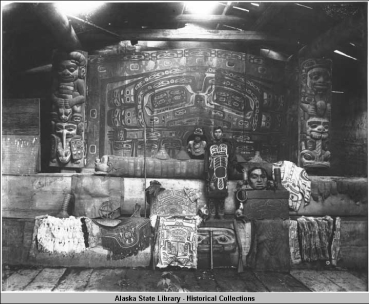
Among the Tlingit, for example, the most basic social
unit at the local level was the household group. It consisted of men of the
same matrilineal line and their families living together in very large wooden
plank-and-beam houses (See Figure 5-1). Sometimes these “longhouses” were
as large as 40 x 60 feet. (A full-size basketball court measures 50 x 84 feet).
The head of the household group usually did not physically participate in subsistence
activities. He had instead a full time job as the political and ceremonial
leader of the household and as their chief historian and educator.
If their
skills were especially prized, individuals could gain wealth and privilege
ordinarily reserved for those of a higher hereditary rank. The possibility
of upward social mobility through demonstrated expertise in a valued specialty
was certainly important to slaves. It was one way they could rise above their
wretched social rank and avoid a life of despair and the possibility of being
sacrificed at a potlatch. In a word, there existed a more elaborate division
of labor based on occupational specialization than we find in northern Native
societies.
The North. With some exceptions,
the often seasonally marginal subsistence resources found north of the Alaska
Range – particularly
for interior Athabaskans – meant smaller, more mobile Native populations
spread over large areas. In contrast to the south, there was far less permanence
and density
of settlements. The exceptions were some Central Yup’ik areas around
Bristol Bay and in the Yukon-Kuskokwim Delta. In fact, the Central Yup’ik
region has been described as a “transitional zone” between
north and south because it has environmental features found in both.2 Another
exception
was the Point Hope region of Northwest Alaska in the early 1800s. At that
time the area’s subsistence resources, mainly marine mammals and
fish, sustained a large settlement area estimated at 1,000 people.3
For
the most part, the social stratification of northern Native societies
was more egalitarian in structure. Unlike the social hierarchies of the
south, there was no easily identifiable ranked social order where power
and privilege
differed significantly among classes of people. Normally birth into a
particular family was not the chief factor determining a person’s opportunities
in life and future adult social standing. The northern societies offered
a more level socio-economic playing field to all members of the group.
Unlike
the southern hierarchical society, individual effort and merit were more
likely to determine a person’s social status. The institution of
slavery, moreover, did not exist north of the Alaska Range.
Because everyone
was always involved in some part of the harvesting and preparation of
subsistence foods and material products, less time was
available to develop
the kind of occupational specialization that occurred in the south. This
does not mean there was no specialization or no development of specialized
knowledge
in the north. Every Native group had to develop the necessary science
and technology to successfully meet the unique demands of their environments.
We should not
be surprised that expertise in weather forecasting and in animal behavior
are well developed areas of traditional Native science throughout Alaska.
Examples
of Native technologies included the construction of sea worthy hunting
craft such as the kayak and umiak, various hunting tools and weaponry,
protective
battle vests, weather resistant housing, dog sleds and snowshoes. We
will
have a fuller discussion of Native applied science and technology when
we discuss
cultural products in Chapter Ten.
Social stratification: beware of false
dichotomies. We have said that social stratification refers to the
structure of wealth, power, and social
rank
in society. We have discussed two seemingly opposite forms of traditional
Native
social stratification — the southern hierarchical societies versus
the northern egalitarian societies. In so doing, however, we must be
careful not
to create a false dichotomy by implying that these are two quite separate
and distinct systems of social stratification. The word “dichotomy” means
the separation of a thing or idea into two opposite parts. A dichotomy
is an either-or proposition — it is either this thing
or that thing. It is either apples or oranges.
So what is the problem?
The problem is that there is no such thing
as a purely hierarchical society or purely egalitarian society, either
in
modern
or traditional
times. What we have are human societies which are more – sometimes
much more – hierarchical than egalitarian and vice versa. And
when we talk about the more or less of things, we are talking about
variables. Variables
are not absolute and permanent things. They are constantly influenced
by other factors and therefore always subject to change. In the real
world, social stratification
is very much a variable because any society can have a mix of hierarchical
and egalitarian elements. As much as its members may wish or claim,
no society is completely egalitarian. Some form of social ranking is
always present. Some
individuals or families or groups in society have more power and resources
than others.
In their study of reindeer herding and social change
among the Iñupiaq
of the northern Seward Peninsula, the late Linda Ellanna and her co-author,
George Sherrod, emphasize this important social fact. Their study even
includes a chapter entitled “The Myth of the Egalitarian Society” in
which they detail how wealth and power were never distributed evenly.
Nor did the
Inupiat expect to live in a purely egalitarian community. There were
always some who were more clever and more ambitious than others. There
were always
some families who prospered more than other families and passed these
advantages on to later generations. Ellanna and Sherrod make this interesting
observation
on control of vital subsistence technologies and key hunting and fishing
sites:
Technologies employed in collective harvesting endeavors
included umiat [skin boat], caribou surrounds, and fish weirs and nets. These
items
of technology
were not owned by the society nor owned equally by all segments of
a large extended local family. Instead, this technology was associated … with
the eldest productive male of the group possessing the skills, knowledge,
and wealth necessary to supervise construction, maintenance, and use
of these means
of production. Additionally, this individual and his closest kin controlled
key geographic sites from which these technologies were deployed.4 [Emphasis ours]
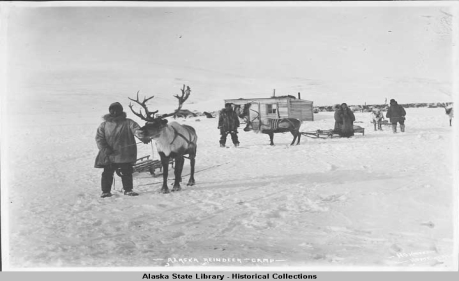
Figure
5-2
Alaska Reindeer Camp, c. 1913
In the South, the occupational specialization of
the Tlingit and Haida hierarchical societies did allow for the egalitarian
element of upward social mobility. No matter the status of one’s family
or clan, an individual could achieve a higher social rank based on demonstrated
merit – on proven ability and accomplishment in an occupation or
skill valued by the society. Moreover, a society’s social order can be
changed by historic events such as internal revolts and revolutions or by external
forces such as invasion and occupation by a foreign power. In 1886, for example,
a federal court ruled that the 13th amendment of the United States Constitution
prohibiting slavery also applied to Tlingit and other Native groups regardless
of what inherent tribal sovereignty they may otherwise possess. Obviously this
legal ruling significantly changed Tlingit society by removing a major social
and economic stratum — slaves —from their traditional hierarchical
structure.5
So we must learn to think in terms of more or
less hierarchy or egalitarianism, not in terms of either – or ,
not in terms of either a completely hierarchical or a completely egalitarian
society. Some argue,
for example, that despite
its ideal values of equality and the rule of law, the social stratification
of American society falls somewhere between hierarchical and egalitarian
because it has characteristics of both social structures. Please understand
that we
use the dichotomy of hierarchy versus egalitarian only as a starting point,
only as a framework for thinking about the different kinds of social stratification
that may exist. If you are doing a cultural profile of a northern Native
society, do not hesitate to look hard for elements of social ranking. Likewise,
if you
are researching a southern Native society, look hard for elements of egalitarianism
such as social mobility – the ways individuals could rise above or
fall below the social rank of their birth.
A false dichotomy in modern Native
times. A good example of a widely held
dichotomy misrepresenting Alaska Native life today is traditional versus
modern. One
harmful example of this unfortunate dichotomy arose in the 1970s when the
Bowhead whale was declared an endangered species and many people in other
parts of
the world said Eskimo whaling should be completely stopped. They argued
that it was no longer a “traditional” subsistence activity because
Umialiks (whaling captains) and their crews use modern hunting gear such
as harpoon
bombs and modern transportation devices such as outboard motors. They further
argued that the nine Alaska Eskimo whaling communities now have many modern
conveniences such as electricity and access to store-brought foods as well
as other consumer goods. Therefore these Iñupiaq and Siberian Yupik
whaling communities lead modern lives and can no longer claim a cultural
or economic need for subsistence whaling.
Of course these outsiders knew
little about the vital role whaling has always played within the subsistence
culture and economy of Eskimo whaling
communities.
What they did not understand or chose to ignore is described by the Inuit
Circumpolar Conference (ICC):
The size of the (bowhead) whale makes it
an important part of the annual subsistence harvest. The taste of the various
parts of the whale makes
it prized as food.
The communal nature of the hunt and the sharing of the whale give it
a central place in the spiritual and physical culture of the region.
The
bowhead provides
life, meaning, and identity to the Eskimo whalers and their communities.
Sharing
the whale with the whole community, and with other communities too, is an
old and highly- valued practice. At the butchering site,
the parts
of the
whale are divided among the whaling crews, with some shares reserved
for elders and widows and other parts kept for festivals. At these
festivals,
including
Thanksgiving and Christmas as well as the traditional feasts of Nalukataq
and Qagruvik, the food of the whale is given to everyone who comes
to take part.
In this way, tons of meat find their way throughout the region all
year long.6
Outside pressure on Alaska Eskimo whaling communities
intensified in 1977 when the International Whaling Commission (IWC) imposed
a
complete
ban
on Eskimo
whaling. The IWC ban was in response to scientific reports that the
bowhead whale population
had fallen to a total of 2,000, maybe even as low as 600. Not long
after, the Alaska Eskimo Whaling Commission (AEWC) was organized.
Its members
were Umialiks
representing the nine whaling villages and they quickly went into action.
They disputed these numbers, arguing that they were much too low, and
that the ban
did considerable harm to the health and culture of their whaling villages.
But they were only successful in getting the IWC to shift from a complete
whaling ban to a small quota of allowable whale strikes. The key term
here is “strikes”.
Obviously “to strike” a whale does not guarantee that you
will ultimately harvest that whale. A whale may survive the strike
and escape, which means you
have used up one of your allotted strikes and achieved no benefit.
If they were to abide by this international rule yet meet their subsistence
needs, Eskimo
whaling crews had but one option — to use the most modern and
effective equipment to ensure that a whale struck was a whale harvested.
This
increased use of modern devices gave still more ammunition to all those
outsiders pressing for a end to all whaling, including that
done
by subsistence-based
indigenous communities throughout the Arctic. Many of these people
were members of large, well organized, and powerful environmental and
animal
rights groups.
So the political pressure was immense and the Eskimo whalers were trapped
in the dilemma of “damned if you do and damned if you don’t.” If
they didn’t use modern equipment, they could not close the strike – harvest
gap. On the other hand, if they did use the latest equipment, then
they were labeled “modern” and judged to have no essential
ties to the cultural traditions and nutritional benefits of whaling.
The
dichotomy is proven false. After a series of confrontations
with federal officials, the AEWC reached an agreement with The National
Oceanic and
Atmospheric Administration (NOAA), the federal agency responsible for
managing whale
protection. In 1981, NOAA delegated to the Umialiks of the AEWC management
authority over
Eskimo whaling. This allowed the AEWC to manage the hunt without the
presence of federal agents in whaling communities. Today it is the
Umialiks who
supervise whale hunting in the nine whaling communities and report
to NOAA.
Using traditional Eskimo knowledge of whale behavior
along with modern
scientific technology, there are now much better methods for estimating
the population
of bowheads. As a result, the ICC reported in 1992 that the population
level of
bowheads was increasing and no longer a cause for concern. This has
helped the whalers secure increased quotas based on the subsistence
needs of
the whaling villages. In cooperation with NOAA, a Whaling Weapons Improvement
Program was
organized in an effort to increase the safety and reliability of whaling
weapons and equipment. One example is use of a float equipped with
a radio
transmitter
to find whales in fog and rough water.7
After years of political strife
and cultural distress, it is now understood that thinking based on the traditional – modern
dichotomy greatly distorts the realities of Eskimo whaling cultures. The
dichotomy was also found to be a major
obstacle to resolving the international issue of how to maintain
healthy bowhead whale populations. By using traditional Eskimo knowledge
of whale behavior
along
with modern marine science, this ancient culture of the Arctic and
the whale population on which it depends has a much better chance of survival.
A South – North summary. We
can compose a brief outline to summarize the contrast between the north and
the south. The symbol ↓ means “results
in”.
Southern Native societies (south of the
Alaska Range)
Abundant subsistence resources, even to the point
of producing surpluses
↓
Larger, more permanent and more densely settled Native communities
↓
Hierarchical societies with an uneven distribution of power and wealth,
with a more complex division of labor based on occupational
specialization
Northern Native societies (north of the Alaska
Range)
With some exceptions, marginal, sometimes scarce
subsistence resources
↓
Smaller, more mobile and sparsely settled Native communities
↓
More egalitarian social organization with much less division
of labor based on occupational specialization.
Interior Athabaskans
and Southern Athabaskans. In traditional times the only social
facts the Interior Athabaskan groups north
of the
Alaska Range had
in common with the Tanaina and Copper River Ahtna Athabaskans
of the south was
language and ethnicity. On the broad cultural profile factors
of regional environment, land use and occupancy, and social organization,
Tanaina
and Copper River Ahtna
life more closely resembled the other southern Native societies.
In the
North, the life of the Interior Athabaskans more closely resembled
other northern
Native
societies.
Special features of the regional environment. Some
features of the regional environment require special attention. These
are
features which “set up” the
significance of certain elements of Social Organization and Cultural
products later in your Cultural Profile. The fauna [animal
life]
of any Native group’s
region is probably the most obvious set-up element because people’s
lives were almost totally organized around hunting and fishing.
A clear description
of the area’s fish and game resources therefore sets
up what you later say about how the group organized
its hunting and gathering, what were their
primary and secondary subsistence resources, and what hunting
and fishing materials were necessary for success.
But there may
be other set up features also requiring special attention. If
you choose to profile the coastal Iñupiaq, for example,
you will describe the usual topographical features of mountains,
valleys, and rivers. Of course
you will do this for whatever Native group you are profiling.
But for the coastal Iñupiaq, an equally significant but
often overlooked topographical feature of their environment is
sea ice. Think about the relationship between sea ice
and Iñupiaq life. Does not much of the coastal Iñupiaq
subsistence activities – from seal hunting to whaling – depend
on sea ice conditions? If so, then the social and technological
adaptations made by the Iñupiaq
to different sea ice conditions were absolutely crucial for establishing
a way of life that went beyond mere survival. Therefore a more
detailed picture of
sea ice and its seasonal changes is necessary to set up your
later descriptions of coastal Iñupiaq social organization
and cultural products.
Environmental adaptation: a summary. The
first thing your Cultural Profile must do is describe the regional
environment to which
your selected Native
group had
to make adaptations over time. In later chapters you will go
below the line of arrows to land use, social Organization and
cultural
products and describe
how the Native group made these necessary adaptations.
Environmental adaptation is the concept tying together all
these elements.
And again, we mean
by this concept
the process by which a Native society socially organized itself
and developed
the technology and knowledge to effectively harvest the resources
of its region. Obviously a Native group had to have the right
hunting and fishing
technologies
to survive within a particular environment. What may not be
so obvious is that Native groups first had to socially organize
themselves in
ways that
a) maintained
the most effective member participation in harvesting of subsistence
resources, and b) most effectively distributed these resources
among its members according
to the values and traditions of the group.
Note, finally, that
already we are discussing different ways Native societies
were organized. Even with the social organization
part
of the Cultural
Profile still several chapters away, we are already using
terms like social stratification,
hierarchical societies, egalitarian societies. Why? Because
significant features of social life in traditional times
were shaped by the
nature of the environment.
It was imperative that Native groups socially organized themselves
in ways that took best advantage of the opportunities of
their environment while
avoiding the dangers.
Review Questions.
Can you define environmental adaptation and explain
how this process works?
Can you explain the major differences between Northern
Native societies and
Southern Native societies and the way different environments shaped
the nature of these societies?
Why do we say beware of false dichotomies when
studying Alaska Native life in traditional as well as in modern times?
Why have we been forced to look at aspects of traditional
Native social life long before we get to the chapter on Social Organization?
* Professor Kawagley employs the appellation Yupiaq when referring
to Central Yup’ik people. In his Native People of Alaska, Steve
Langdon favors Yupiit.4 To be consistent throughout our project, we
stick with the Alaska Native Language Center’s appellation of Central
Yup’ik. [Appellation: the name by which someone or some group is
known.]
ENDNOTES
-
The idea that cultural knowledge largely consists of mundane, taken
for granted, often invisible rules governing social interactions in everyday
life is well explained in the works of James Spradley and David McCurdy.
See their: The Cultural Perspective. Prospect Heights, IL: Waveland Press.
1989. Also see: Susan Philips The Invisible Culture: Communication
in Classroom and Community on the Warm Springs Indian Reservation (Long
Grove, Ill:Waveland Press,1992).
-
Henry Louis Gates Jr. ”Axing a Few Questions About Black
Vernacular,” New
York Times, October 2004.
-
Oscar Kawagley, A Yupiaq Worldview (Prospect
Heights, IL: Waveland Press. 1995) pp. 7-8.
-
Steve Langdon, Native
People of Alaska (Anchorage: Greatland Graphics, 5th edition,
2002).
Table of Contents | Chapter
6
 The
University of Alaska Fairbanks is an Affirmative
Action/Equal Opportunity employer, educational
institution, and provider is a part of the University of Alaska
system. Learn more about UA's notice of nondiscrimination. The
University of Alaska Fairbanks is an Affirmative
Action/Equal Opportunity employer, educational
institution, and provider is a part of the University of Alaska
system. Learn more about UA's notice of nondiscrimination.
Alaska Native Knowledge
Network
University of Alaska Fairbanks
PO Box 756730
Fairbanks AK 99775-6730
Phone (907) 474.1902
Fax (907) 474.1957 |
Questions or comments?
Contact ANKN |
|
Last
modified
July 6, 2011
|
|