Alaska Native in Traditional Times: A Cultural Profile
Project
as of July 2011
Do not quote or copy without permission from Mike
Gaffney or from Ray Barnhardt at
the Alaska Native Knowledge Network, University of Alaska-Fairbanks. For
an overview of the purpose and design of the Cultural Profile Project, see Instructional
Notes for Teachers.
Mike Gaffney
Chapter Six
Social Organization
Social Relations – main social institutions: family structure, kinship system,
education, social stratification, regional groups and
relations between regional groups
Economics – primary and secondary subsistence resources,
Commerce: trade routes and relationships, trade goods
Governance – group decision-making, leadership, law and order
By now you should have completed the first section of the Cultural Profile Project on
Native environmental adaptation and land use and occupancy. Here you study Social
Organization. Then you move directly to Worldview and finish with Cultural Products. Your
work here will provide a snapshot of how social relations were organized within families,
communities, and even regions. It will show how your selected Native group or groups sustained
life through the economics of subsistence and commerce. Because traditional Native governance
is so different from our own experiences, you are asked to do some extra thinking about this
element. Note that several aspects of Social Relations already have been discussed in earlier
chapters – education in Chapter Three and social stratification in Chapter Four. They should be
reviewed to refresh your memory.
SOCIAL RELATIONS
Social institutions. Your assignment here is to describe how your selected Native group
socially organized themselves, usually along kinship lines. This includes main social institutions
and the cultural rules regulating people’s behavior within these institutions. A cultural profile of
the Tlingit, for example, requires description the clan as a main social institution and how
membership was determined by the cultural rule of matrilineal descent. You also describe how
all of Tlingit society was socially divided into two parts. These parts are termed moieties
(sometimes called phratries), and the fundamental cultural rule was that marriage must always be
with a person of the opposite moiety. Indeed, you will find that kinship – a person’s network of
relatives determined by birth, marriage or adaptation – to be the central social institution of
whatever Native group you are profiling.
Comparative referents. Whenever we are confronted
with something new, our first reaction is an attempt to make sense of the new
thing by asking ourselves how it compares to
something I already know. This is a natural human response. Whether it is
a religious ceremony or a marriage custom or even a tool, is there anything
in my own experience that helps me
understand this new thing? In a word, we seek comparative referents. The
problem is that how we might describe our life in modern times will not be
very helpful when attempting to describe
Native life in traditional times. Your experience as a student in a modern
school, for example, will not help you understand how Native youth were educated
back in those days.
There is another problem. Upon finding no clear comparative
referents, we can start sliding down that slippery slope to the ethnocentrism
discussed
in earlier chapters. Our efforts to
understand cultural differences now becomes secondary to an evaluation
of those “other people”
according to our own cultural values and standards. It is no longer about
understanding cultural differences. Now it is about identifying cultural
deficiencies. Without clear comparative
referents, we of the modern world will always have difficulty understanding
the social institutions of Native societies in traditional times. So what
do we do? We start by first
separating social function from social structure.
Social Function. Recall during our earlier discussion of the six parts of culture we
suggested that a key element of any culture is its “persistence over time.” But to persist over
time, a society must create institutions which function to fulfill the essential everyday needs of its
members. Critical organs of the human body such as the heart, lungs, and liver must, for
example, continually perform certain functions for us to remain alive. Likewise, the institutions
(the organs) of a society must perform certain functions to keep that society alive. Indeed, the
elements we have identified as making up a society’s Social Organization directly reflect these
necessary functions:
Social Units –-- function to fulfill the society’s need to organize relationships among
members and to have cultural rules regulating these relationships.
Economics ---- function to fulfill the society’s need to produce and distribute food and
other goods and services necessary to sustain a tolerable quality of life.
Governance --– functions to fulfill the society’s need to make decisions affecting the
general welfare of all and to maintain law and order.
Worldview --- functions to fulfill a society’s need for an agreed upon set of moral values
and sense of cultural cohesion. This is fully discussed in the next chapter
on Worldview.1
The important point is that although we may have a hard time identifying the specific
institutions performing these four functions, they most certainly had to exist in traditional times.
Otherwise Alaska Native societies could not have long endured as cohesive cultures. This is
especially so given the nature of their demanding physical environments. What we have to
understand is that back in those days the main social institutions of Native societies were “multi-
functional.” Moreover, these four vital social functions were “embedded” in these institutions
which can make it difficult for us modern folk to find them let alone understand them. So let’s
take a close look at these concepts of multi-functional institutions and embedded social
functions.
Social Structure. Along with other organs, the
heart, lungs, and liver make up the physical structure of the human body.
So also do institutions make up the social structure of
societies. One characteristic distinguishing modern societies from those
of traditional times is
institutional specialization. Modern society seems to have established
separate institutions to meet almost every social need. To understand
this specialization, think about how many
institutions we might deal with during a single, very busy day.
Either face-to-face or through telecommunications devices such
as the telephone and computerized internet services, we might have dealings
with institutions specializing in social
and health services such as a Native non-profit organization, an office of
the State of Alaska, or some BIA program. We can attend a service at
any one of several churches representing different
religious beliefs and practices. Our general economic well-being may depend
upon contact with several businesses, including Native corporations,
and with state and federal economic
development programs and agencies. Of course there is our everyday interaction
with local companies and with those doing subsistence hunting and fishing
on whom we may depend for
food.
Our day can become even more hectic if we are involved in civic
affairs, perhaps as a village council member. To accomplish a civic goal like
better
fish and game management may
require us to do work at different levels of the political system. This
could include meetings with local tribal councils and contact with state and
federal
officials, perhaps even members of the
state legislature. Everyday, moreover, we count on state troopers, local
police departments, Village Public Safety Officers (VPSOs), sometimes even
the FBI, to keep us safe. If we have to
go to court, we count on an extensive civil and criminal legal system to
fairly uphold the rule of law. It seems, finally, that we have a school
or school system to carry out whatever educational
function we or our children might need during that day. There are, of course,
some modern institutions that do take on extra functions. Schools, for
example, lend their facilities to
community events and sports activities. But these activities must not interfere
with their main function of education. Can you think of any non-educational
functions taking place in your
school?
There is still another characteristic of modern institutional
specialization. During our day of conducting lots of business, we must often
interact with
strangers. It’s possible we know only
one in five of the institutional representatives we contact on this
busy day. So living with institutional specialization can also mean living
in a highly impersonal world. This can even be
the case if you live in a village, but especially if you live in a
city where strangers are part of your everyday life. Outside of people
providing subsistence foods, few of us have personal
relationships with those who actually produce and distribute much of
what we eat.. And most of the time we have no personal relationship with
those in state and federal offices who may
exercise considerable power over our lives. To live in the modern
times is to live in a world of strangers and be subject to distant power
centers.
Multi-functional institutions. In Native societies
of the traditional past, it was a different situation altogether. There was
little institutional specialization and social relationships
were personal and local. In contrast to life in modern society, the everyday
activities of economics, education, governance, law enforcement, and spirituality
were “embedded” in only a
few local, mainly kinship institutions such as the extended family, band,
or clan. Performing these social functions was almost always viewed as the
primary responsibility of a kin-related
group. Under these conditions, a person’s everyday business was conducted
with familiar people and not with strangers. You personally knew those
who had the power to shape your life and
future. Before the invasions, interaction with complete strangers was rare,
ordinarily confined to distant trade and war.
Even if not strictly part of the kinship system, you should include
any other significant institution functioning to meet the needs of the group.
A good example is the qasegiq, the men’s
house of the Central Yup’ik. Within the exclusively male qasegiq
were embedded a number of social functions. Some of these were the economic
and technological functions of maintaining
hunting and fishing gear and preparing for group hunting or trading trips.
Another was the spiritual function of directing significant community
rituals and ceremonies. There was also the
governance function of group decision-making by family leaders and elders
of the qasegiq.
Finally there was the educational function of men giving instruction
to older boys who also lived in the qasegiq. Although not an
exclusive male residence, the coastal Iñupiaq whaling
communities had a similar multi-functional institution called the gargi.
The Iñupiaq educator,
Edna Mclean, offers this description.
Activities within the whaling communities were centered in the whaling captains’ traditional communal organization called the qargi in Ieupiaq. Uqaluktuat ‘life
experience stories’ and unipkaat ‘legends’ were told in the qargit (plural form of qargi).
Here people learned their oral history, songs and chants. Young boys and men learned to
make tools and weapons while they listened to the traditions of their forefathers.2
You will find other social institutions which served more than one function in society. In
traditional Tlingit society, for example, a key institution was the potlatch. The Tlingit
anthropologist Rosita Worl gives this description of the potlatch:
The Tlingit potlatch ..[was].. a ritualized competition in which clan leaders
increase their status through the opulent consumption and distribution of goods and the
destruction of property. While these activities were part of the traditional ceremonial
activities of a potlatch, they are not its central elements. Basically, the Tlingit social and
spiritual order is acted in the traditional potlatch.3
Here is another description of the potlatch given by Steve Langdon, also an
anthropologist:
The major ceremonial institution among the Tlingit and
Haida was the potlatch. This was staged with great pomp an ceremony, primarily
to honor a deceased person but also to
demonstrate the clan’s status and the competence of the heir. Due
to a combination of
grieving and fear of the corpse, Tlingit clansmen did not handle arrangements
for the interment of their dead. Rather the members of the opposite
moiety, typically those of the
clan with which long-established ties existed, would take care of the
body and details of the burial or cremation, depending on the status
of the dead person’s position...
About a year later, the heirs
of the deceased would invite those who carried out the burial work
and other clan members from the opposite moiety to the potlatch. Goods,
wealth and foods which had been accumulated during the intervening year
were distributed in memory of the deceased individual and in thanks for the
efforts of the other
side.4
We know that theories on the distribution and consumption of resources is a major
subject of economics courses. Since Rosita Worl uses these economic concepts to describe a
function of the potlatch, maybe you should describe the potlatch under economics. But the
potlatch also served spiritual functions. So do you put it under worldview? It also had the social
function of increasing clan or household social status through displays of wealth and generosity.
So do you put it under social stratification? Of course the greater the social status of the clan, the
greater the clan’s political influence within the tribe’s system of governance. So do you need to
say something about it as an element of governance? Here is a suggestion: Like the Yup’ik
qasegiq, the Tlingit potlatch was a major multi-functional institution and best treated as single
topic with all of its functions described in one place.
Structure and function: a summary. Always keep
in mind that Alaska Native societies could not have survived over such a long
period of time without having a structure of institutions
performing critical social functions. On this point, shortly we will
discuss how the United States Court of Claims used a functional analysis to
conclude that in traditional times the Tlingit and
Haida did indeed have authentic governing systems exercising sovereign
authority over a defined territory. Therefore they had legal standing to press
their right of aboriginal title in American
courts. Also keep in mind that our everyday experience with modern institutional
specialization provides no clear comparative referent for understanding the
multi-functional institutions of
traditional times – the idea that any number of significant social functions could be “embedded”
in a single institution, most often the kinship system.
Regional confederations and interregional relations.
Here our interest goes beyond family and other local institutions like the
qasegiq
and potlatch. Now we want to know about the
relationships, if any, among a) Native groups within a region and b) between
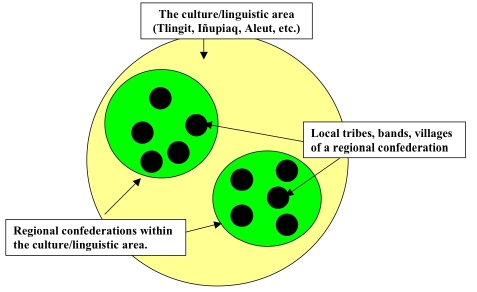
different regional groups. Figure 6-1 presents the main elements of this
discussion. The large outer circle
represents the broad culture/linguistic areas as shown on the ANLC map.
The green circles represent regional confederations made up of local groups
shown
as black dots .
The questions here are: Did the Native group I am researching
belong to a regional confederation? And if so, what did this relationship
look like?
What sorts of activities brought
members of the confederation together on a regular basis? For example,
did
people gather at certain times of the year for trade or ceremonial events
or hunting activities? Are there any oral
or written reports of major conflict within a confederation?
As for relationships among local
groups within a confederation, we must not forget the ultimate bonding power
of kinship as a system of mutual obligations and protections. For the
very practical reasons of survival and
prosperity, we should expect to find that people often relied upon kinsmen
living in other parts of the region. When on a trade mission or hunting
expedition, for example, a person could receive
aid and comfort from kin living in other areas of the region. Of course
these regional kin relationships were established over time through whatever
form
of marriage was the custom of
the regional group.
Figure 6-1
Then, finally, there is the question of relations between different
regional groups within the larger culture/linguistic area. Under what conditions
could one regional group expect
assistance from other regional groups? Apparently the relations between people
of different Aleut Islands were not generally harmonious. Yet three Fox Island
groups were able to mount
coordinated attacks on the Russians in the 1760s. And in 1802, several Tlingit
regional groups (Kwaans) carried out simultaneous attacks on Russian posts
at Sitka, Yakutat, and Kake. On the
other hand, there are historical reports of major conflict between regional
groups. We know of an intense interregional war between the Iñupiaq nations
of Kotzebue and Point Hope.5 And then
there were the “Bow and Arrows Wars” waged by Central Yup’ik
regional confederations of the Lower Yukon River Delta.6 And we
can learn from Miranda Wright about shaman-led conflict between groups within
the Koyukon Athabaskan region.7
What rules governed marriages across regional boundaries? Among
the Central Yup’ik,
for example, interregional marriage was generally frowned upon. Yet it
did occur, perhaps to strengthen a profitable trade relationship between
families of different confederations.8 So you
may come across terms such as “arranged marriages” and “women
exchanges.” Understand that
Local tribes, bands, villages
of a regional confederation
Regional confederations within
the culture/linguistic area.
The culture/linguistic area
(Tlingit, Iñupiaq, Aleut, etc.)
such customs were certainly not limited to Alaska Natives. For centuries
European royal families arranged marriages across national boundaries
to create political and military alliances or to
reinforce these alliances. Queen Victoria of Great Britain (1819-1901),
for example, was of partial German descent. She has been called the
grandmother of modern Europe because she
worked tirelessly to arrange the marriages of her nine children and
twenty-one grandchildren with the royal families of other European
nations.
ECONOMICS
Native subsistence. The Cultural Profile element
of economics has two parts. The first part is description of your Native group’s
traditional subsistence activities. Under Regional Environment you have already
described the fish and game inhabiting the area. Now you want to
know which fish and game were primary subsistence resources and which
were secondary. A primary subsistence resource is one which a Native group
heavily depended upon to maintain the
expected quality of life. One way to determine what constituted a primary
resource is to ask: What would have happened if this resource was severely
reduced or disappeared altogether?
What, for example, would have happened to Southeast Alaska tribes if
the salmon had stopped running? Or what would have happened to Iñupiaq and
Siberian Yupik whaling communities if the migration pattern of the Bowhead
whale radically changed? If it could not be readily replaced
with other fish and game, then it is a primary subsistence resource.
We can think of what constituted secondary subsistence resources
by asking: If the
primary resource was severely reduced, what resources were available to take
its place? And would these resources, taken together, have been enough to
meet the dietary needs of the same
number of people? If the salmon had stopped running, what subsistence resources
were still available to Southeast tribes? It may be that the Tlingit and
Haida people could still preserve
their quality of life by harvesting other fish species, including shellfish,
and by more aggressively hunting sea mammals and land animals. But would
these secondary resources –
even when added together – have been enough to sustain the comparatively
large, densely populated Tlingit and Haida settlements?
And, of course, you want to highlight any special ways the group
organized itself to carry out subsistence activities. One example that comes
to mind is the “fence and corral” method of
hunting caribou among interior Athabaskans. You also want to include
how subsistence foods were distributed among community members. Were
there cultural rules about who received
shares of recently gotten fish and game? Was distribution only to
immediate family members? Or to extended family members or clan?
Or was it expected that members of the entire
community should share the harvest, perhaps based on the charitable
principle of who is the most needy.
Native commerce. In most discussions of traditional
Native economics, this section would be entitled “Native trade.” Here, however, we use the term commerce.
We have changed this wording to emphasize the fact that Native trading activities
ranged far and wide and were
complex in their organization. This often underestimated aspect of
traditional Native life was of
such significance that the word, “trade” does not adequately capture the full meaning of what
actually took place. Commerce is defined by most dictionaries as the large scale buying and
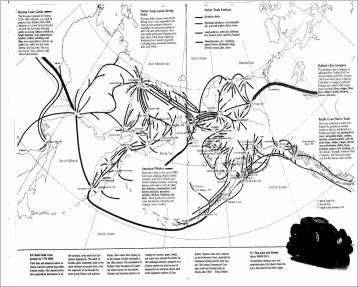
selling of goods and services over a broad geographical area. The Crossroads of Continents map
of North Pacific trade systems (Figure 6-2) illustrates the various
commercial systems of Alaska
Natives in traditional times. Take a good look at this map. Surely
the number of different Native groups involved, the large geographic
reach – indeed an intercontinental reach – of the various
Native trade networks, and the extensive inventory of goods traded clearly fits the definition of
commerce as we think of it today.9
Figure 6-2
[click on
image for a larger graphic]
Using the Crossroads map as a visual aid, we see that
Alaska Native groups conducted commerce reaching beyond the borders of their
home territories, sometimes far beyond these
borders. As with any commercial enterprise throughout human history,
the purpose is to overcome the local scarcity of a valued product. This was
done by trading for “foreign products”
manufactured or harvested by people living in another region having the material
resources to produce these goods. One of the first things you study in any
economics course is the law of
supply and demand. If there is high demand for a scarce product, the more it
is valued. The more valued a product, greater will be the time and energy
people spend producing it. And, obviously,
the more people will pay or give in trade to acquire it. Of course you would
prefer to acquire these scarce goods by developing a favorable commercial
relationship with those who have
them. Traditional Native economies were as influenced by the law of supply
and demand as are modern industrial economies. If you lived on the coast,
for example, you had a good supply of
seal oil for cooking and lighting, but you lacked the forest resources to produce
highly useful wood products. If you lived in interior Alaska, on the other
hand, the forest resources necessary
to make wood products were all around you. But everyday interior life was made
easier if you had a supply of seal oil with its cooking and lighting benefits.
So what did Native people do in such economic situations? They
developed commercial networks based on the principle of supply and demand.
From earliest times,
Alaska Native
groups have always enjoyed products developed from natural resources not
found in their own region. This also included goods from Russia and from other
parts
of North America even before
contact with these Western economic systems. On the traditional commerce
of Interior Athabaskans, the oral history scholar William Schneider says:
Long before explorers and fur traders made their way to the Alaskan Coast, the
goods of their world were arriving across the Bering Strait. The Chukchi and the Eskimo
people of Siberia traded regularly with northwestern Alaskan Eskimos, who then made
exchanges with Athabaskans of the Interior. Iron, copper, tobacco, and reindeer skins
enriched the traditional trade between these people. 10
The Crossroads map lists other examples of valued products exchanged along ancient
intercontinental Native trade routes. Some of these were jade, dogs, pipes, bowls, sea
mammal oil and skins, and various fur peltries.
New commercial opportunities. Because they are
unfamiliar with the overall significance of Native commerce in traditional
times, many people are surprised at the
remarkable speed with which Alaska Natives became shrewd traders within the
new commercial systems introduced by the Russians, Americans, and agents of
the Hudson Bay Company.
Therefore they conclude that this speedy adaptation can only mean that Natives
eagerly sought assimilation into Western culture. Let’s present a different
perspective.
We start our discussion of Western culture and Alaska Native
assimilation
by asking: Just who was commercially assimilated by whom during
the early contact period? Can it be argued
that in many cases what occurred during these early years was actually
the assimilation of Western traders into longstanding Native commercial
activities and attitudes? An example would
be the early years of the Hudson Bay Company at Fort Yukon where Gwich’in
Athabaskans
controlled trade with the Company’s agents. At the time, the
Company’s supply lines were
stretched over a thousand miles. This meant that re-supplying the
Fort Yukon post with foodstuffs and trade goods was a slow and
uncertain proposition, all of which made the
Company’s agents more dependent on local Gwich’in for
basic life-sustaining food and materials.
The white traders at Fort Yukon soon found that many of the trade
goods they had to offer were of little value to the Gwich’in
whose own subsistence-based material for making winter clothing
and other items was far superior. We go to Bill Schneider who helps
us
understand the early Hudson Bay trader’s predicament. He provides
us with this report from Alexander Murray who established the Fort
Yukon post in 1847:
Blankets, axes, knives, powder horns and files went off readily enough,
but it was hard to dispose of the clothing, as they [Gwich’in] consider their own
dresses much superior to ours both in beauty and durability, and they are pretty
right, although I endeavor to persuade them to the contrary. I could not give them
a reason for bringing so few goods, that we had brought only a few for trial, but
more would be sent next year, which was the only way to prevent them from
disposing of their furs elsewhere. [When Murray says “disposing of their furs
elsewhere,” he means through traditional Gwich’in commercial networks reaching agents
of the Russian American Company down the Yukon River and beyond as well as the
Iñupiaq on the Arctic Coast.] 11
Another example is the early assimilation of whalers and traders
into Eskimo commercial networks governed by Eskimo rules on how trade was
to be conducted. We turn again to Tiger
Burch. Using both written records and Native oral histories, he shows
that the history of contact between the Iñupiaq and many of the thousands
of whalers and traders who came to the Arctic between 1850 and 1910 can be
divided into an early and a late period.12 During
the early period, 1850 to about 1870, it was the Iñupiaq and not the whalers
who controlled the contact situation, including control of commerce. During
this time the whalers and traders sailed in fragile wooden
sailing ships and therefore had a well founded fear of Arctic sea and
ice conditions. Burch reports that as many as seventy-six whaling ships were
lost in the Northwest Arctic between
1860 and 1871. Whaling crews were well aware that surviving a ship wreck
often depended on swift rescue and the offer of food and shelter by the Iñupiaq.
They knew their very lives may well depend on how they behaved within Iñupiaq
communities.
Here is a final point. Suppose I think German-made automobiles
and kitchen appliances are the best in the world. For as long as I can remeber,
in fact, I have only purchase German
brands. Does this mean I’ve assimilated German culture? That I have generally
adopted German customs and values? Of course not.
The rest of the story. We know Iñupiaq control
of the contact situation was not to last. From the 1870s onward an ancient
way of life was under intense
physical and cultural assault
from many directions. There was widespread famine and disease. Burch
estimates that the Iñupiaq population of Northwest Alaska plummeted from
5,500 in 1860 to only about 1,100 in 1890. Soon there was an ever increasing
presence
of outsiders in everyday Iñupiaq life as
missionaries and government agents soon followed the whalers and
traders. Unlike the early
period controlled by the Iñupiaq, these newcomers came with power.
They controlled the distribution of western goods (food, clothing,
tools,
building materials) now absolutely necessary
to sustain life in many Iñupiaq communities devastated by famine
and disease.13
To summarize, during early contact, the energetic pursuit of new
economic opportunities offered by outsiders was only an extension
of Native
traditional commerce. It did not signify a
major change in attitudes and activities through assimilation. To the extent
Western ways were adopted in the late period, most often it was the
only life-sustaining option available. It was,
therefore, the only reasonable response to life-threatening new conditions
rather than an eager pursuit of Western values.
GOVERNANCE
The cultural profile element of governance focuses on how decisions were made for and
by the whole group as well as how law and order was maintained. Of all the traditional Native
social institutions we study, governance may be the most difficult to describe. This is because the
political systems we are most familiar with today are so different from the ways Native
governance was done in traditional times. Indeed, our experiences with national, state and city
governments, with tribal councils, and with the police and the court system are of little help here.
It defies our modern experience to think that so critical a social function as governance was
embedded in broad multi-functional institutions.
Euro-Americans and Native governance. Historically,
Europeans found among many Native American societies no comparative referents
to their own political experience of absolute
control exercised by a royal monarch and his/her political and military
representatives. There were, however, a few exceptions. The centralized political
systems of New World Native
empires such as the Maya, Inca, and Aztecs made some sense to Europeans.
So did powerful Indian confederacies ruled by a well defined governing body
like the Grand Council of the
League of the Iroquois. So did large Indian nations ruled by a paramount
chief like Powhatan in Virginia during the early 1600s. For the most part,
however, the general European view was that
New World indigenous people had little, if any, political organization.
Therefore they were not true political states possessing a sovereign authority
to be respected, especially a sovereign
authority over land. But this attitude should not surprise us. We know
Europeans were looking for institutions akin to their idea of a “political
state” and for concepts of law similar to the
traditions of Christian Europe. Of course such ethnocentric evaluations
of Native governance certainly provided the invaders with intellectual cover,
no matter how flimsy, as they feverishly
sought fertile land and valuable resources.
As with other areas of traditional Native social life, political
processes were embedded in kinship institutions, making them almost
invisible to outsiders. Even today, proving the historical
existence of a sovereign political authority which neatly fits the Western
ideal has been especially difficult for many Native American tribes.
Remember that to gain federal recognition
a tribe is required to present documented proof of continuous political authority
and
cohesiveness from the beginning of sustained contact to present times. As
we know, this can be a
very difficult task indeed.
We must therefore approach the study of traditional
Native governance by keeping in mind that all human communities down through
time had ways of
making decisions and enforcing rules
affecting the welfare of the whole group. Complete community agreement
on a major issue is hard to achieve in any society, whether traditional or
modern. Some political process had to exist for a
community to endure over time. There had to be some mechanism for controlling
internal disputes in ways that did not break the community apart. As we
did with other Native social institutions, let’s
focus on political functions rather than political structures. This
is exactly what the Court of Claims did in the Tlingit and Haida land claims
case.
The Tlingit and Haida case and Native governance. We
return to the 1959 Tlingit and Haida case where we previously discussed
whether
a Native group’s valid aboriginal title
extends to lands not regularly used and occupied by them. Now
we turn to another argument presented by the federal government’s
lawyers – that the Tlingit and Haida were never politically
organized according to the federal definition of a “tribe.” Therefore
they were not true political entities capable of exercising
any real authority over land. And therefore they could not possibly
hold a legitimate aboriginal title to that land.
In rejecting this argument, the Court of Claims took a functional
approach to
validate the existence of traditional Tlingit and Haida systems
of governance. Citing the Indian Claims
Commission’s extensive research on the different social and political
functions of clans, the Court ruled that the lack of a separate, specialized
political structure as we generally think of
governance today did not mean the lack of a functioning political
authority. The Court also noted that the Tlingit and Haida had
maintained their cultures and cultural identities from time
immemorial. Such an epic achievement of social cohesion could
not have been accomplished without a functioning political authority.
In traditional Tlingit and Haida cultures, this authority
was embedded in a complex structure of clans with rules of governance
mostly invisible to Europeans. Therefore the Tlingit and Haida
clearly
had legal standing in American courts to
claim a violation of their aboriginal title by the United States
government.
Summary. we can say that in traditional times the functions of governance were
embedded in the general day-to-day activities of kinship groups and in other multi-functional
institutions like the Central Yup’ik qasegiq. We know we will not find specialized political
institutions similar to the tribal, city, state, and federal governing bodies of our modern
experience. We understand, finally, that the functions of governance had to exist in order for
Native societies and cultures to survive through the ages. Even without separate institutions like
tribal councils and courts, there still had to be functional forms of group decision-making,
leadership and law. We now turn our attention to leadership and law, the two remaining aspects
of governance.
Leadership. Here are some questions you might
keep in mind when researching leadership in traditional Native societies:
- Who were considered leaders when decisions involving the total group had
to be made?
- In times of crisis or great controversy, to whom did members
of
the community look for direction? For example, a key leadership
role might be the hereditary
head of an Aleut matrilineal household. Or it may be a highly
respected whaling captain among the coastal Iñupiaq. Or it may
be a Koyukon Athabaskan chief with shamanic powers. Or it may
be the elders of a Central Yup’ik
qasegiq.
- How did one become a leader and what powers did a leader
have? Did the group expect leadership from certain families
who, from
generation to generation,
seemed to produce people with special talents?
- Perhaps leadership
was situational. A person was considered a leader for some situations such
as hunting and fishing but
not
for other situations such as
conducting foreign relations and war.
- Could a powerful, charismatic person be recognized as the group’s
leader in all matters such as the once powerful Shahnyaati, chief
of the Deenduu Gwich’in
band?14
- Could a leader simply
announce a decision and all others were obliged to follow?
- Or did leaders have to build a political consensus within the community
on an issue before providing an opinion or
announcing a decision?
- Or did community consensus on an
issue simply emerged over time, and leaders were those who could best execute
that
decision?
Finally, keep in mind that complete agreement
on an political issue is always difficult to achieve within
any group
at any time in any place. There is always the potential
for
conflict.
There is, moreover, always some criminal behavior
in any society, no matter how strongly
members of the group believe in the cultural rules prohibiting
such behavior. This brings us to law and order.
Law and Order: different perspectives on justice. The first line of defense against
lawlessness is that the members of society agree on a philosophy of law which distinguishes
acceptable from unacceptable behavior and affirms how the laws will be enforced. In today’s
legal language, a society’s philosophy or science of law is called jurisprudence. Like spiritual
beliefs, philosophies of jurisprudence can differ greatly from culture to culture. In fact, most
often laws reflect long held moral and spiritual beliefs. American jurisprudence, for example,
derives from what is commonly called the Judeo-Christian tradition found in the teachings of the
Old Testament of the Bible, also known as the Torah in Judaism, combined with the teachings of
Jesus Christ as described in the New Testament. Here is a short description of the Judeo-
Christian tradition provided by a 1991 Washington Post editorial:
In our country, “Judeo-Christian values” is shorthand for a complex idea: the
common culture of the American majority. The values are called Judeo-
Christian because they derive from the complementary ideas of free will, the
moral accountability of the individual rather than the group, the spiritual
imperative of imperfect man’s struggle to do what is right and the existence of
true moral law in the teachings of Christ and the Jewish prophets.
A word of caution is necessary here. The fact is that Judaism
and Christianity differ on important theological points such as on the nature
of God, on the relationship between God and
the individual, and on the origin and punishment of sin.15 Nevertheless,
the concept of a Judeo- Christian tradition is still widely used
and understood to signal clear differences in basic values
between the West (Euro-Americans) and other major culture areas of
the world, including differences with Native American tribes. It
has, in a word, made its way into history’s lockbox.
Indeed,
a major cultural difference between American jurisprudence and that
of many Native American tribes is found in how they have historically
dealt with criminal justice. The
American approach draws on the so-called Judeo-Christian notion of retribution wherein
justice is sought through finding guilt and assigning punishment.
On the other hand, the approach of
many tribes was often one of restitution which sought to justly compensate
the injured party for the wrong done to them, even for heinous crimes
such as murder of a loved one. In their book, American Indians, American Justice,
Vine Deloria Jr. and Clifford Lytle describe the difference:
Under Anglo-American notions of criminal jurisprudence, the objectives are to
establish fault or guilt and then to punish. The sentencing goals of retribution , revenge,
and deterrence and isolation of the defender are extremely important (though the system
often pays much lip service to the concept of rehabilitation as well). Under the traditional
Native system the major objective was more to ensure restitution and compensation than
retribution.....In most instances the [tribal] system attempted to compensate the victim
and his or her family and to solve the problem in such a manner that all could forgive and
forget and continue to live within the tribal society in harmony with one another. 16
But rather than construct a list of research questions as we did for leadership, let’s use a real
historical event to jump-start our thinking on traditional Native jurisprudence.
The case of Ex Parte Crow Dog. In their
book, Deloria and Lytle give a good historical example of the retribution – restitution
difference when they review the facts of a very significant case in federal
Indian law. The case is Ex Parte Crow Dog decided by the United
States Supreme Court in 1883.
The case arose during a time of almost continuous hostilities
between the Sioux Indian Nation and the United States government. Often using
its
armed forces, the federal government
was relentless in its effort to put Indians on reservations. The Sioux and
other tribes were equally relentless in their resistance to this reservation
policy, resorting to armed conflict on many
occasions. Most of us know the Lakota, Nakota, and Dakota Indians of the
Northern Great Plains as the Sioux Nation. This can be confusing to many people.
Like
the names of so many Native
American groups, “Sioux” is actually a term historically used by
outsiders. Apparently it is a mix of French and Ojibwa languages. Since the
Sioux and the Ojibwa Indian nation had a history of
conflict before contact with Euro-Americans, most likely it is not
originally intended to be a flattering term. Whatever its original meaning, “Sioux” remains
in history’s lockbox as the most
common appellation for these indigenous people.
The Lakota
Sioux historian, Joseph Marshall III, tells us that the Lakota, Nakota, and
Dakota are three geographical divisions of the Sioux Nation. Within each
of these three divisions
there exists self-governing tribes. Some of the best known Sioux tribes are
the Santee, Teton, Yankton, Oglala, Hunkpapa, and Brulé. 17 Historically
these tribes were able to quickly form alliances among themselves when threatened
by outside forces. A good example is when they
came together with several groups of Cheyenne Indians in 1878 to defeat Colonel
George Armstrong Custer and the 7th Cavalry at the historic battle of the
Greasy Grass (Little Big Horn).
In 1883, a Brûlé Sioux medicine man named Crow Dog killed a Brulé Sioux chief
named Spotted Tail who was working closely with United States officials. Because
he was
willing to compromise Sioux lands to get peace, the American press and many
white settlers saw Spotted Tail as the best Indian hope for negotiating a
final land settlement favorable to the
settlers’ interests. But the great Sioux chiefs Sitting Bull and Crazy
Horse were adamantly opposed to Spotted Tail’s acceptance of most American
demands. They aggressively resisted any further loss of Sioux territory and
viewed many of Spotted Tail’s actions as traitorous.
Following the killing, the relatives of both Crow Dog and Spotted
Tail met to negotiate compensation for the victim’s family. As was the
Sioux custom, Spotted Tail’s relatives sought
restitution rather than retribution and revenge. They were anxious
to avoid any long-term quarrels which might weaken the tribe’s solidarity
during those difficult times. After lengthy negotiations conducted by Brûlé peacemakers,
Spotted Tail’s relatives agreed to a compensation
package of $600, eight horses, and one blanket from Crow Dog’s
people. The Peacemaker was
part of many Native American tribal justice systems. Usually this
person was a distinguished elder proven wise in using the custom
of restitution
to solve disputes among tribal members. The
purpose was to settle a dispute quickly before its emotional impact
spread throughout the tribe, ultimately involving other people and
families, perhaps in violent conflict. It functioned as the “court
of first resort” when disputes arose. Even today, for example,
the role of Peacemaker is an important part of the Navajo Nation’s judicial
system.
When it was learned that Crow Dog was still free, the American
press and public opinion cried for his arrest and trial. Americans clearly
wanted
retribution
for the killing of Spotted Tail.
Even though the dispute had been settled in the traditional Sioux way,
a warrant was issued for Crow Dog’s arrest. He was convicted of murder
by a jury of the federal territorial court and sentenced to death. But he
convinced local federal marshals that he would return for the
execution if released to spend his last days with his family. To
the surprise of many Americans, on the appointed day Crow Dog simply walked
into the federal marshal’s office at Deadwood,
South Dakota and gave himself up for execution. He had given his
word, had he not? Many Americans saw this as a brave and honorable act,
even those who had most loudly called for his
execution. Crow Dog now received favorable press coverage and became
somewhat of a romantic public figure. Acting in Ex Parte (on his
behalf), a group of lawyers filed a writ of
habeas corpus with the United States Supreme Court. Habeas
corpus literally means “you have
the body” in Latin. In today’s jurisprudence, a writ
of habeas corpus is a warrant issued by a judge ordering a person’s
release from jail because the police can show no lawful reason
for detaining him.
The question facing the Supreme Court in the Crow Dog case was
whether the federal government had jurisdiction over Indian-on-Indian
crimes
committed on Sioux lands. The
Supreme Court reasoned that the only way the federal government had such
criminal jurisdiction was if the Sioux had clearly given away
this sovereign power when they signed the 1868 Fort
Laramie Treaty. The Court found no such extinguishment or “giveaway” language
in the Treaty or in its amendments. Nor could they find Sioux criminal
jurisdiction extinguished by any other
act of Congress. The Court therefore ruled that the Sioux retained
all jurisdiction over Indian-on- Indian crime committed on their lands.
Since a) the tribe’s justice system had already resolved
the dispute through restitution, and b) the federal government
had no jurisdiction over the case, the Supreme Court issued the writ of
habeas corpus and Crow Dog became a free man.18
The rest of the story: allotment and assimilation. Crow
Dog may have emerged as a romantic figure, but many Americans
and their political representatives still viewed tribal justice
systems as uncivilized and called for a federal takeover of criminal justice
in Indian country.* As a result, the Major Crimes Act was passed
two years later in 1885. It severely diminished this
key element of tribal sovereignty by transferring to the federal government
complete jurisdiction over seven felony crimes (murder, etc.)
committed
in Indian country regardless of the race or
tribal membership of the parties involved. This was quickly followed by
passage of the General Allotment Act of 1887. This policy had
two parts.
It first sought to break down the traditional
communal ownership of tribal lands by allotting 160 acres to heads of Indian
families, eventually to be held as individual parcels of private
property. Congress believed that the very fact of
owning private property would accelerate the assimilation of Indians into
the American capitalist economy and its Euro-American culture.
And secondly, once the allotment process was
complete, remaining tribal lands were declared “surplus” and opened to non-Indian settlement
and businesses. By the time of the Indian Reorganization Act of 1934 – only 47 years later – tribes
had lost 90 million acres of their lands.
Retribution and restitution are variables. A
word of caution on drawing a bright line between the retribution
approach and the restitution
approach to achieving justice. As we did
with social stratification (hierarchal versus egalitarian societies), we
must be very careful not to create a false dichotomy by falling into the
either–or trap. Elements of jurisprudence such as
retribution and restitution are variables. We will find more or
less of either one depending on the situation.
The point is that American
jurisprudence is not just about retribution and traditional Native American
jurisprudence was not only about
restitution. Deloria and Lytle acknowledge
the variability of criminal justice when they say that the main objective
of the traditional tribal system “was more to
ensure restitution and compensation than retribution.” That
is, when a crime was committed, traditional Native American
tribes
leans toward the restitution approach instances where tribes
dealt with major crimes by imposing severe penalties, including
execution and exile. American jurisprudence, moreover, is of
two
parts: criminal law and civil law. While
criminal law is certainly about determining guilt and punishment,
civil law is about restitution – about fairly and justly compensating
the injured party. Deloria and Lytle rightly confine their discussion to criminal
justice.
A strategy for researching law and order. To
get your work on law and order quickly underway, start by testing the retribution
versus restitution thesis. Did the traditional
jurisprudence of your selected Native group lean more or less toward the
restitution approach, and how so? Or was it a mix of the two and, again, how
so?
Along with jump-starting our inquiry, testing the retribution
versus restitution question has another advantage. In the course of researching
this question
you should find basic
information on your Native group’s law and order system. What were
considered to be crimes, particularly major crimes? What institution or
individuals functioned as “judges” and heard
criminal complaints and determined guilt or innocence? Or was
it left to the relatives of the victim to decide the punishment and carry
it
out? Was there anything like a police force as we
think of it today? How might a perpetrator of a serious crime
be punished – by
loss of property? by execution? by exile?
There is still another
advantage to starting with the retribution versus restitution question.
Because it reflects two broad philosophical
approaches to law and order, it takes us to the
connection between jurisprudence and the main characteristics of your
Native group’s traditional
worldview. Already it has been suggested that the origins of a
peoples’ legal
system can be found in their core beliefs and values. Therefore
some of your work on law and order may
overlap with your work on worldview in the next chapter.
Review questions
To best understand traditional Native social institutions, it is strongly
suggested that we start by separating social function from social
structure. Why?
Why divide the traditional Native subsistence economy into primary
and secondary resources?
We think commerce rather than trade best describes a very important
part of Native life in traditional times. Why?
Do you think Alaska Natives knew something about Russians and
Euro-Americans before first contact with them?
(Hint – look at the Crossroads of Continents map on page 112.)
We note that the Court of Claims took a functional approach to
deciding that the Tlingit and Haida had legal standing for claiming an
aboriginal title to lands. Explain.
How does the Ex Parte Crow Dog case illustrate the contrasting
criminal justice philosophies of the Sioux (restitution) and the
Americans (retribution).
* The term “Indian country” is a significant concept
in federal Indian law having a precise meaning. It refers to all Native American
lands on which tribes exercise self-governing powers under the supervision
of the federal government.
ENDNOTES
1
The list of requisite social functions is loosely based on, Aberle,
D. F., Cohen, A. K., Davis, A., Levy, M. & Sutton, F. X. (1950). “Functional prerequisites of society.” Ethics,
60, 100-111.
2
Edna Ahgeak MacLean, “Culture and Change for Iñupiat and Yupiks of Alaska.” Online
at www.Alaskool.org
3
Rosita Whorl, , “Tlingit” in Hoxie, Frederick E. (ed.)
The Encylopedia of North American Indians, Houghton Mifflin, 1996,
p. 631
4
Steve Langdon, The Native People of Alaska. Great land Graphics, 2002.
5
Ernest S. Burch, Jr. “From Skeptic to Believer: The Making of an Oral Historian” Alaska
History, Vol. 6, No. 1, Spring 1991
6
Ann Fienup-Riordan, “Regional Groups on the Yukon-Kuskokwim Delta” in
Etudes Inuit, Vol. 4, 1984, p. 74-75.
7
Miranda Wright, The Last Great Indian War, Masters Thesis, (Fairbanks: University of Alaska, 1995).
8
Ann Fienup-Riordan (1984)
9
The map is from: Burch, E., “War and Trade” in Crossroads
of Continents, Smithsonian Institution Press, 1988, p. 236-237.
10 “On the Back Slough,” Schneider, William, in J. Aigner et al (eds.) Interior
Alaska, Alaska Geographic
Society, 1986, p. 148. For a summary of research showing Iñupiaq
pre-contact access to Western goods, See: Ellanna (2004) pp. 23-26.
11
Schneider (1986) p. 152-153
12
Ernest Burch Jr., The Traditional Eskimo Hunters of Point Hope,
Alaska, 1800–1875. Barrow, Alaska: The
North Slope Borough, 1981.
13
Burch, 1981. Also, Bockstoce, John, Whales, Ice, and Men, University
of Washington, 1995, pp. 205 – 230.
14
See: Peter-Raboff (2001) pp. 133-135, and Schneider (1986) p. 155.
15
David Ross, “the Judeo-Christian Oxymoron” (www.rossde.com/editorials/edtl_oxymoron.html)
16
Deloria Jr. Vine and Lytle, Clifford American Indians, American
Justice, Univ. of Texas Press, 1983,
pp. 112 -113.
17
See: Marshall, Joseph III, The Journey of Crazy Horse, Viking Press, 2004.
18
Deloria and Lytle, pp. 168 – 170.
Table of Contents | Chapter
7