Alaska Native Life in Traditional Times: A Cultural Profile Project
Draft as of January 2011
Do not quote or copy without permission from Mike
Gaffney or from Ray Barnhardt at
the Alaska Native Knowledge Network, University of Alaska-Fairbanks. For
an overview of the purpose and design of the Cultural Profile Project, see Instructional
Notes for Teachers.
Mike Gaffney
Chapter Ten
Cultural Products
Technology – hunting/fishing
gear, tools, weaponry (and armor?), housing, transportation.
Applied Science – specialized
knowledge of the regional environment developed to maintain and improve
the group’s quality of life.
Artistic Expression – artistic purposes.
design, decoration, materials.
Culture
and Its Products
A cognitive definition of culture. In
Chapter Three we discussed the six parts of our concept of culture. When you
finished reading
that chapter
you
may have
said to yourself: “But wait a minute! Something is missing. What
about a people’s technology and their science and art — the
material things they produced that can be seen and touched?” They
are missing because we consider these visible and material things the products
and reflections
of culture, but not basic elements of culture itself. Here is why.
We employ
what is called a cognitive definition of culture. The term cognition
refers to the mental processes of knowing, of reasoning, of being aware.
Culture is not a physical thing. It is a mental thing. The elements of
social organization,
cultural rules, cultural identity, and worldview are carried about in
the minds and habits of the group’s members. Technology does not come
into existence by itself. It cannot stand by itself. There first must
be recognition by someone
or some group that a particular technology is needed or desired before
efforts are made to design and develop that technology.1
Technology.
Here we use the term technology to mean
those material products developed by a Native group in order to maintain
and improve the quality of life
within their natural and social environments. Indeed, no other element
of your Cultural
Profile has such a direct connection to the process of environmental
adaptation than does technology. This is because technology furnishes
the basic means
or instruments of adaptation. Housing, clothing, tools, weaponry
(including armor), and transportation (kayaks, canoes, umiaks, dog sleds) are
all things we can actually see and touch. As such, they can have considerable
impact
on
how we picture a Native group’s way of life. It is what first
gets our attention. Any museum we go to anywhere in the world displays
cultural products.
This is the main purpose of most museums. But we must be very careful
not to assume the material things we see tells us all we can learn
about that culture.
If technology is not part of our core concept
of culture, then why include it in the Cultural Profile? Remember
that the central purpose
of your
assignment is to develop a profile of what life was like in traditional
times for
an Alaska Native group. To draw the most complete picture of a people’s
way of life requires going beyond elements of cognitive culture.
As we have already
done, it requires description of the natural and social environments
to which a Native group had to adapt. Now we need a description of
the technology and
science they developed to successfully accomplish this environmental
adaptation.
Cultural products as reflections of cognitive
culture. Although technology and its products do not fit
within our cognitive definition of culture,
they can reflect core cultural elements. The Central Yup’ik
storyknife is a good example of a cultural product or artifact offering
a peek into Yup’ik
cognitive culture.* Artfully carved out of
ivory either by an uncle or the father, the storyknife became one
of a young Yup’ik
woman’s most
prized possessions. Usually the carvings included decorative symbols
and images of birds. The storyknife was used mostly by the young
woman’s grandmother
as a teaching tool. As she told her granddaughter a story of particular
cultural significance to women, she would take the knife and draw
on the ground pictures
and symbols to reinforce the educational points she was making. So
knowing about an Yup’ik artifact such as the storyknife offers
a window onto aspects of Yup’ik cognitive culture. We catch
a glimpse of several important social relationships in a young Yup’ik
woman’s life by knowing who carved her storyknife and who was
the “educator” who
used it. And secondly, we get some sense of the Yup’ik worldview
as reflected in the carved illustrations on the knife and the themes
of the stories told.2
Native Applied Science
Native applied science and
a good story. It is not a question of whether traditional Native
societies did “science.” It is, rather, a question of what
kind of science was done. Here is a good story to illustrate
the point. Awhile back, Alaska magazine had an article entitled “The
Ice Man” by
the Anchorage writer, Charles Wohlforth. Here is part of the
story he tells about the late Iñupiaq elder, Mr. Kenny Toovak, who
was a longtime employee of the Naval Arctic Research Laboratory in Barrow
before it closed
in 1980:
One fine summer morning decades ago,John Kelley,
a marine scientist and later director at Barrow's Naval Arctic Research Laboratory,
went to
Kenny Toovak,
who managed the lab's boats and equipment, and asked for a ride
out to Point Barrow in one of the 18-footers with an outboard
motor. As the
story goes,
Kelley had work to get done and limited time, and wanted to go
right
away. Toovak looked at the sky and told him, with typical Iñupiaq
indirectness, "I'd
like for you to wait a bit."
Kelley didn't insist at first,
but paced around impatiently, making it clear he needed to go
soon and saw no reason to wait.
The weather
looked
perfect.
In 15 minutes, he returned and told Toovak that it was time to
go.
Toovak, a skilled storyteller who can draw out
every detail in a slow, dignified style, said he told Kelley, "You really
want to go out, I'm going to give you a boat and an outboard. You can go. But
I'm no going
to give you a driver.
And I don' think we're going to look for you, even. You really
want to go out, go on and go.'
Kelley returned to his office. Shortly, the
wind picked up. It was soon howling, with white caps frothing on top of the
waves.
He returned
once
again and
said, "Kenny,
I thank you for not sending me out."
Scientists and
the Iñupiaq of Barrow have worked together, on and
off, for 150 years; similar incidents may have happened many
times as Eskimos kept
scientists safe and taught them about the natural history
of the Arctic. Toovak's story stands out because hardly anyone
has done as much to bring Iñupiaq
knowledge to science, and because, in his early 80s, he is
still teaching. Changes in the arctic climate have become
a topic of scientific urgency and
Toovak's memories have attained special value.
Some scientists
would like to reverse- engineer the skill of Eskimo elders,
hoping that the signs and patterns that
elders
use would
help researchers
understand nature as well. But it's not easy to dissect the
magic of what an old man feels
in his bones.
When asked what he saw that day with John Kelley
decades ago, Toovak said, "It
was something about the sky, the clouds and south wind,
a bit warm. It's always kind of rapid, it always happens in a rapid way.
I learned
that lesson from
my parents and from the elder people. When the wind is
kind of blowing from the south you better hold off for a while and see what
the
weather will do.”
Elders across the Arctic have told researchers
that the weather has become erratic and more difficult to predict since
the climate started
to change
in the past two decades. Atmospheric scientists following
up on these observations agreed that the weather is more
changeable
and
cyclonic
storms have become
more frequent in the Arctic, shorting times of stability
and perhaps breaking the rhythm of the winds that the
elders had
learned to
anticipate.3 (pp.
42-43)
How did Mr. Toovak learn to anticipate changes in
Arctic weather so precisely? He said he learned this special knowledge from
his parents
and other
elders as he grew up. And, of course, they learned to do weather
forecasting from
the generation before them. What is clear is that at some point
in the distant past, perhaps over several generations, the North
Slope
Iñupiaq carefully
studied these weather patterns. Their very survival in Arctic
waters and on sea ice depended on reliably forecasting changing
weather conditions. In the
language of modern science, it depended on developing special
knowledge of meteorology, the study of the earth’s atmosphere,
especially its patterns of climate and weather. In another section
of his story about Mr. Toovak, Mr.
Wohlforth tells us that many of today’s scientists now
take very seriously Iñupiaq knowledge of changing Arctic
weather patterns and seek ways to fit this traditional Native
science into their own work. Scientists also
have begun to incorporate Iñupiaq traditional knowledge
into other aspects of their work on the Arctic ecosystem. In
an earlier chapter we saw an example
of this when we discussed how traditional Iñupiaq knowledge
of Bowhead Whale behavior has changed the way scientists look
for and count current whale
populations.
Wohlforth also says that “it’s not easy
to dissect the magic of what an old man feels in his bones.” But
it is really not magic at all. What Mr. Toovak “feels in
his bones” is a confidence to apply a
specialized body of knowledge built upon generations of very
careful study of Arctic weather. What seems like magic was Mr.
Toovak’s special talent
for applying Iñupiaq meteorology so effectively. It has
all the elements of what today is called applied science. Applied
science develops in situations
where, first, a problematic condition like sudden weather changes
has been identified. Then members of the group seek the knowledge
necessary to understand
the problem. Over time they develop a body of specialized knowledge
and learned to directly apply this knowledge to whatever health,
security, or welfare issue
confronts the group.
Applied versus basic science. Because
it is concerned with solving immediate problems, applied science
has a purpose different from
basic science.
Basic (or pure or theoretical) science does not seek a solution
to an urgent
problem. Its purpose is to study a particular phenomenon simply
because it exists
and greater understanding of it would advance scientific knowledge
generally. In
formulating his universal law of gravitation, for example, Sir
Isaac Newton only wished to understand why objects fell to the
earth at
accelerated rates and why the moon and other heavenly bodies
maintained their positions
in
space. His purpose was not to meet an immediate need or desire
of English society.
Eventually the theories and findings of basic
science may contribute to solving immediate problems, but that is not the
original intention.
All
the basic science
done over many years on the chemistry of gases, for example,
contributes to understanding and hopefully reducing green house gases, including
their impact
on the Arctic.
But we can be certain that the scientists who developed the first
theories of gases such as Robert Boyle in 1662 and Joseph Gay-Lussac
in 1802
did not have
greenhouse gases and Arctic warming in mind. Because specialized
Native knowledge developed as an immediate response to the
problems
and
opportunities of the
environment, applied science seems the more appropriate term.
Specialized knowledge. We have
made the point that Mr. Toovak had a unique talent for applying a specialized
body of Iñupiaq knowledge to understanding
Arctic weather patterns. But what is specialized knowledge?
The answer becomes clear when we separate specialized knowledge from common
knowledge.
In order to live successfully within their natural
and social environments, all members of a traditional Native group had
to know a body of
common knowledge and be able to apply it to their daily life.
At a minimum,
this common knowledge
included obtaining and preparing food, having and raising children,
coping with
illness, and knowing how to deal with the opportunities and
dangers of the surrounding environment. It also included knowing how
to maintain in good
working condition
such cultural products as tools, housing, clothing, modes of
transportation, and hunting and fishing gear. Of course most
of this list can be
applied to life generally because it covers the timeless and
essential requirements
for
living
in the world. After all, doesn’t everyone down through
time need food, clothing, shelter, health care, and child-rearing
skills?
So the question becomes: Beyond common knowledge,
was there knowledge needed or valued by the group which could only
be
developed with
special talents
and special methods of study? Where we discussed common knowledge
and cultural products above, we were careful to avoid the verbs “to
construct” or “to
build.” We only used the verb “to maintain.” We
said that common knowledge was required to maintain various
cultural products. Why? Because many
times the design and construction of essential products was
not done by just any man or woman. They were done instead by
individuals who became specialists
in a particular art or craft.
The traditional Aleut kayak,
for example, is still considered by master boat builders
around the world to have the ultimate
design
for speed
and maneuverability
of a one and two man ocean-going paddle craft. Just imagine
what special knowledge was required to design a kayak that
would withstand
the often
furious currents
and winds of the North Pacific along the Aleutian chain of
islands. These ancient Aleut craftsmen even designed a bilge
pump allowing
the kayaker
to suck out
sea water that sloshed into the kayak. Although the Kayak
( or baidarka in Russian)
was an essential Aleut cultural product operated and maintained
by many, only some had the special talent and training for
its design
and construction.
Another
example is the intricately carved totem or house poles of
the Tlingit and Haida. Again, a needed and valued cultural product
requiring
special talents
in art
and woodworking only possessed by some.4
Figure 10-1
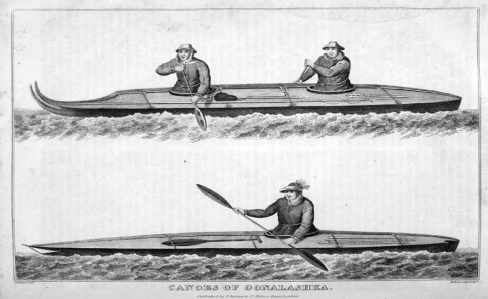
This drawing from Captain Cook’s 1778
voyage to Alaska shows Aleuts in double and single hole kayaks. The men
are wearing
traditional waterproof skins. The man in the single man kayak is also
wearing the distinctive Aleut sea visor with feathers. [From: Alaska Digital
Archives.]
Specialized knowledge can become common
knowledge. Over time aspects of specialized knowledge can become
common knowledge. The internal combustion engine, for
example, is a scientific invention of the mid 1800s that became part of everyday
life. Among other things, it powers the various vehicles we use daily — autos,
trucks, ships, boats, airplanes, and snow machines. If it requires fuel to
run, it is an internal combustion engine. If you wish to be a well trained
mechanic, you would likely take courses in such areas as “engine thermodynamics,” “heat
transfer in engines,” and “fluid mechanics.” Obviously
this is all very specialized knowledge acquired by relatively few people
after considerable
study. But because the internal combustion engine is so essential to our
daily life, many of us know enough about it to perform fairly complicated
maintenance
and repair operations. We may not be able to explain engine thermodynamics,
but we do know about carburetors, pistons, spark plugs, fan belts, engine
blocks, and the need to change the oil according to the season. And probably
we know
the difference between 2 stroke and 4 stroke engines. We need to know these
things if we are to keep the motors of our fishing boat and snow machine
in good working order. All of this has become common knowledge necessary
for living
as a modern subsistence hunter, trapper, and fisherman in Alaska.
One measure
of how much an area of specialized knowledge has become common knowledge
is the extent to which it is part of our everyday language. We
even use some of them as metaphors — she is the “spark plug” of
the high school basketball team. This vocabulary did not exist before the
invention of the internal combustion engine. It had to be invented along
with the engine
itself. As you read this chapter, you can bet that somewhere vocabulary
is being invented to keep up with the rapidly expanding information technology
of computers and the internet. Not too long ago, nobody heard of “spam” or “blog” or “twitter.”
In
the course of developing specialized knowledge, traditional Native societies
also had to invent specialized vocabularies. And over time these new
words became common knowledge and part of the language of everyday life. An
good
example is the set of thirty-one Inuit words establishing a detailed
classification system for various conditions of snow.5 Here are some of those
words:
Aluiqqaniq: Snowdrift
on a steep hill, overhanging on top.
Aniuk: Snow for drinking water.
Aput: Snow on the ground (close to the generic Snow)
Aqilluqqaaq: Fresh and soggy snow
Auviq: snow brick, to build igloo
Ijaruvak: Melted snow.
Isiriartaq: Falling snow, yellow or red.
Kanangniut: Snowdrift made by North-East wind.
Katakartanaq: Crusty snow, broken by steps.
Kavisilaq: snow hardened by rain or frost
Kinirtaq: wet and compact snow.
Masak: wet snow, saturated.
Matsaaq: snow in water
Maujaq: deep and soft snow, where it's difficult
to walk.
|
Mingullaut: thin powder
snow, enters by cracks and covers objects.
Mituk: small snow layer on the water of a fishing
hole.
Munnguqtuq: compressed snow which began to soften
in spring.
Natiruviaqtuq: snow blasts on the ground.
Niggiut: snowdrift made by south-west wind
Niummak: hard waving snow staying on ice fields turned
in ice crystals.
Pingangnuit: snowdrift
Piqsiq: snow lifted by wind.
Pukak: dry snow crystals, like sugar powder
Qannialaaq: light falling snow
|
Notice how just one Inuit word highlights a condition
of snow requiring several English words. Like the English words used to capture
the functions of the internal combustion engine, this Inuit classification
of snow conditions is clear indication of specialized knowledge becoming common
knowledge.
The scientific method. Along with
specialized knowledge, a definition of science must include the process by
which scientific evidence
is obtained
and theories
tested. This process is called the scientific method. The key idea here is
contained in the verb “to do.” If people anywhere at any time
follow a series of well defined steps to understand some aspect of the natural
or
social world, they are doing science. They are using the scientific method.
The Iñupiaq who painstakingly developed the metrological knowledge
Mr. Kenny Toovak relied upon that fateful day used the scientific method
which
is ordinarily thought of as consisting of two parts. The first part is attitude.
Is the attitude of the investigator working on a scientific problem such
as Arctic warming dedicated to rational thinking? That is, does he use logic
and
reason rather than emotional, magical, or spiritual thinking when making
his observations and drawing his conclusions? Is the attitude of the investigator
objective? Is he willing to go wherever the facts take him although it may
contradict strongly held beliefs? Is he open to new evidence and ideas even
if they may prove his current theory wrong?
Many consider the scientific
method to be the major difference between matters
of science and matters of faith. Religious doctrine such as belief in God
and a supernatural world cannot be empirically tested – that is,
proven right or wrong by real life observation and experimentation. But
this does
not mean
a reasonable person schooled in the scientific method cannot also conclude
that a well ordered universe with no apparent middle or edges suggests
the existence of a supreme being or ultimate creative force. Albert Einstein,
the scientist best known for his theories on how the universe works, believed
exactly
this. Responding to the question of whether he believed in God, Einstein
said, "I
believe in a ... God who reveals himself in the orderly harmony of
what exists, not in a God who concerns himself with fates and actions of
human
beings."** In our earlier discussion of the
Central Yup’ik storyknife, we said that the imagery carved on the
ivory handle was an example of how this Yup’ik
artifact can give us a glimpse of Yup’ik cognitive culture. But at
the same time it is equally an artistic product. Like all art, the images
carved into the storyknife handle were meant to represent an idea or series
of ideas. The father or uncle who did the carving was perhaps expressing
a significant thought for the young girl to keep in mind as she anticipated
adult female responsibilities.
One of Einstein’s most
famous quotes is “God does not play
dice with the Universe.”6 Most important,
he never claimed that his scientific work proved or disproved the existence
of God. Certainly he
would be the
first to say that science was never meant to answer questions of faith
and how the
faithful should imagine a supernatural world. That world must be thought
about and approached in other ways.
The second part has to do with method — the
actual process of doing science. Is the information (the data) gathered
by the investigator accomplished through
a series of deliberate and well organized observations of the phenomenon
under study? A fundamental rule of the scientific method is that theories
must be
constructed so that their propositions can be further tested by others
under the same conditions using the same methods. Usually scientific
proof is based
on empirical evidence. Interior Athabaskans, for example, developed a
method for hunting caribou by chasing the animals into large corrals where
they
were “speared,
snared, and shot with arrows.”7 It
is easy to imagine how different “chase
methods” were empirically tested before finding the most effective
method. Or their testing of different materials used for constructing
the corral before
finding one that was easy to work with but strong enough to hold frightened
caribou. And Mr. Kenny Toovak’s story certainly gives us some idea
of how the Iñupiaq applied the scientific method to the study
of weather in much the same way Albert Einstein studied the universe.
Ancient
Alaska Native
societies did not have written scientific journals to record and organize
their research. Their oral traditions served this function. Certainly
they did not
have the scientific instruments available to Albert Einstein and other
modern scientists. Even so, they could not have accomplished such extraordinary
adaptations
to the unique challenges of their environments without applying what
today we call the scientific method.
Medical science. We must not forget
that traditional Native cultures
also used the scientific method to advance their understanding of the
human body
and medical treatment of it. Aleuts (Unangan), for example, performed autopsies
to increase their understanding of human autonomy and causes of death. They
also developed an inventory of herbal cures — in modern terms, a pharmacy — derived
from the precise mixing of substances taken from various plant life found within
the Aleutian regional environment. Aleut medical science also allowed development
of a special feature of their worldview found on several Aleutian islands — the
practice of mummification to memorialize the spirit of a deceased person of
high social standing or for extraordinary accomplishments in life. Only through
rigorous empirical study could such a body of medical knowledge be achieved.8
In discussing traditional medicine among the Yup’ik, Oscar Kawagley directly
connects the development of medical knowledge to application of the scientific
method. After describing several complex and lengthy treatments for arthritis,
he says:
The experimental process leading to the development
of a treatment such as this [arthritis] had to occur over a very long period
of time before
its medicinal
value was recognized. This required experimentation, using the rational ability
of the human being, establishing a process for refining a natural substance,
using very practical means at hand, observing and committing to memory the
process of change in the solution [for treating arthritis], and noting the
effects on the human body for determination of its effectiveness.9
Your Cultural
Profile, moreover, should describe the health care responsibilities of shamans
to the community. Often shamans performed the dual role of spiritual
leader and healer of both physical and mental health problems. In fact,
many traditional Native worldviews did not clearly separate spiritual issues
from
health issues. In many cases, physical and mental illness was viewed as
a sign of possible spiritual disharmony within the community or within the
individual
who is sick. Some shamans were even viewed as having the power to create
this disharmony and make people physically or mentally ill. But no matter
how this
dual role was performed within a specific Native culture, shamans and other
prominent healers used elements of the scientific method to advance their
medical knowledge.
Artistic Expression
What is Art? A main cultural
product of any society is its Art. A people’s
values, traditions, and aspirations are often expressed through powerful
artistic imagery. Of all the elements that make up any society’s cultural
production, it is art which most clearly reflects aspects of that society’s
worldview. The Sistine Chapel at the Vatican in Rome, Italy is an excellent
example of
how art is used to visualize a major religious tradition, in this instance
the Roman Catholic tradition. Its interior is covered with paintings
of biblical stories done by Italian renaissance artists, including the ceiling
painted
by the renowned Michelangelo, a section of which is shown in figure 10-2.
Figure 10-2
Michelangelo's ceiling at the Sistine chapel10

In our earlier discussion of the Central Yup’ik
storyknife, we said ]that the imagery carved on the ivory handle was an example
of how this Yup’ik artifact can give us a glimpse of Yup’ik cognitive
culture. But at the same time it is equally an artistic product. Like all art,
the images carved into the storyknife handle were meant to represent an idea
or series of ideas. The father or uncle who did the carving was perhaps expressing
a significant thought for the young girl to keep in mind as she anticipated
adult female responsibilities.
Where do we find traditional Native Art? The
storyknife gives us a major clue to finding and describing traditional Native
art. Unlike art collections found
in modern museums, in traditional times we would not find separate structures
housing pieces of a Native group’s art to be contemplated and admired.
What we would find is artistic expression displayed in the decoration and design
of material objects having other functions. Remember that the Yup’ik storyknife
was also crafted to serve an educational purpose. Also within the Central Yup’ik
artistic tradition is expression of their supernatural world through the design
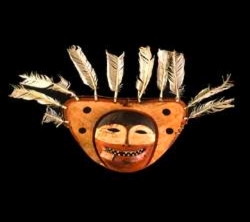
and decoration of ceremonial masks. Just as the art of the Sistine Chapel vividly
displays elements of the Roman Catholic tradition, the art of ceremonial masks
vividly displays aspects of the ancient Yup’ik spiritual tradition. Figure
10-3 below shows a Nepcetaq (shaman mask) with face peering through a triangular
shield, painted red, white, and black. Red sometimes symbolized life, blood,
or give protection to the mask's wearer; black sometimes represents death or
the afterlife; and white sometimes can mean living or winter.11
Figure 10-3
Yup'ik Shaman Mask
We even find art in decorative designs fastened
or sewn onto clothing. For interior Athabaskans whose life was almost constant
movement, their cultural products had to be easily transported on one’s
back or in bags carried by dogs. Of course they also had to be easy to assemble
and disassemble. One scholar of Native art, William Fitzhugh, says of Athabaskan
clothing that “most outstanding was their skin work, which employed dyed
porcupine quill and moose hair embroidery in its early stages and, later, glass
beads, dentalium shell, and other trade goods.”12
Figure 10-4
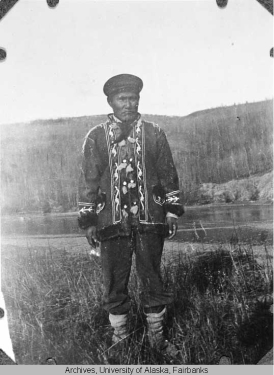
Albert Maggie with beaded coat. Nenana, AK, c. 1913
Here we should highlight what we said earlier about
the importance of commerce in traditional Native economies. Because these pre-contact
commercial networks reached beyond Alaskan borders, many of the decorative
beads and shells were acquired by interior Athabaskans before their actual
encounters with Europeans. Dentalium seashells, for example, are found along
the northwest coast of North America. They are usually white and hollow inside
and cone shaped like a tooth or tusk. They were so highly valued by Indians
from California to Alaska that they became a medium of exchange much as we
use dollar bills and coins today. Look at the photo of a Tlingit
shaman on
page 133. Dentalium shells decorate his apron-like leg covering .
Figure 10-5
Little Diomede Iñupiaq ivory carver, c. 1928
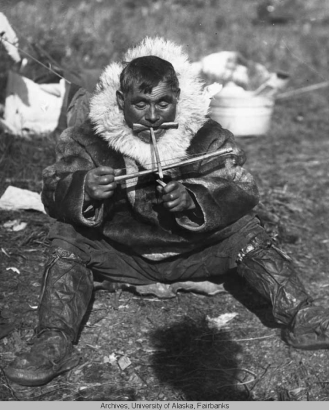
What we learn from Native art. We
have said that art serves as a window through which we can view elements of
peoples’ worldview.
But art can also help us understand how the worldviews of otherwise similar
cultural groups can differ. William Fitzhugh has observed that Central Yup’ik
art “was more diverse, abstract, and symbolic than that of the Iñupiaq
peoples.” The exquisite and celebrated Iñupiaq art of ivory carving
portrayed life in its natural form. An outsider knows at once that it is a
carving of a polar bear or a whale or a seal. On the other hand, making sense
of the more abstract and symbolic Central Yup’ik decorative art requires
knowledge of their worldview, particularly aspects of their traditional spirituality.13
We also learn that some Native art crossed territorial
boundaries. One of the best known and most studied of all Native American art
forms is the Northwest
Coast Indian tradition. This very distinctive Native art stretches 1,200
miles along the Pacific Coast from Oregon in the south to the Tlingit and Haida
homelands
of Alaska in the north. Although speaking different languages, these Northwest
Coast tribes had in common a heavily wooded temperate maritime environment,
a clan-based hierarchical social organization, and a totemic worldview with
Raven at the center of their creation mythologies. The late Andrew Hope III,
refers to this entire Northwest culture area as the “Raven Creator
Bioregion.” Perhaps
one of the most knowledgeable experts on Northwest Coast Indian art is University
of Washington Professor Emeritus, Bill Holm. For his distinguished work,
he was honored in 2001 with a certificate of appreciation from the Sealaska
Heritage
Institute, an organization which seeks to perpetuate and enhance Tlingit,
Haida and Tsimshian cultural knowledge. Holm characterizes Tlingit and other
Northwest
Coast Indian art as a well organized design system of ovid-shaped form lines
depicting totemic creatures central to the mythological histories of clans
and of house groups within clans.
A detailed artistic depiction of a totemic
creature along with other clan or clan house symbolism is called a crest.
Here is another good example of
art
teaching us something about the society in which it is found. In this case
we learn about the connection between Tlingit social organization and Tlingit
art. Again we go to Andrew Hope III for instruction:
To appreciate Tlingit
pole art, one must understand Tlingit social organization: what Frederica
de Laguna refers to as .” . . the fundamental principles
of . . . clan organization, . . . the values on which Native societies
are based," that is, the names and histories of the respective Tlingit
tribes, clans, and clan houses.
The seventy-plus Tlingit clans are separated
into moieties or two equal
sides-the Wolf and the Raven. Tlingit custom provides for matrilineal
descent (one
follows the clan of the mother) and requires one to marry one of the
opposite moiety.
The clans are further subdivided into some 250 clan houses.
To underscore
the duality of Tlingit law, Wolf moiety clans generally claim predator crests,
whereas Raven moiety clans generally claim non-predator
crests. For example, the Kaagwaantaan, a Wolf moiety clan, claim Brown
Bear, the Killer
Whale, the Shark and the Wolf as crests. The Kiks.áàdi,
a Raven moiety clan, claim the Frog, the Sculpin, the Dog Salmon and
the Raven as crests.
Tlingit totem art is utilitarian as opposed to decorative art. Tlingit
pole art depicts clan crests and histories.
The figures seen on a totem
pole are the principle subjects taken from traditional treating of
the family’s rise to prominence or of the
heroic exploits of one of its members. From such subjects crests are
derived. In some houses,
in the rear between the two carved posts, a screen is fitted, forming
a kind of partition which is always carved and painted.14
According to
traditional Tlingit property laws, moreover, a clan or clan
house has clear ownership of their crest and it can be used only by their
members.
Elements of the crest ornamented other cultural products such as house
poles, screens, war canoes, headgear, boxes and chests, and even parts
of hunting
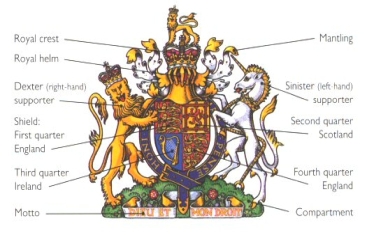
and fishing equipment. (See figure 5-1 on page 52.) In some ways a European
noble family’s coat-of-arms is comparable to the Tlingit clan and
house group crests because it also exhibits symbolism of the family’s
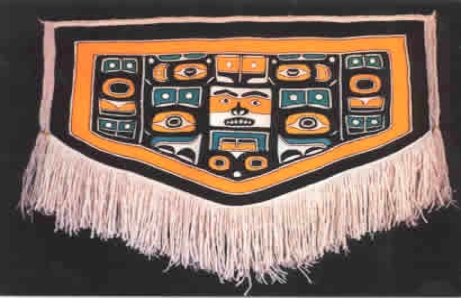
honored history and mythological beginnings. Figure 10-5 shows a Chilkat
blanket or
robe, the prized part of Tlingit ceremonial regalia. It is emblazoned
with clan and clan house crests and symbols. It clearly shows the ovid-shaped
form
lines described by Bill Holm.15 For comparison, just below is the British
Royal Family’s coat-of-arms or crest.16
Figure 10-6
British Royal Family's coat-of-arms
According to George Emmons, a United States Navel
officer who carefully observed Tlingit life in the late 1800s, ceremonial blanket-weaving
originated with the Canadian Tsimshian and later spread north to the Tlingits
through commerce and marriage. (Don’t forget that before the Alaska Tsimshian
moved to Annette Island in 1887, their homeland was in British Columbia, Canada,
where about 7,500 Tsimshian still live.) Long settled near the present day
town of Haines, Alaska, the Chilkat tribe of Tlingits developed their own design
style and became the best weavers, producing numerous blankets for clans and
clan houses of other Tlingit groups. The Chilkat Blanket was highly sought
by Indian nobility up and down the Northwest Coast long before the first explorers
came to the region.17
Not only did the ovid-shaped form lines of Northwest
Coast Indian art extend 1,200 miles south to Oregon, but it also influenced
the artistic
expression
of other Alaska Native groups along the North Pacific Rim. We know that hostilities
often existed between the Tlingit and other Pacific Rim peoples. Yet studies
by Bill Holm and others show that the Chugach of Prince William Sound and
the Koniag of Kodiak Island adopted some elements of the Northwest Coast artistic
tradition to decorate their basketry, headdress, storage chests, and eating
utensils. Indeed, the spread of the unique Northwest Coast Indian art form
offers yet another example of Native people traveling great distances to
exchange
both goods and ideas.18
An interesting artistic comparison. According to
historical records, it took Michelangelo about four years to complete his ceiling
at the
Sistine Chapel.
In all, Michelangelo’s work covers 5,000 square feet. (A NBA basketball
court measures 4700 sq. feet.) By comparison, in 1998 Clarissa Hudson, a
master Chilkat blanket weaver, began weaving a blanket for a Canadian Native
chief.
As she says, “Between caring for my family, finishing my other commissions,
and moving (twice!) I finished the blanket in just over two years.”19 Let’s
assume Clarissa spent a quarter of her time on the chief’s blanket
while attending to other parts of her full life. If this is a reasonable
assumption,
it means that if she were able to work full time on her blankets, she could
only weave four 25 sq. foot Chilkat blankets in the time it took Michelangelo
to complete his 5000 sq. foot Sistine Chapel painting.
* Whenever you come across the term artifact in your research, stop
and take notice. This is because it refers to a material object made by humans
and,
therefore, a cultural product from times past.
**Benedict De Spinosa was a controversial
17th Century European philosopher known for his view that any rational scientific
investigation will lead to the conclusion that God and nature are one and the
same. God does not rule the universe. He is the universe.
Review Questions
Cultural products are not a basic part of our concept of culture?
Why not?
Why do we say it is not a question of whether Alaska Natives
did science in traditional times, but a question of what kind of science
was done?
Why distinguish specialized knowledge from common knowledge?
(Hint – the connection between science and specialized knowledge.)
Can
you explain the scientific method, and why we say it is not just a modern
or Western practice, but has been used down through time by all
peoples?
Why do we say: “Of all the elements that make up any
society’s cultural
production, it is art which most clearly reflects aspects of that
society’s
worldview? Can you give examples from Alaska Native cultures?
Give
some reasons why we must look for traditional Native art on cultural
products having other functions.
ENDNOTES
- See: Erickson, Frederick, “Culture in society and in
educational practices” in J. Banks and C. Banks (Eds.)Multicultural
Education – Issues and Practices, John Wiley & Sons; 5
edition (February 1, 2001). A comprehensive review of the concept
of culture
with an introduction to culture and cognition.
- Fienup-Riordan, 1988,
p. 262, and Langdon, 2002, p. 52.
- Charles Wohlforth, “The Ice
Man”, Alaska Magazine, October
1, 2004, pp. 42-43.
- Black, Lydia and R. G. Liapunova, “Aleut: Islanders
of the North Paciific”in
W. Fitzhugh & Crowell (eds.), Crossroads of Continents, Smithsonian
Institution Press, 1988, p. 55
- Go to:http://www.athropolis.com/links/inuit.htm
- Einstein: The Life and
Times, Ronald W. Clark, Page 502.
- Richard K. Nelson’s “Raven’s
People” in J. Aigner,
Op Cit. p. 206.
- Laughlin, William S. Aleuts: Survivors of the
Bering Land Bridge (Harcourt Brace College Publishers June 1980),.
Steve Langdon,
2002, p. 24. Black,
Lydia and
Liapunova, 1988, pp. 53.
- Kawagley, Op Cit., pp. 71-72.
- Go to: academics.skidmore.edu/../the infamous
ro.html
- Arctic Studies Center exhibit: “Agayuliyararput, Our Way
of Making Prayer.” Go
to: (www.mnh.si.edu/arctic/features/yupik/index.html
- Fitzhugh,
W., “Comparative Art of the North Pacific Rim” in W.
Fitzhugh & Crowell
(eds.), Crossroads of Continents, Smithsonian Institution
Press, 1988, p. 304.
- Fitzhugh, Ibid, p. 301.
- Andrew Hope III, Andy Hope, “Southeast Region:
Reading Poles” in
Sharing Our Pathways, A newsletter of the Alaska
Rural Systemic Initiative. Volume 3, Issue 5, 1998. Also see his article
in Raven’s Bones Journal,
Vol. 5, No. 1, Nov. 1996.
- Sheldon Museum and Cultural
Center, Haines, AK. (www.sheldonmuseum.org/chilkatblanket.htm)
- From:
http://www.britroyals.com/arms.htm
- Emmons, George Thorton, The Tlingit
Indians, (Fredrica de Laguna, ed.), University of Washington Press,
1991
- Holm, Bill, “Art and Culture Change
at the Tlingit – Eskimo border” in
W. Fitzhugh & Crowell (eds.), Crossroads
of Continents, Smithsonian Institution Press,
1988, pp. 281 – 293
- Go to: Clarissahudson.com
Table of Contents | Congratulations
 The
University of Alaska Fairbanks is an Affirmative
Action/Equal Opportunity employer, educational
institution, and provider is a part of the University of Alaska
system. Learn more about UA's notice of nondiscrimination. The
University of Alaska Fairbanks is an Affirmative
Action/Equal Opportunity employer, educational
institution, and provider is a part of the University of Alaska
system. Learn more about UA's notice of nondiscrimination.
Alaska Native Knowledge
Network
University of Alaska Fairbanks
PO Box 756730
Fairbanks AK 99775-6730
Phone (907) 474.1902
Fax (907) 474.1957 |
Questions or comments?
Contact ANKN |
|
Last
modified
January 5, 2011
|
|