|
|
|
 The Alutiiq Ethnographic The Alutiiq Ethnographic
Bibliography compiled by Rachel Mason
March 1995
This project is supported in part by a grant from the Alaska
Humanities Forum and the National Endowment for the Humanities,
a federal agency. It is sponsored by the Kodiak Area Native Association,
402 Center Avenue, Kodiak, Alaska 99615.
TABLE OF CONTENTS
I. INTRODUCTION
A. Why This Bibliography Was
Written
B. How To Use This Bibliography
II. ALUTIIQ CULTURE, PAST AND PRESENT
A. The Name "Alutiiq"
B. Prehistory
C. Koniag/Chugach Ethnography
D. The Russian Colony
E. The American Era, 1868-1964
F. The Earthquake to the Present Day
G. Cultural Revitalization
III. SOURCES ON ALUTIIQ CULTURE, PAST AND
PRESENT
A. General
B. Prehistory
C. History: Russian Era, 1784-1867
D. History: American Era, 1868-1964
E. The 1912 Mount Katmai Eruption
F. The 1964 Earthquake and Tsunami
G. Current Ethnography, 1965-Present
H. The 1989 Exxon Valdez Oil Spill
IV. SPECIAL TOPICS
A. Language
B. Kinship
C. Subsistence
D. Warfare
E. Religion, Art, and Folklore
F. Medicine
V. VIDEOS AND COMPUTER SOFTWARE
VI. ALPHABETICAL LIST OF SOURCES
APPENDIX: MAP OF ALUTIIQ
COMMUNITIES IN 1984.
THE ALUTIIQ ETHNOGRAPHIC BIBLIOGRAPHY
I. INTRODUCTION
A. WHY THIS BIBLIOGRAPHY WAS WRITTEN
This project was undertaken in order to make
what has been written about Alutiiq culture more accessible
to the public. The "public" I
am most concerned with is the Alutiiq people themselves. Alaska
Natives have long been the subject of anthropological study,
and many have been frustrated when they were unable to find out
what happened to the information they provided. This bibliography
is intended to serve primarily as a guide to those who want to
find out what has been written and recorded about their own culture.
Anthropology, the study of human beings, is a broad field. Among
the several branches of anthropology are archaeology, which focuses
on the remains and artifacts of people who lived in the past,
and ethnography, which deals with living people. Generally, ethnography
is based on face-to-face interaction between the researcher and
the people being studied. Ethnographers study human culture:
how people live and how they view their world. The branches of
anthropology also include physical anthropology, which studies
man as a biological species, and linguistic anthropology, which
focuses on human language.
While each of the branches of anthropology emphasizes a different
aspect of human existence, there are some areas in which they
overlap. All anthropologists have typically tried to understand
the totality of culture in a holistic way, because they see that
different aspects of culture are interconnected For example,
in talking about Alutiiq culture, it is impossible to talk about
subsistence hunting without talking about religion, because in
Alutiiq tradition, humans and animals are part of the same spiritual
world.
This bibliography emphasizes ethnography, rather than archaeology;
however, it includes some entries by archaeologists, because
archaeologists and cultural anthropologists who have attempted
to learn about Alutiiq people are both trying to understand the
same culture, only at different times. The bibliography also
contains references to historical documents written by Russian
colonials and others who came into contact with Alutiiq people.
These historical documents are also important, since they give
information about Alutiiq culture at a particular time.
I have attempted to compile material written or recorded about
the entire Alutiiq culture area, including the Kodiak Archipelago,
Prince William Sound, Lower Cook Inlet, and the south coast of
the Alaska Peninsula. I was able to find more references on Kodiak
than the other Alutiiq areas, both because more studies have
been undertaken in Kodiak than the other regions and because
I was working in Kodiak and had more access to Kodiak sources.
I am greatly indebted to the prior work of Dr. Donald Clark,
whose ongoing bibliography of Kodiak Island, Alaska served as
a starting point for my own research. Some of my entries and
annotations are copied directly from his. Funding for this project
was provided by the Alaska Humanities Forum. I am grateful for
the Forum's support, as well as for the sponsorship provided
by the Kodiak Area Native Association.
B. HOW TO USE THIS BIBLIOGRAPHY
The primary organization of the bibliography is by subject,
and alphabetically within each subject by author. Each subject
contains a list of annotated entries. If there is no description
of the reference, it means that I have not been able to locate
or review it.
The bibliography begins with a section on general sources. These
are books or articles which deal with all Alaska Native cultures,
or with a number of aspects of Alutiiq culture. Following that
category, there are headings for prehistory and a series of historical
eras, leading to the present day. There are separate sections
for references on three disastrous events in Alutiiq history:
the 1912 Mount Katmai eruption, the 1964 earthquake and tsunami,
and the 1989 Exxon Valdez oil spill. Next, there are sections
on special topics. These include language, kinship, subsistence,
warfare, religion and mythology, and medicine. There is a short
section containing references to videos and a computer curriculum
on Alutiiq culture. Because not every source on the Alutiiq fits
neatly into a small category, some entries are included in more
than one subject heading.
Each bibliographic entry contains information
on where the documents can be found. "AEB Collection" stands for "Alutiiq Ethnographic
Bibliography Collection." Documents with this notation have been
copied from journals or received from authors, government agencies,
or private donors, and are located in the Kodiak Area Native
Association Cultural Heritage Center.
I would especially like to thank Nancy Jones of Kodiak for her
donation of the 1890 Alaska census (listed as Porter 1893). Other
documents and tapes which can be found in the archives of the
KANA Cultural Heritage Center are identified in the bibliography.
The libraries listed here are the A. Holmes Johnson and Kodiak
College libraries in Kodiak; Anchorage Municipal (Loussac), Alaska
Resource Library (in the Federal building), and University of
Alaska-Anchorage Consortium Library in Anchorage; Homer Public
Library; and Valdez Consortium Library. These were chosen because
they seem the most accessible to people living in Alutiiq communities.
In most cases, information on the locations of these documents
comes from the LaserCat catalogue system available in each of
the Anchorage libraries.
Several unpublished dissertations are included in this bibliography.
While most of them are not available in Alaska libraries, copies
of dissertations from United States universities may be ordered
by calling UMI Dissertation Services at 1-800-521-0600. There
is one Canadian dissertation (Grubis 1981), which may be ordered
from Micromedia Limited in Ottawa, Ontario at 1-800-567-1914.
The final portion of the bibliography is an alphabetical listing
by author. This contains the same entries as the annotated portions
listed by subject.
I hope this bibliography is of assistance to those who want
to know more about Alutiiq culture. This project can never be
entirely completed, because new work on Alutiiq culture continues
to be undertaken, and new articles and books written. If you
have suggestions for correcting or updating this volume, please
contact me at 4912 Roger Drive, Anchorage, Alaska 99507.
(Webpage converter's note: not all special
characters are available; words with an asterisk contain a
special character. OCR scanning may not have converted 100%.
I've attempted to present this document like the original;
so if there are any errors, please contact ANKN
Clearninghouse)
II. ALUTIIQ CULTURE, PAST AND PRESENT
A. THE NAME "ALUTIIQ"
The term "Alutiiq" is relatively new. It
has been used by Native speakers and scholars since the early
1980s to refer to both
the language and culture of the group of Alaska Native people
indigenous to the Kodiak Island Archipelago, the southern coast
of the Alaska Peninsula, Prince William Sound, and the lower
tip of the Kenai Peninsula. These people speak a language so
similar to Central Yup'ik (a language spoken by Eskimos in Western
Alaska) that they can almost converse with Yup'ik speakers of
western Alaska. There are smaller dialect differences between
Alutiiq groups.
Beginning in Russian colonial times, most Alutiiqs were called
and have called themselves Aleuts, although their language is
not very similar to the language spoken by Aleuts on the Aleutian
Chain. The Russians recognized that Alutiiqs were different from
Aleuts, and referred to them by area as Kadiaks or Chugashes.
However, the Russians used one blanket term, Aleuts, to distinguish
Alutiiqs and Aleuts from other Native groups. In addition to
a common language and traditional culture, Alutiiqs share a history
of Russian colonization and the lasting influence of Russian
Orthodox religion. Following the end of the Russian colony, Alutiiqs
experienced a common induction into commercial fishing when it
became the main wage industry in their coastal villages. In the
twentieth century, many Alutiiqs also shared the experience of
three disasters: the 1912 Mount Katmai eruption, the 1964 Great
Alaskan Earthquake and tsunami, and the 1989 Exxon Valdez oil
spill.
Those who attempt to find ethnographic references to Alutiiqs
will find that they are known by a variety of names. Linguists
have referred to the language spoken by Alutiiqs as Sugpiaq,
Sugcestun, Suk, Western Eskimo or Pacific Eskimo. Other terms
used by anthropologists include Yup'ik or Yuit.
Throughout this report, the term Alutiiq refers to the people
and language of the entire culture area. Natives of the Kodiak
area and south coast of the Alaska Peninsula are called Koniag
(Koniagmiut) and their counterparts in Prince William Sound and
Lower Cook Inlet are called Chugach (Chugachmiut). Within the
Koniag group are the Qikertarmiut (people of Kodiak Island) and
Aglegmiut (people of the Alaska Peninsula). The people of Lower
Cook Inlet are the Unegkurmiut, while the Chugach of Prince William
Sound are the Paluwigmiut (Haggerty et al. 1991:76-77).
B. PREHISTORY
Some archaeologists believe that the ancestors of the present-day
Native Alaskan residents of the Alutiiq culture area have continuously
inhabited the area for at least 7,000 years (Jordan and Knecht
1986). They developed a ritually elaborate maritime hunting culture
with many connections to other peoples through trade and warfare.
Archaeologists have identified several distinct cultural traditions
in the Kodiak Island area. These are Ocean Bay (ca. 4500-1400
B.C.), Kachemak (ca. 1400 B.C.-1200 A.D.) and Koniag (ca. 1200-1784
A.D.). The dating of these phases continues to be a matter of
debate. Archeological data has been found from each part of the
historically known Alutiiq culture area--Kodiak, Alaska Peninsula,
Lower Cook Inlet, and Prince William Sound--for all the prehistoric
traditions.
The "Ocean Bay" tradition was first identified with a site near
the present-day village of Old Harbor on the south end of Kodiak
Island. The name "Kachemak" was first used by archeologist Frederica
de Laguna in 1930 to describe assemblages from Kachemak Bay.
Koniags were the people inhabiting Kodiak Island at the time
of European contact. The Chugach were the people living in Prince
William Sound when the first Europeans arrived.
Because of purported physiological and cultural differences
between the Kachemak and Koniag phase peoples, and because of
chronological gaps between phases in the archeological record,
there has been debate about the continuity of residence of Alutiiq
Natives in prehistory. Some scholars, following Hrdlicka's* early
research (1944), argue that the Kachemak people were annihilated
in war or were gradually replaced through in-migration of the
Koniags. However, more recently archaeologists have suggested
that the Kachemak and Koniag peoples are not separate groups,
but represent evolutionary phases of a single cultural tradition
(Jordan and Knecht 1986).
C. KONIAG/CHUGACH ETHNOGRAPHY
The Koniags and Chugach lived in semi-subterranean sod houses
in their permanent winter villages. In summer, they moved to
temporary fish camps. They hunted sea mammals such as whales,
seals, sea lions, and sea otters. Some Alutiiqs were able to
hunt caribou on the Alaska Peninsula. Although the Koniags were
more dependent on salmon than the Chugach, salmon was a major
dietary staple of all Alutiiqs. They dried great quantities of
salmon for use in the winter. They also caught other fish, and
gathered intertidal resources on the shores. Hunting was done
with harpoons and clubs, and fish were speared, gaffed, harpooned
or hooked. Salmon were often caught in weirs built across rivers.
Skilled in handling skin kayaks (which the Russians called bidarkas)
and larger wooden boats (bidars), they travelled over
rough seas for war raids and more peaceful trading with other
Alutiiq groups and with people as far away as the Aleutian Islands
and Southeastern Alaska. The Chugach warred with the Koniags
and the Tlingits of Southeastern Alaska, and traded with the
Athabaskan Ahtna, with the neighboring Eyaks serving as middlemen.
Despite the many contacts with other groups, each Alutiiq village
was politically autonomous, headed by an inherited chief. Invariably,
the villages were on the coast, reflecting the Alutiiqs' love
of and dependence on the sea. Above the level of the village,
there were eight autonomous groups of Chugach Natives in Prince
William Sound at the time of contact (Hassen 1978). Among the
Koniags, there were at least four (Townsend 1980).
There was marked social hierarchy which early European observers
interpreted as a class system of nobles, commoners, and slaves.
Slaves, who were generally war captives, were the property of
wealthy people. Wealth was redistributed in ornate ceremonies
which included dancing and feasting.
Government was through a system of hereditary
leaders who also had to prove their worthiness to rule. Because
these leaders
were also wealthy, one word for them is "richman" (Townsend 1980).
There were also wise men similar to priests, some of whom composed
poetry and songs.
Alutiiq shamans were healers and ritual performers. They could
forecast the weather and make contact with the supernatural.
Women as well as men could be shamans. Some of the men belonged
to a secret whale hunting society. Their wives also had important
ritual roles in the whale hunt.
Both men and women could have more than one spouse. Most commonly,
an important man had several wives. Divorce was possible and
not infrequent.
Marriages were arranged by the parents of the bride and groom.
The couple usually went to live with the bride's parents for
a year or until they had children of their own. The young husband
was expected to work for his in-laws and bring them food during
this period.
It is uncertain whether Alutiiq kinship was matrilineal (reckoned
through the mother's side), patrilineal (reckoned on the father's
side), bilateral (both), or neither. There is some evidence that
both Koniags and Chugach were matrilineal, but Alutiiq kinship
terminology suggests a bilateral system. The Alutiiqs had many
contacts with known matrilineal groups such as the Tlingits and
Aleuts. In matrilineal societies, the mother's brother has a
strong role in raising children. The importance of such uncles
to Alutiiq children as late as the mid-1980s has been interpreted
as evidence of past matrilineality (Davis 1986:186).
Alutiiq children were raised permissively but also taught stoicism.
At their first menstrual period, girls were secluded for several
weeks in a special hut and taught adult skills by a knowledgeable
older woman. Adult women stayed in menstrual huts for a few days
every month. Men feared bad luck in hunting if their gear came
into contact with a menstruating woman. Childbirth also took
place in special huts, and both mother and baby stayed there
for several days. Before they re-entered society, the new mother
and infant would have a sweatbath (or banya, as the sweatbath
has been called since Russian times).
Occasionally, a boy child would be raised to dress and act like
a woman. Less often, a girl would be raised like a boy. Being
a transvestite was an esteemed role, and some transvestites became
shamans.
Both men and women wore long hoodless fur or bird skin parkas,
and hooded rain parkas (which came to be called by the Siberian
Russian term kamleikas) made from strips of intestine.
Shoes were not worn in summer, and archaeologists have not discovered
any trousers or gloves. Men's (and possibly women's) lips were
pierced to allow the insertion of small plugs called labrets.
Women's chins were tattooed at puberty. Sea hunters wore bent
wood hats in the shape of a cone, decorated with amulets and
painted designs.
D. THE RUSSIAN COLONY
Soon after the explorer Vitus Bering first stopped in the Aleutian
Islands in 1741, Russian hunters and merchants called promyshlenniki established
a colonial presence in what is now Alaska to profit from the
furs of sea otters. Lacking the sea mammal hunting expertise
of Aleut and Alutiiq people, the Russians exploited Native labor
for their colonial venture. They sold the valuable pelts of sea
otters to a Chinese market and to fellow Russians.
Following the decline of sea otters in the Aleutian Chain, the
Russians turned toward the rich waters of the Kodiak region.
Although Kodiak Natives successfully repelled an initial trading
visit by a promyshlennik, the Russians' muskets and cannons
soon enabled the colonials to dominate the Alutiiqs by force.
One way the Russians were able to subjugate the Alutiiqs was
through their practice of taking hostages, usually the children
of chiefs. When one of the Russian leaders, Shelikhov, approached
the southern end of Kodiak Island, several thousand Natives took
refuge on a large rock near Sitkalidak Island. They were betrayed
by an Alutiiq man travelling with the Russians who knew the hidden
access to the refuge rock. Hundreds of Natives perished as they
jumped over a cliff to escape. Others were shot with cannons
or rounded up and speared to death.
Thus in 1784 the first sustained Russian contact with Alutiiqs
occurred when Shelikhov's men founded a Russian settlement on
Kodiak Island at Three Saints Bay, near the present-day village
of Old Harbor. Soon they conscripted the local population as
laborers in the sea otter hunting industry. Able-bodied Alutiiq
men were organized into work groups and forced to hunt at sea
in large fleets of bidarkas, while women, old men, and
children were made to work on shore. Hardship, accidents, and
starvation, along with diseases introduced by the Russians, quickly
led to a decimation of the Native people. By the end of the Russian
colony in 1867, the pre-contact population of perhaps 8,000 on
Kodiak Island had dwindled to around 2,000. The many deaths disrupted
every aspect of Alutiiq society.
The Chugach had less intense and less devastating interaction
with the Russians than did the Koniags. The first European to
visit Chugach territory was Vitus Bering in 1741, on a further
leg of the same journey in which he travelled to the Aleutian
Islands. Spanish explorers soon followed. Captain Cook, who arrived
in 1778, was the first European to meet the Chugach people. In
1793, the Russians founded a post near Nuchek on Hinchenbrook
Island. Partly because the population of Prince William Sound
was quite small (between 400 and 1000 people), and perhaps also
because the sea otter population was not as large there as in
other areas, the Russians did not see the Chugach as a likely
source of mass conscripted labor for sea otter hunting. Similarly,
while Russians traded with Alutiiqs on the Alaska Peninsula,
they did not establish such a ruinous colonial presence there
as they did on Kodiak Island.
In 1793, the Russians decided to move the
capital of their colony from Three Saints Bay to the northern
part of Kodiak for better
access to lumber. They established a new center of government,
which they named Pavlov Harbor ("Paul Harbor"), at the site of
today's city of Kodiak. Pavlov Harbor's central position in the
colonial empire lasted until 1808, when the capital was again
moved, this time to Sitka, for closer access to the Russian's
expanded holdings in California.
A contingent of Russian Orthodox clergy arrived in Kodiak in
1794 to convert Alaskan Natives to Christianity. They immediately
began to perform mass baptisms and marriages, and soon afterwards
established a school and orphanage near Kodiak. The clergy also
opposed the abuses the colonial officials inflicted on Natives.
One of the original eight monks, Father Herman, was canonized
by the Orthodox church in 1971. This saint, highly revered among
Alutiiq Orthodox people, is credited with performing miracles
such as healing the sick and turning back a tsunami.
Among the Alutiiq people, the Orthodox church is the most enduring
remnant of the Russian colony in Alaska, and is a central feature
of social life in almost every village. Among the American missionary
groups who began to work in the territory of Alaska in the early
1880s were the Baptists, who sent religious workers to the Kodiak
area, Prince William Sound, and later the Alaska Peninsula. As
part of the Baptist mission, an orphanage and school were opened
in Kodiak in 1886. While some Alutiiq villages now have both
Protestant and Orthodox churches, the Russian Orthodox church
has remained the dominant religion in every Alutiiq community
except Ivanof Bay.
Today, most Alutiiqs are baptized, married, and buried in Russian
Orthodox ceremonies. In the villages, services are usually led
by Native lay readers. Priests who live in Anchorage or Kodiak
travel to villages for important ceremonies. It has been suggested
that the Alaskan Russian Orthodox religion incorporates some
indigenous beliefs and customs (Oleksa 1982). Membership in the
Orthodox church became a symbol of Native identity (Davis 1970;
Rathburn 1984).
In the 1840s, following a smallpox epidemic,
the Russian colonial administration consolidated the remaining
Native population of
Kodiak Island into seven villages. Two villages were intended
as "creole" settlements. Creoles were the children of Native
women and Russian men, or the children of creoles. This group
increased in size during the years of the Russian colony. Many
creoles were educated for trades or religious leadership in Russian
church-operated schools. Creole settlements included Afognak
and Ouzinkie, in the northern part of the Kodiak Archipelago;
these villages were also conceived as "retirement communities" for
colonial employees, especially those with Native families, who
wanted to settle permanently in Alaska. There was also a significant
creole population in the Russian capital, which is now Kodiak
city.
During the Russian period Natives became more dependent on European
goods and were increasingly involved in a cash economy. Some
Alutiiqs in outlying areas, such as the shore of the Alaska Peninsula,
traded furs and other products to the Russians instead of providing
labor in the indenture system that characterized other Alutiiq-Russian
relations. In the final days of the Russian colony, Alutiiqs
began working for trade goods or cash. As Natives became more
involved in trading and a wage economy, they became bound by
debt to traders and employers.
E. THE AMERICAN ERA, 1868-1964
By the time the Russians sold Alaska to the United States in
1867, their colonial venture had become unprofitable. Soon after
the sale, a number of American entrepreneurs arrived to continue
sea otter hunting until the near demise of this animal led to
a ban on hunting it in 1911. The Americans attempted various
other industries, including trapping, whaling, cattle ranching,
and gold mining. A number of tiny islands around the Kodiak Archipelago
and off the Alaska Peninsula were deemed suitable for fox farming.
The farms were largely owned by trading companies which hired
Native men to hunt and fish to provide food for the foxes.
The salmon fishing industry, which had both high risks and high
profits, enjoyed the most dramatic and lasting success of the
new commercial efforts. The barely-tapped potential of the Karluk
River on the west side of Kodiak Island, one of the richest salmon
streams in the world, had long been recognized. The Russians
built zapors (weirs) on the river to catch red salmon,
and Alutiiq women dried the fish for winter use for the colony.
A commercial salmon saltery was experimentally operated by the
Russians on the Karluk River in 1867, the same year the United
States purchased Alaska.
The first cannery in Karluk was established in 1882. Within
a few years, there were several canneries there. By 1890, there
were fish processing operations at Chignik on the Alaska Peninsula
and on the mouth of the Copper River in Prince William Sound.
Canneries rose and fell regularly, their competition sometimes
manifested in sabotage of each other's efforts. Generally, the
isolation of the canneries discouraged any interference from
the government, to the satisfaction of unscrupulous operators.
The expansion of the industry quickly led to overfishing and
a dramatic decline in salmon runs.
Some Natives were hired as cannery workers, but the early cannery
operators preferred Chinese labor, mainly hired in through Chinese
employment contractors. In most canneries, only a few Natives
were hired to work as laborers in fishing operations. In 1900,
for example, the three canneries in Karluk together had 43 white,
8 Native, and 263 Chinese processing workers. They employed 171
white and 13 Native fishermen (Moser 1899:53). Cannery operators
complained that Natives were likely to leave before the season
was over, often in order to pursue seasonal subsistence fishing
and hunting.
Starting in the 1870s, Norwegians, Danes, and Swedes were among
those who came to hunt sea otters around Kodiak; a later wave
of Scandinavians came to work as fishermen. Some of them married
local Alutiiq women and settled permanently in the Kodiak area
and Alaska Peninsula. The Scandinavian names of many Alutiiq
Natives are a reflection of this intermarriage.
Soon after the establishment of the Karluk, the fishing industry
grew in other parts of the Alutiiq culture area, especially Chignik,
Afognak and Uyak (now Larsen Bay). Natives sold fish to the canneries.
Most operations were confined to beach seining until purse seining
took hold following the advent of fuel-powered boats in the 1920s.
Natives became increasingly involved in commercial fishing after
1900. Few owned their own boats, but some fished on cannery-owned
boats. Most Native fishermen moved to fishing camps for the summer,
harvesting salmon with beach seines. As Natives became fuller
participants in a cash economy, they coordinated traditional
hunting and fishing with commercial fishing.
The lives of Alutiiq residents of the Alaska Peninsula and Kodiak
were disrupted by the volcanic eruption of Mount Katmai in June
1912. The Alaska Peninsula villages of Katmai and Douglas were
destroyed by ash from the eruption. People from those communities
were first brought to Afognak, then relocated back to the mainland
where they established the new village of Perryville, named after
the captain of the ship that brought them there. The volcano
covered Kodiak with eighteen inches of ash, clogged salmon streams
and killed vegetation. Commercial salmon fishing was halted that
year. In subsequent years, however, the ash served as fertilizer
for bumper-crop gardens.
Halibut fishermen from the Northwest Coast, many of them Norwegian
immigrants, began stopping in Kodiak in the early twentieth century.
By the 1920s, herring and cod boats also fished in Kodiak waters,
although Native Kodiak fishermen's efforts continued to be mainly
concentrated on salmon fishing.
In 1938 and 1939, the U. S. Congress allocated funds for the
construction of a Navy base at Kodiak. During World War II, the
military presence increased dramatically. Kodiak became a base
for as many as 15,000 servicemen. After the war, the Navy base
remained in Kodiak and later became a Coast Guard base.
In the post-war years, salmon continued to be the major fishery.
Both Native and white fishermen began to concentrate more on
purse seining than other gear types. There were several the town
of Kodiak, and several more scattered in remote areas throughout
the island. Commercial fishing was the main source of cash for
Natives living in Kodiak area villages, who continued to fish
for subsistence as well as for sale. In some villages, residents
moved each summer to live and work at nearby canneries.
F. THE EARTHQUAKE TO THE PRESENT DAY
The Great Alaskan Earthquake of March 27, 1964, and the tsunami
that followed it, caused great destruction to Alutiiq communities.
Three Native villages, Chenega, Kaguyak, and Afognak, were destroyed.
Twenty-three people died in Chenega, about a third of the population
of the village. There were eleven deaths in the Kodiak Island
area. The town of Kodiak was greatly damaged, as was the village
of Ouzinkie. Old Harbor was practically demolished and had to
be substantially rebuilt. Residents of Afognak were relocated
to a new village, Port Lions, and Kaguyak villagers were moved
to the existing community of Akhiok.
While a considerable portion of Kodiak's
fishing fleet was destroyed by the earthquake and tsunami,
the rebuilding of Kodiak city
hastened its emergence as the "king crab capital." The canneries
near Old Harbor and Ouzinkie, destroyed in the earthquake, were
never rebuilt. As a result, processing was increasingly consolidated
in the town of Kodiak. Some fishermen, both in Alutiiq villages
and in non-Native centers such as Kodiak and Cordova, were able
to buy bigger and more modern boats with disaster loans.
During the 1960s, Alaska Natives began pressing for the settlement
of land claims. The discovery of oil at Prudhoe Bay gave the
state and federal government new incentive to settle these claims.
In 1971, the Alaska Native Claims Settlement Act was passed,
allotting cash settlements and land grants to regional and village
Native corporations. The regional corporation for the Kodiak
area is Koniag, Inc., and Chugach, Inc. represents Natives of
Prince William Sound and Lower Cook Inlet. Residents of the five
Chignik villages on the Alaska Peninsula belong to Bristol Bay
Native Corporation. Enrollment in Native corporations propelled
the Alutiiq people into new forms of government and sometimes
unfamiliar business ventures.
In 1975, the state of Alaska issued limited entry permits for
commercial salmon fishing, giving the right to fish only to a
limited number of people with gear licenses who could establish
a past fishing history. This had a dramatic effect on skipper-crew
relationships. It also changed the ease of entry into fishing
for both Native and non-Native fishermen. Alutiiqs who did not
qualify for the permits because they were young crewmen at the
time of the establishment of limited entry, or who sold their
original issue permits, found themselves locked out of fishing
in their home communities. In the late 1970s and early 1980s,
most Alutiiq Natives who were commercial fishermen continued
to concentrate on salmon, although some diversified into other
fisheries such as herring, cod, and crab.
The state of Alaska passed a law in 1978
granting harvest priority to subsistence users. The term "subsistence" has
a special meaning in Alaska, referring to the harvesting, processing,
and consumption
of wild foods. It implies not only personal harvesting, but also
cultural activities. Subsistence is a lifestyle that involves
sharing, teaching, and learning, oral traditions, and respect
for the land and resources. It is a past and present relationship
between people and their environment. The issue of determining
which Alaskans are eligible for subsistence remained contentious
and unresolved in Alaska throughout the 1980s and early 1990s,
involving further state and federal legislation as well as several
court actions.
Both commercial and subsistence harvests were strongly affected
by the huge Exxon Valdez oil spill which occurred on March
27, 1989. When the Exxon Valdez tanker hit Bligh Reef,
it spilled almost 11 million gallons of oil into Prince William
Sound. Response teams were unable to contain the oil before it
was carried by currents throughout the entire Alutiiq culture
area, ending as far south as Ivanof Bay on the Alaska Peninsula.
The oil first hit Kodiak area beaches in mid-April. The salmon
season there was closed due to the fear of oil contamination
of fish. Fishermen in Prince William Sound and Lower Cook Inlet
were eventually able to fish that summer, but their season was
disrupted by the oil and the cleanup efforts. In the Chignik
villages on the Alaska Peninsula, salmon fishing was allowed
but was restricted to a smaller area than normal. In all Alutiiq
communities, subsistence harvests of salmon and other resources
were considerably lessened by the presence of oil, by the residents'
involvement in the cleanup effort, and by their fears of oil
contamination of subsistence foods.
Today, the Alutiiq villages include Akhiok, Karluk, Larsen Bay,
Old Harbor, Ouzinkie, and Port Lions in the Kodiak region; Chignik
Bay, Chignik Lagoon, Chignik Lake, Ivanof Bay, and Perryville
on the Alaska Peninsula; Port Graham and Nanwalek in Lower Cook
Inlet; and Chenega Bay and Tatitlek in Prince William Sound.
Port Lions was built after the 1964 earthquake and settled by
residents of Afognak, which was destroyed in the disaster. Some
of the survivors of the earthquake and tsunami at Chenega founded
Chenega Bay at a new site in 1982. Nanwalek was formerly called
English Bay but in the 1990s changed its name back to the Alutiiq
name for the community. The villages range in population from
about 35 to 300; all are predominantly Native. There are also
sizeable Alutiiq populations in the larger towns of Kodiak, Cordova,
and Valdez.
G. CULTURAL REVITALIZATION
A cultural revitalization movement has strenthened the identity
of Alutiiq people, and has enhanced their pride in their cultural
traditions. Similar movements have occurred elsewhere among Alaska
Natives. In the Kodiak area, efforts toward cultural revitalization
began to gather force in the early 1980s, aided greatly by the
development of an energetic cultural heritage program within
the Kodiak Area Native Association. The North Pacific Rim Health
Corporation (now renamed Chugachmiut), representing Alutiiq communities
in Prince William Sound and on the Kenai Peninsula, has also
supported programs contributing to cultural identity and self-esteem.
At the time of the passage of the Alaska
Native Claims Settlement Act (ANCSA) in 1971, enrollment in
Native corporations was a
controversial issue for some Alutiiq people who had not previously
thought of themselves as Natives, but instead as Russian or Creole.
During the Russian period, intensive intermarriage occurred between
Russians and Natives, and the children of these unions were known
as "creoles." Later intermarriages with other Europeans, especially
Scandinavians, resulted in the further "creolization" of Alutiiq
culture. Under the rule that enrollment required that a person
be at least one-fourth Native, and the original stipulation that
the earliest identified creole in a person's ancestry was to
be considered 50 percent Native, some Alutiiq Natives with creole
ancestors were at first excluded. After a series of hearings
and appeals, the Secretary of the Interior issued an order that
these people were eligible for enrollment (Pullar 1990b:3).
The ANCSA enrollment effort attempted to group together people
of common cultural heritage in regional corporations, Alutiiqs
were enrolled in three different corporations. Although both
Koniag, Inc. and Chugach, Inc. are dominated by Alutiiq people,
Alutiiqs on the Alaska Peninsula were included in the mainly-Yup'ik
Bristol Bay Native Corporation. While enrollment in Native corporations
created a new institutional framework for Alutiiq unity within
each region, it also underscored the separation of Alutiiq subgroups.
In 1976, Kodiak High School began a project modelled after the
Foxfire program previously used elsewhere in the United States,
in which students interviewed elders and other knowledgeable
people and wrote stories about local traditions. Other communities
in the Alutiiq culture area (Ouzinkie, English Bay, Port Graham,
and Cordova) also established such programs. Excerpts from the
Kodiak students' journal Elwani/Iluani and from interviews
conducted by youths on the Alaska Peninsula are included in Vick
(1983). These projects were intended to teach the younger generation
to record their elders' traditions and knowledge that might otherwise
be lost, and to reinforce a sense of continuity between the generations.
The Kodiak Area Native Association's Cultural Heritage Program,
begun in the early 1980s, made great strides in fostering Alutiiq
pride and achievement. Some projects included oral history programs,
arts and crafts programs, elders' conferences, and educational
outreach. KANA worked closely with archaeologists conducting
research on the island and coordinated local Native youths' involvement
in archeological excavations. It encouraged the development of
an Alutiiq language dictionary, grammar, and school curriculum.
In 1988, KANA and the Alaska Humanities Forum sponsored a Kodiak
Island Cultural Heritage Conference, and the next year, KANA
hosted another conference focusing specifically on kayaks. Several
annual Cultural Heritage Conferences have followed.
Also in the 1980s, a group of traditional dancers formed in
Kodiak. At first called the Shoonaq Dancers, they have been renamed
the Alutiiq Dancers and are sponsored by the Kodiak Tribal Council.
They have traveled widely to perform in the United States and
overseas. The Kodiak Tribal Council also markets Native crafts
and has worked to protect Native subsistence rights.
Part of KANA's mission is to work toward solutions to health
and social problems. Its leadership has taken the view that such
problems, including alcohol abuse, can be addressed through developing
cultural pride and self-esteem. KANA's social service programs
have therefore focused not only on counseling individuals, but
on encouraging community activities that allow elders and other
knowledgeable persons to transmit traditions to younger people.
Toward this end, KANA has held several Elders' Conferences, often
in conjunction with a Cultural Heritage conference.
Another aspect of cultural revitalization is the Native sobriety
movement. The village of Akhiok received widespread attention
in 1988 when at first a few residents of the village, then almost
every person in the village, stopped drinking. One of the aspects
of sobriety that Akhiok residents said they appreciated was having
the time and energy to participate in traditional subsistence
activities with their families. The movement had some setbacks
during the months following the 1989 Exxon Valdez oil
spill, but many Akhiok residents and other Alutiiqs have persevered
in the collective sobriety movement.
Ironically, although the Exxon Valdez oil spill wreaked
havoc in residents' lives throughout the Alutiiq culture area,
it also contributed to a sense of cultural unity. Some Alutiiq
people had more opportunities to travel to other parts of the
culture area (for example, to work on the cleanup operation)
and to communicate with residents of other Alutiiq communities
whose lives had been disrupted by the oil spill. At the end of
the summer of 1990, Native residents of Prince William Sound
hosted an Alutiiq cultural celebration, inviting other Alutiiq
people from Prince William Sound, Lower Cook Inlet, and the Kodiak
area.
An important development for Alutiiq identity was the 1991 repatriation
to Larsen Bay of human remains that had been taken by Ales Hrdlicka* in
the 1930s and stored in the Smithsonian Institution in Washington,
D.C. The story of Hrdlicka's* excavations and
of Kodiak Island Natives' efforts to retrieve the Larsen Bay
bones is detailed in Bray and Killion (1994). The Smithsonian
was reluctant to relinquish the remains until it was demonstrated
that the people whose bones were taken were ancestral to the
present-day residents of Larsen Bay. The eventual return and
reburial of the remains contributed to Kodiak Alutiiqs' unity
with their past.
In the 1990s, some Alutiiq tribal organizations
made new forays into ecotourism (or "ethno-tourism "). In 1994,
the Afognak Native Corporation instituted a program called
Dig Afognak that allows
tourist participation in archaeological excavations and also
offers instruction in Alutiiq cultural traditions. The Kodiak
Tribal Council has promoted a tour package which includes learning
about Alutiiq culture and performances by the Alutiiq Dancers.
The 1990s have seen new progress in Alutiiqs' efforts to make
sure their language is learned by a younger generation. Due to
the work of Alutiiq speakers such as the late Nina Olsen, Florence
Pestrikoff and Ephraim Agnot, Sr., as well as to the efforts
of Philomena Hausler-Knecht, Alutiiq language classes have been
held in Kodiak area elementary and high schools and at Kodiak
College. Port Graham residents participated in a language course
in 1993.
Since the passage of ANCSA in 1971, Alutiiqs' pride in and interest
in their culture has slowly grown, thanks in large part to cultural
revitalization efforts. Younger people are learning to speak
the Alutiiq language, once thought to be lost or nearly forgotten.
KANA is in the process of opening a Native museum in Kodiak that
will be a center for research and education as well as a repository
for Alutiiq art and artifacts. The establishment and development
of cultural heritage programs, the sobriety movement, the response
to the Exxon Valdez oil spill, the Larsen Bay repatriation,
the development of ecotourism, and the new museum are all part
of a growing sense of Alutiiq unity and continuity with tradition.
III. SOURCES ON ALUTIIQ CULTURE, PAST AND PRESENT
III. A. GENERAL
- Alaska Department of Community and Regional Affairs
- 1981 Village profiles prepared by DOWL Engineers, with North
Pacific Aerial Surveys and Honda Graphics. Akhiok, Karluk,
Larsen Bay, Old Harbor, Ouzinkie, Port Lions.
A series of aerial maps with narrative
portions on community government and services. Although
the information given is dated, it would be useful
for historical studies.
Location: KANA Cultural Heritage Center
Archives.
-
Alaska Geographic
- 1977 Kodiak, Island of Change Alaska Geographic 4(3).
Includes a short summary of Kodiak
prehistory and ethnography by Donald Clark, pp. 10-16.
Location: A. Holmes Johnson, Alaska
Resource Library, UAA.
-
Alaska Geographic
- 1979 Alaska's Native People. Alaska Geographic 6(3).
The chapter on the Koniags and Chugach,
pp. 175-193, contains photos of several well-known
residents. Karl Armstrong, Jr. wrote an essay on the
Koniagmiut, pp. 176-179.
Location: A. Holmes Johnson, Anchorage
Municipal, Alaska Resource, UAA, Homer Public Library.
-
Alaska Geographic
- 1992a Kodiak. Alaska Geographic 19(3)
Includes a summary of the prehistory
of the Kodiak Archipelago by Richard A Knecht, pp.
30-35.
Location: Kodiak College, UAA, Homer
Public Library.
-
Alaska Geographic
- 1992b Prince William Sound. Alaska Geographic 20(1).
Section by Chris Wooley and Jim Haggerty, "The
Hidden History of Chugach Bay," pp. 12-17, tells of
Native population and traditional culture. Chenega
Bay and Tatitlek are described on pp. 56-60.
Location: A. Holmes Johnson, Anchorage
Municipal, Alaska Resource Library, UAA, Valdez Consortium.
-
Alaska Geographic
- 1994 The Alaska Peninsula. Alaska Geographic 21(1).
Brief mention of prehistory and Native
residents of the Alaska Peninsula, pp. 13-15. Discussion
of contemporary villages concentrates on commercial
fishing and non-Natives.
Location: Anchorage Municipal.
-
- Arnold, Robert D.
- 1976 Alaska Native Land Claims. Anchorage: The Alaska Native
Foundation.
An introduction to the history of
the Alaska Native Claims Settlement Act and the founding
of Native corporations. Includes thumbnail sketches
of the main Alaska Native culture areas, including
prehistory and history, and brief descriptions of Chugach,
Inc. and Koniag, Inc., the two regional corporations
with a majority of Alutiiq members.
Location: A. Holmes Johnson, Kodiak
College, Anchorage Municipal, Alaska Resource Library,
UAA, Homer Public Library, Valdez Consortium.
-
- Case, David S.
- 1984 Alaska Natives and American Law. Fairbanks: University
of Alaska Press.
Laws and court cases affecting Alaska
Natives, including land claims, reservations (there
is an enlightening discussion of Karluk's status as
a reservation, pp. 102-107), human services, subsistence,
and self-government. In Chapter 8, "Traditional Native
Societies," written by Anne Shinkwin (pp. 354-359),
Alutiiqs are included as part of Southwestern Alaskan
Yup'ik.
Location: A. Holmes Johnson, Kodiak
College, Anchorage Municipal, Alaska Resource, UAA,
Homer Public Library, Valdez Consortium.
-
Chaffin, Yule, Trisha Hampton Krieger, and Michael Rostad
- 1983 Alaska's Konyag Country Pratt Publishing
An update and revision of Chaffin's
earlier "Koniag to King Crab." History of the Kodiak
area, with many old and new photos. Also includes sections
on Kodiak villages.
Location: A. Holmes Johnson, Kodiak
College, UAA, Homer Public Library.
-
Clark, Donald W.
- 1975 Koniag-Pacific Eskimo Bibliography. Ottawa: National
Museums of Canada
Includes prehistory, history, and
current ethnography, as well as articles appearing
in popular journals.
Location: A. Holmes Johnson, Kodiak
College, Anchorage Municipal, Alaska Resource, UAA,
Valdez Consortium.
-
Clark, Donald W.
- 1984a Pacific Eskimo: Historical Ethnography. In Handbook
of North American Indians: Arctic Vol. 5 D. Damas, ed. Washington,
D.C. : Smithsonian Institution. Pp. 185-197.
Description of Alutiiq culture as
observed by Russians and other early European visitors.
Location: A. Holmes Johnson, Anchorage
Municipal, Alaska Resource, UAA, Homer Public Library,
Valdez Consortium.
-
Clark, Donald W.
- 1988 The Peoples and History of Kodiak Island, Alaska: A
Bibliography. Ottawa, Ontario, Canada: Unpublished manuscript
and diskette.
A continuation or work begun for Clark
1975. The author sees this bibliography as a work in
progress.
Location: AEB collection.
-
Davis, Nancy Yaw
- 1984 Contemporary Pacific Eskimo. In Handbook of North American
Indians: Arctic. Vol. 5. D. Damas, ed. Washington, D.C.: Smithsonian
Institution. Pp. 198-204.
Summary of recent history and influences
on the four different Alutiiq areas (Kodiak Archipelago,
Alaska Peninsula, Lower Cook Inlet, and Prince William
Sound). Includes discussion of involvement in commercial
fishing, the Russian Orthodox Church, and disasters
(1912 Mount Katmai eruption and 1964 earthquake and
tsunami), along with profiles of Alutiiq villages.
Also listed under 1912 Mount Katmai Eruption and 1964
Earthquake and Tsunami.
Location: A. Holmes Johnson, Anchorage
Municipal, Alaska Resource, UAA, Homer Public Library,
Valdez Consortium.
-
Fitzhugh, William W. and Aron Crowell, eds.
- 1988 Crossroads of Continents: Cultures of Siberia and Alaska.
Washington: Smithsonian Institution Press.
An edited volume of papers on Siberia
and Alaska. Contains several references to Kodiak,
placing its culture and prehistory in broad context,
and illustrates in color numerous ethnographic and
archaeologic specimens.
Location: A. Holmes Johnson, Kodiak
College, UAA, Homer Public Library, Valdez Consortium.
-
Haggerty, James C., Christopher B. Wooley, Jon M. Erlandson,
and Aron Crowell
- 1991 The 1990 Exxon Cultural Resource Program Site Protection
and Maritime Cultural Ecology in Prince William Sound and the
Gulf of Alaska. Anchorage: Exxon Shipping Company and Exxon
Company, U.S.A.
Chapter 4 presents a very complete
cultural and historical information on Alutiiqs. Contains
many pictures of traditional items. Also listed under
1989 Exxon Valdez Oil Spill.
Location: Anchorage Municipal, Alaska
Resource, UAA, Valdez Consortium.
-
Krauss, Michael E.
- 1982 Native Peoples and Languages of Alaska. Fairbanks: Alaska
Native Language Center, Center for Northern Educational Research,
University of Alaska.
Wall map showing geographic distribution
of language groups The Alutiiq language area is shown
as "Pacific Eskimo" or "Sugpiaq." Also listed under
Language.
Location: UAA.
-
Langdon, Steve J.
- 1987 The Native People of Alaska. Anchorage: Greatland Graphics.
This slim volume with chapters on
each of the major Alaska Native groups provides a good
overview. Alutiiqs are categorized as part of "Southern
Eskimos - Yuit" in pp. 40-53.
Location: UAA, Valdez Consortium.
-
Mobley, Charles M. , et al.
- 1990 The 1989 Exxon Valdez Cultural Resource Program.
Anchorage: Exxon Shipping Company and Exxon Company, USA.
This multi-authored report of the Exxon
Valdez program contains succinct regional summaries
of prehistory and natural environment. Also listed
under 1989 Exxon Valdez Oil Spill.
Location: Anchorage Municipal, Alaska
Resource, UAA, Valdez Consortium.
-
Oswalt, Wendell
- 1967 Alaskan Eskimos. San Francisco: Chandler Publishing.
A general volume on Alaskan Eskimos
which contains information on the Pacific Eskimos,
or Alutiiq people.
Location: A. Holmes Johnson, Kodiak
College, UAA , Homer Public Library, Valdez Consortium.
-
Orth, Donald J.
- 1971 Dictionary of Alaska Place Names. Washington: Geological
Survey Professional Paper 567.
Reprinted from the 1967 edition with
minor revisions. Includes many place names in the Alutiiq
culture area.
Location: A. Holmes Johnson, Anchorage
Municipal, UAA, Valdez Consortium.
-
Pullar, Gordon L.
- 1994a Alutiiq. In Native America in the Twentieth
Century: An Encyclopedia. Mary B. Davis, ed. New York: Garland
Publishing. Pp. 29-31.
A concise summary of the history and
culture of Alutiiq people as a whole, and of regional
subgroups. Includes a description of recent events
and movements contributing to cultural revitalization.
Also listed under Cultural Revitalization.
Location: AEB collection.
-
Townsend, Joan
- 1980 Ranked Societies of the Alaska Pacific Rim. In Alaska
Native Culture and History. Y. Kotani and W. Workman, eds.
Senri Ethnological Series No. 4. Senri, Osaka: National Museum
of Ethnology. Pp. 123-156.
Interprets historical ethnographic
information for various groups, including the Koniags.
The book is a collection of papers given at the Second
International Symposium of the National Museum of Ethnology.
Townsend asserts that there are broad similarities
in social organization among several groups (she objects
to calling them "tribes") of southern Alaska, including
the Koniags, Chugach, Aleuts, Ahtna, and Eyaks. These
are all ranked societies which traditionally had slaves.
Townsend uses the term "richman" to refer to a leader
in these societies. Wealth and inheritance were the
two important factors in rank. Leaders also had to
demonstrate their worthiness. Townsend suggests that
southern Alaska societies had at least two spheres
of exchange: one for common objects such as food and
skins, and another for wealth items such as shells
and amber. Slaves might have been exchanged in a third
sphere.
Location: Alaska Resource, UAA.
-
Townsend, Joan B.
- 1983 Pre-contact Political Organization and Slavery in Aleut
Society. In The Development of Political Organization
in Native North America. Elizabeth Tooker, ed. Philadelphia:
American Ethnological Society. Pp. 120-132.
Mainly about the Aleuts, but also discusses Koniag
slavery.
Location: Not found.
III.B. PREHISTORY
- Clark, Donald W.
- 1974 Koniag Prehistory. Tubinger Monographien zur Urgeschichte,
Band 1. Stuttgart, Germany: Verlag W. Kohlhammer.
This document, which contains much
ethnographic information, is a revision of the author's
1968 dissertation.
Location: A. Holmes Johnson, Alaska
Resource.
-
Clark, Donald W.
- 1984b Prehistory of the Pacific Eskimo Region. In Handbook
of North American Indians: Arctic. Vol. 5. D. Damas, ed. Washington,
D.C.: Smithsonian Institution. Pp. 136-148.
A good introduction to sources on
Alutiiq prehistory. Clark mentions sites in the Kodiak
Archipelago, Alaska Peninsula, Kachemak Bay, and Prince
William Sound. Not much comparative information is
available from Prince William Sound because many early
sites were destroyed by changes in the level of the
land.
Location: A. Holmes Johnson, Anchorage
Municipal, Alaska Resource, UAA, Homer Public Library,
Valdez Consortium.
-
Clark, Donald W.
- 1992 Only a Skin Boat Load or Two: The Role of Migration
in Kodiak Prehistory. Arctic Anthropology 29(1):2-17.
Addresses the problem of whether the
Koniags were an outgrowth of the earlier Kachemak people,
or migrated to Kodiak. Using archaeological and linguistic
evidence, it is proposed that there was a modest amount
of migration, but not population replacement. This
article gives a concise summary of current findings
on the phases of Alutiiq prehistory.
Location: UAA, AEB collection
-
Clark, Donald W.
- 1994a Archaeology on Kodiak: The Quest
for Prehistory and its Implications for North Pacific Prehistory.
Anthropological
Papers of the University of Alaska 24(1&2).
A guide to the archaeological literature up to
1990.
Location: A. Holmes Johnson, Kodiak College, Anchorage
Municipal, Alaska Resource, Valdez Consortium.
-
Clark, Donald W.
- 1994b Still a Big Story: The Prehistory of Kodiak Island. In Reckoning
With the Dead: The Larsen Bay Repatriation and the Smithsonian
Institution. Tamara L. Bray and Thomas W Killion, eds. Washington,
D.C.: Smithsonian Institution Press. Pp. 137-149.
Summarizes the archeological work
done on Kodiak Island and the prehistory of the area.
The author points out that there is still no definite
answer to the key question of continuity, either between
Kachemak and Koniag traditions, or between Ocean Bay
and Kachemak traditions.
Location: Kodiak and Anchorage libraries.
-
de Laguna, Frederica
- 1934 The Archaeology of Cook Inlet, Alaska. Philadelphia:
University of Pennsylvania Museum
Record of materials found in Lower
Cook Inlet and Kachemak Bay. De Laguna used the term "Kachemak" to
describe the culture of a prehistoric group of people
that lived in this area. The name has also been applied
to a cultural phase of Kodiak Island and parts of the
shore of the Alaska Peninsula during this same period,
perhaps around 1400 B.C. to 1200 A.D. De Laguna mentions
sites at Alexandrovsk at English Bay (today known as
Nanwalek) which have the Native name "Nanu'aluq," and
at Port Graham, called in Alutiiq "Palu'vik." Seldovia
has a Kenai Athabaskan name, "Axitaxnu." The author
promises a further report of research in Prince William
Sound.
Location: Kodiak College, .Anchorage
Municipal, UAA.
-
de Laguna, Frederica
- 1956 Chugach Prehistory: The Archaeology of Prince William
Sound, Alaska. Seattle: University of Washington Publications
in Anthropology, Vol. 13.
Excavations and surveys in Prince
William Sound in the summers of 1930 and 1933. The
author calls the culture "Palugvik." The material compares
to Kachemak findings in other Alutiiq areas. De Laguna
concludes that Prince William Sound, Lower Cook Inlet,
Kodiak and parts of the Alaska Peninsula are subareas
of the "Pacific Eskimo-Aleut province." In discussing
findings on Kodiak Island, de Laguna harshly criticizes
the work of Ales Hrdlicka*.
Location: Anchorage Municipal, Alaska
Resource, UAA, Valdez Consortium.
-
Donta, Christopher
- 1988 Archaeological Indications of Evolving Social Complexity
on Kodiak Island, Alaska. Unpublished M.A. Thesis, Department
of Anthropology, Bryn Mawr College.
Looks at late prehistoric material
culture and describes practices such as gambling.
Location: Bryn Mawr College.
-
Donta, Christopher
- 1992 Koniag Ceremonialism. Unpublished Ph.D. dissertation,
Department of Anthropology, Bryn Mawr College.
Karluk and Monashka Bay sites provide
data on traditional Alutiiq ceremonial life. A model
previously applied to ranked societies of the Northwest
Coast is employed to interpret Koniag cultural change.
Location: UMI Dissertation Services.
-
Donta, Christopher
- 1994 Continuity and Function in the Ceremonial Material Culture
of the Koniag Eskimo. In Reckoning with the Dead: The
Larsen Bay Repatriation Case and the Smithsonian Institution.
Tamara L. Bray and Thomas W. Killion, eds. Washington, D.C.:
Smithsonian Institution Press. Pp. 122-136.
A Koniag site in Monashka Bay gives clues to the
elaborate ceremonial life of this tradition. Also listed under Religion,
Art, and Folklore.
Location: Kodiak and Anchorage libraries.
-
Dumond, Don E.
- 1994 The Uyak Site in Prehistory. In Reckoning With
the Dead: The Larsen Bay Repatriation Case and the Smithsonian
Institution. Tamara L Bray and Thomas W. Killion, eds. Washington,
D.C.: Smithsonian Institution Press. Pp. 43-53.
The original version of this paper
was written in response to Pullar and Hausler-Knecht's
(1990) argument for continuity of residence at the
Uyak site. Dumond's perspective is that of a broad
regional context. While he concedes that nearby Karluk
seems to have had at least partial continuity of residence,
he says there is no archeological evidence that specifically
demonstrates continuity of residence in Larsen Bay/Uyak.
Location: Kodiak and Anchorage libraries.
-
Hausler-Knecht, Philomena
- 1993 Early Prehistory of the Kodiak Archipelago. Paper presented
at the International Seminar on the Origins, Development, and
Spread of North Pacific-Bering Sea Maritime Cultures, Honolulu,
Hawaii.
Discusses ties between weather and
subsistence in the Kodiak area, such as the problems
the weather poses for hunters. Also listed under Subsistence.
Location: Author.
-
Heizer, Robert F.
- 1956 Archaeology of the Uyak Site, Kodiak Island, Alaska.
University of California Anthropological Records 17:1.
Describes Hrdlicka's* collections
from "Our Point," near the present village of Larsen
Bay; contains data on burials and houses.
Location: A. Holmes Johnson, Anchorage
Municipal, Alaska Resources.
-
Hrdlicka, Ales*
- 1975 The Anthropology of Kodiak Island. Philadelphia: Wistar
Institute of Anatomy and Biology. Reprint of 1944 edition by
AMS Press, New York.
Part I is primarily quotations from
historical sources. Part II is an archaeological survey
of Kodiak Islands. Part III contains daily notes for
the Uyak excavations at Our Point, Jones Point, and
Larsen Bay, and a summary of archaeological work. Part
IV deals with the physical anthropology of Kodiak.
Location: A. Holmes Johnson, Anchorage
Municipal, Alaska Resource.
-
Jordan, Richard H.
- 1992 Qasqiluteng: Feasting and Ceremonialism Among the Traditional
Koniag of Kodiak Island. In Anthropology of the North
Pacific Rim. William W. Fitzhugh and Valerie Chaussonnet, eds.
Washington, D.C. : Smithsonian Institution Press.
Describes traditional Koniag life and places artifacts
from Kodiak Island in cultural context, using archeological data
as well as the statements of early European observers.
Location: A. Holmes Johnson, Kodiak College, Alaska
Resource, Homer Public Library.
-
Jordan, Richard H. and Richard A. Knecht.
- 1986 Archaeological Research on Western Kodiak Island, Alaska:
The Development of Koniag Culture. In Late Prehistoric
Development of Alaska's Native People. R. D. Shaw, R. K. Harritt,
and D. E. Dumond, eds. Anchorage: Aurora IV, Alaska Anthropological
Association. Pp. 225-306.
Formulates a view of continuity between Koniag
culture and previous phases of Alutiiq prehistory.
Location: Anchorage Municipal, Alaska Resource,
UAA.
-
Kemp, Kenneth L.
- 1981 Differential Development of Village Size Social Units.
Unpublished Ph.D. dissertation, University of New Mexico.
Location: UMI Dissertation Services.
-
-
- Moss, Madonna L. and Jon M. Erlandson
- 1992 Forts, Refuge Rocks, and Defensive Sites: The Antiquity
of Warfare Along the North Pacific Coast of North America.
Arctic Anthropology 29(2):73-90.
See listing under Warfare.
-
Pullar, Gordon L. and Philomena Hausler-Knecht
- 1990 Continuous Occupation of Larsen Bay/Uyak by Qikertarmiut.
Paper prepared for the Native American Rights Fund.
This paper was written in support
of Larsen Bay Natives' efforts to retrieve and rebury
the human remains taken from the community by Hrdlicka* in
the 1930s. It documents the continuity of occupation
in Larsen Bay/Uyak in order to demonstrate that the
people whose remains were excavated were ancestral
to those living in that village, and throughout Kodiak
Island, in the present.
Location: AEB collection.
-
Simon, James J K and Amy F. Steffian
- 1994 Cannibalism or Complex Mortuary Behavior: An Analysis
of Patterned Variability in the Treatment of Human Remains
from the Kachemak Tradition of Kodiak Island. In Reckoning
With the Dead: The Larsen Bay Repatriation and the Smithsonian
Institution. Tamara L Bray and Thomas W. Killion, eds. Washington,
D.C. : Smithsonian Institution Press. Pp. 75-100.
Some of the bones Hrdlicka* found
at the Uyak site had been modified after death, and he thought this
was evidence of cannibalism. Simon and Steffian argue that cannibalism
and violence alone cannot explain the complex mortuary behavior
of Kachemak-era people. The authors place bone modification in a
larger cultural context, suggesting that human bones might have
been used as ritual objects and territorial markers.
Location: Kodiak and Anchorage libraries.
-
Urcid, Javier
- 1994 Cannibalism and Curated Skulls: Bone Ritualism on Kodiak
Island. In Reckoning With the Dead: The Larsen Bay Repatriation
and the Smithsonian Institution. Tamara L. Bray and Thomas
W. Killion, eds. Washington, D.C. : Smithsonian Institution
Press. Pp. 101-121.
Like Simon and Steffian (1994), this author responds
to Hrdlicka's* conclusion
that bone modification on Kodiak Island was evidence of cannibalism.
Urcid examines drilled and cut skulls and other bones from the Uyak
site. He suggest that the skulls of certain individuals were used
after their deaths as ritual objects.
Location: Kodiak and Anchorage libraries.
-
Workman, William B.
- 1980 Continuity and Change in the Prehistoric Record from
Southern Alaska. In Alaska Native Culture and History.
Y. Kotani and W. Workman, eds. Senri Ethnological Series No.
4, pp. 49-101. Senri, Osaka (Japan): National Museum of Ethnology.
A comprehensive summary of the prehistory
of the entire Alutiiq region, with a map of important
archaeological sites.
Workman proposes that this culture area be designated as the Eastern
Sector of a North Pacific maritime "co-tradition." The co-tradition's
branches include the traditions of the eastern Alaska Peninsula,
the Kodiak Archipelago, outer Cook Inlet, and Prince William Sound.
Location: UAA, Alaska Resource, AEB.
-
Workman, William B.
- 1992 Life and Death in a First Millennium A.D. Gulf of Alaska
Culture: The Kachemak Tradition Ceremonial Complex. In Ancient
Images, Ancient Thought: The Archaeology of Ideology. S. Goldsmith,
S. Garvie, D. Selin, and J. Smith, eds. Proceedings of the
23rd Annual Chacmool Conference. Calvary Archaeological Association.
Location: Not found.
-
Yarborough, Linda F.
- 1993 Prehistoric Use of Cetacea Species in the Northern
Gulf of Alaska. Paper presented at the 20th Annual Meeting
of the Alaskan Anthropological Association, Anchorage.
Summarizes ethnographic information
on Alutiiq whaling. Also listed under Subsistence.
Location: Author.
-
Yesner, David R.
- 1992 Evolution of Subsistence in the Kachemak Tradition:
Evaluating the North Pacific Maritime Stability Model. Arctic
Anthropology 29(2):167-181.
Argues that some Kachemak peoples'
intensive exploitation of sea mammals may have led
to the demise of their culture, or at least to their
dependence instead on storable resources such as salmon
instead. Kodiak is discussed, among other areas.
Location: A. Holmes Johnson, UAA,
AEB collection.
III.C. HISTORY: RUSSIAN ERA, 1784-1867
- Bancroft, Hubert Howe
- 1959 History of Alaska, 1730-1885.
The adventures of the Russian promyshlenniki
and of well-known businessmen such as Shelikhov, Baranov,
and Rezanov are told in colorful fashion. Much of the
book is supposed to have been ghost-written by Ivan
Petroff, who lived in Kodiak in the 1880s and was Bancroft's
research assistant
Location: Anchorage Municipal, Alaska
Resource, Valdez Consortium.
-
Birket-Smith, Kaj
- 1941 Early Collections from the Pacific Eskimo Ethnological
Studies, Nationalmuseets Skrifter Etnografisk Raekke 1:121-163.
Copenhagen, Denmark: Gyldendal.
Describes Alutiiq items collected
by Holmberg on Kodiak and in Prince William Sound.
Location: University of Washington
-
Black, Lydia, trans. and ed.
- 1977 The Konyag (The Inhabitants of the
Island of Kodiak) by Iosaf [Bolotov] (1794-1799)
and by Gideon (1804-1807) Arctic Anthropology 14(2):79-108.
Two documents by clergymen in the Russian Orthodox
mission to Kodiak Contains an introduction telling what each of
them were doing in Kodiak. One was Archmandrate Iosaf, the head
of the original mission in 1794, and the other is Hieromonk Gideon,
who was sent by the church in Moscow in 1804, probably to investigate
the situation in the American colony Gideon. especially, gives detailed
ethnographic information The text is difficult because of the large
number of Russian and Alutiiq words. However, at the end there is
a glossary of such terms, as well as a list of plants and animals
referred to in the text.
Location: A. Holmes Johnson, UAA, AEB collection.
-
Black, Lydia T.
- 1992 The Russian Conquest of Kodiak. In Contributions
to the Anthropology of Southcentral and Southwestern Alaska.
Richard H. Jordan, Frederica de Laguna, and Amy F. Steffian,
eds. Anthropological Papers of the University of Alaska 24
(1&2).
Location: A. Holmes Johnson, Kodiak College, Anchorage
Municipal, Alaska Resource, Valdez Consortium.
-
Clark, Donald W.
- 1987 On a Misty Day You Can See Back to 1805: Ethnohistory
and Historical Archaeology on the Southeastern Side of Kodiak
Island, Alaska. Anthropological Papers of the University of
Alaska 21(1-2):105-132.
Lisiansky's observations of 1805 villages
are compared with the archeological remnants of these
settlements. Settlement pattern is examined and discussed.
Location: UAA.
-
- Crowell, Aron
- 1992 Postcontact Koniag Ceremonialism on Kodiak Island and
the Alaska Peninsula: Evidence from the Fisher Collection.
Arctic Anthropology 29(1):18-37.
Discusses ceremonial articles collected
on Kodiak Island and the Alaska Peninsula by naturalist
William J. Fisher between 1879 and 1885. Fisher also
commissioned Chugach items. The presence of dance masks,
headdresses and shaman's articles shows that traditional
religious activities continued well after Russian contact.
Location: A. Holmes Johnson, UAA,
AEB collection.
-
Davydov, Gavriil Ivanovich
- 1977 Two Voyages to Russian America, 1802-1807. Colin Bearne,
trans. Richard A. Pierce, ed. Kingston, Ontario: The Limestone
Press.
Customs, ceremonies, material culture,
and character of the "Koniagas" as observed by a young
Russian Navy officer. A much-quoted source.
Location: A. Holmes Johnson, Kodiak
College, Anchorage Municipal, Alaska Resource, UAA
, Valdez Consortium.
-
D'Wolf, John
- 1968 A Voyage to the North Pacific. Fairfield, Washington:
Ye Galleon Press.
Facsimile of 1861 edition. Describes
travels to Russian America and Siberia, 1804-1807.
D'Wolf (1779-1872) visited Kodiak in July 1806, as
described in pp. 63-66. He also visited Kukak on the
Alaska Peninsula.
Location: A. Holmes Johnson, Anchorage
Municipal, UAA, Valdez Consortium.
-
Fedorova, Svetlana G
- 1973 The Russian Population in Alaska and California: Late
18th Century - 1867. Richard A. Pierce and Alton S. Donnelly,
trans. and ed. Kingston, Ontario: The Limestone Press.
Emphasis on labor relations in the
colony. Among other things. Fedorova discusses the
conditions of the large population of creoles in Russian
America. Sporadic references to Kodiak, called Kad'iak.
Location: A. Holmes Johnson, Kodiak
College, Anchorage Municipal, UAA, Valdez Consortium.
-
Gibson, James R.
- 1976a Imperial Russia in Frontier America: The Changing Geography
of Supply in Russian America, 1784-1867. New York: Oxford University
Press.
Analysis of lines of supply to Russian
America, as well as attempts at establishing agriculture
in Alaska.
Location: Anchorage Municipal, UAA,
Valdez Consortium.
-
Gibson, James R.
- 1976b Russian Sources for the Ethnohistory of the Pacific
Coast of North America in the Eighteenth and Nineteenth Centuries.
Western Canadian Journal of Anthropology 6(1):91-115
Location: Not found.
-
Gideon, Hieromonk
- 1989 The Round the World Voyage of Hieromonk Gideon, 1803-1809.
Lydia T. Black, trans. Richard A. Pierce, ed. Fairbanks, Alaska:
The Limestone Press.
Contains much of the same as Black
1977. Also included is correspondence between Gideon
and the church synod, and between Russian American
Company officers and the clergy of the Kadiak Spiritual
Mission.
Location: A. Holmes Johnson, Kodiak
College, Anchorage Municipal, Alaska Resource, UAA.
-
Golovnin, Pavel Nikolaevich
- 1979 The End of Russian America: Captain P. N. Golovnin's
Last Report, 1862. Basil Dmytryshyn and E. A. P. Crownhart-Vaughan,
trans. and ed. Portland: Oregon Historical Society.
Notes and records of Russia's Alaska
colony, including description of conditions, expenditures,
composition of sea hunting parties, summary of trade
in furs, and population censuses. Golovnin announces
the Russian company's intention to develop commercial
fishing at Karluk.
Location: A. Holmes Johnson, Kodiak
College, Anchorage Municipal, Alaska Resource, UAA,
Homer Public Library, Valdez Consortium.
-
Golovnin, Vasilii M.
- 1985 Memorandum of Captain 2nd Rank Golovnin on the Condition
of the Aleuts in the Settlements of the Russian American Company
and on its Promyshlenniki. Katherine Arndt, trans. and
ed. Alaska History 1(2):59-71.
Reports on investigations in 1817
of abuses of Natives in the colony, at Kodiak and elsewhere.
Golovnin requested
information from "the monk German" (now St. Herman). This, plus
the testimony of Natives and company promyshlenniki, led
him to understand that overwork and cruelty were commonplace in
the Russian colony, leading to the deaths of many Natives.
Location: UAA, AEB collection
-
Gormly, Mary
- 1977 Early Culture Contact on the Northwest Coast, 1774-1795:
Analysis of Spanish Source Material Northwest Anthropological
Research Notes 11(1):1-80.
Describes Spanish and Mexican manuscripts,
including rare publications. Contains many obscure
references for Kodiak, Prince William Sound, and Cook
Inlet.
Location: Alaska State Library.
-
Hassen, Harold
- 1978 The Effect of European and American Contact on the Chugach
Eskimo of Prince William Sound, Alaska, 1741-1930. Unpublished
Ph.D. dissertation, University of Wisconsin-Milwaukee.
Proposes a methodology for developing
a general explanatory model for the post-contact period
in southern Alaska. Also listed under History: American
Era.
Location: Alaska Resource.
-
Holmberg, H. J.
- 1985 Holmberg's Ethnographic Sketches. M. W. Falk, ed. Fritz
Jaensch, trans. Rasmuson Library Historical Translation Series,
1. Fairbanks: University of Alaska Press.
The main ethnographic section is
in Part One, chapter entitled "The Tlingits and Koniags." The
chapter "Development of the Russian American Company," also
in Part One, contains some first-hand notes by Holmberg
concerning historic personalities on Kodiak. Koniags
are described on pp. 35-61. Holmberg depends heavily
on Davydov's description of his trip in 1851; see Davydov
1977.
Location: A. Holmes Johnson, Kodiak
College, Anchorage Municipal, Alaska Resource, UAA,
Homer Public Library, Valdez Consortium.
-
Knecht, Richard A. and Richard H. Jordan
- 1985 Nunakakhnak: An Historic Period Koniag Village in Karluk,
Kodiak Island, Alaska. Arctic Anthropology 22(2): 17-35.
The authors analyze findings from
a nineteenth century site in Karluk, using historical
as well as archeological data, in order to understand
the process of culture change on Kodiak Island. The
site contained European objects such as ceramics, along
with traditional items. Also listed under Russian Era.
Location: UAA library, AEB collection.
-
Liapunova, Roza G.
- 1994 Eskimo Masks from Kodiak Island in the Collections of
the Peter the Great Museum of Anthropology and Ethnography,
St. Petersburg. In Anthropology of the North Pacific
Rim. William W. Fitzhugh and Valerie Chaussonnet, eds. Washington,
D.C.: Smithsonian Institution Press. Pp. 175-203.
Tells of the spiritual and artistic
qualities of Kodiak masks, and their place in traditional
Koniag religious ceremonies.
Some of the masks in this collection were used in a ritual play
known as the "six-act mystery."
Location: A. Holmes Johnson, Kodiak College, Alaska
Resource, Homer Public Library.
-
Lisiansky, Urey
- 1968 Voyage Round the World in the Years 1803, 1804, 1805,
and 1806. New York: N. Israel.
For Kodiak see Chapter IX, Chapter
X, and Appendix III (Vocabulary). This is one of the
most valuable ethnographic sources on the Koniags.
It describes the author's interactions with Natives
on Kodiak Island.
Location: Anchorage Municipal, UAA.
-
Merck, Carl H
- 1980 Siberia and Northwestern America 1788-1792: The Journal
of Carl Heinrich Merck, Naturalist with the Russian Scientific
Expedition Led by Captains Joseph Billings and Gavril Sarychev.
Kingston, Ontario: The Limestone Press.
Merck's is one of the most important
and earliest accounts of Kodiak and the Koniags; includes
also a short report by Captain Billings. Merck tells
of dances, appearance and dress, diet, customs and
games of Kodiak Natives, and also mentions Chugach
Natives. As a naturalist, he was particularly interested
in the flora and fauna of the areas he visited.
Location: A. Holmes Johnson, Kodiak
College, Anchorage Municipal, Alaska Resource, UAA,
Valdez Consortium.
-
National Board of Antiquities (Finland)
- 1988 Alaska, Russian America. Exhibit catalog. Helsinki,
Finland: National Board of Antiquities.
Beautiful photographs of Alutiiq clothing,
with simple text.
Location: KANA Cultural Heritage Center
-
Naughton, Sharon Cissna
- 1978 Samovars in Kodiak: Two Cultures Met. Kodiak, Alaska:
Kodiak Historical Society.
Location: A. Holmes Johnson, Kodiak
College, UAA.
-
Oswalt, Wendell
- 1979 Eskimos and Explorers. Novato, California: Chandler
and Sharp.
Pp. 233-272 deal with Alaskan Yuit,
including Koniag and Chugach. Drawing on secondary
sources, Oswalt relies heavily on Davydov (1977) and
Birket-Smith (1953).
Location: A. Holmes Johnson, Kodiak
College, Anchorage Municipal, Alaska Resource, UAA,
Homer Public Library, Valdez Consortium.
-
Pierce, Richard A., ed.
- 1978 The Russian Orthodox Religious Mission to America. Colin
Bearne, trans. Kingston, Ontario: Limestone .
Contain's Gedeon's (Gideon's) ethnographic
notes (which have also been translated by Lydia Black
(See Black 1977 and Gideon 1979) and other primary
source material, notably about the life of "the monk
German," now known as Saint Herman.
Location: A. Holmes Johnson, Kodiak
College, Anchorage Municipal, Alaska Resource, UAA,
Valdez Consortium.
-
Pierce, Richard A.
- 1990 Russian America: A Biographical Dictionary. Kingston:
Limestone Press.
A major historical source, describing
activities and often-surprising details of the lives
of various well-known figures in Russian America.
Location: A. Holmes Johnson, Kodiak
College, Anchorage Municipal, Alaska Resource, UAA,
Homer Public Library, Valdez Consortium.
Pinart, Alphonse
- 1871-72 Field Notes from the Kodiak Island Region. Manuscript.
See listing under Religion, Art, and
Folklore.
-
Shelikhov, Grigorii I.
- 1981 A Voyage to America 1783-1786. Marina Ramsay, trans.
Richard A. Pierce, ed. Kingston, Ontario: The Limestone Press.
Shelikhov's activities in Kodiak,
including the establishment of a Russian post at Three
Saints Bay in 1784, appear on pp. 36-57. Shelikhov
was prone to exaggeration in his reports. The introduction
tells of Shelikhov's life and gives chilling details
of his conquest of Alutiiq people.
Location: A. Holmes Johnson, Kodiak
College, Anchorage Municipal, UAA, Valdez Consortium.
-
Smith, Barbara S.
- 1980 Orthodoxy and Native Americans: The Alaskan Mission.
Syosset, New York: St. Vladimir's Seminary press.
Emphasizes that Native leadership
has always been an important and necessary part of
the Russian Orthodox church in Alaska. Also listed
under Religion and Mythology.
Location: Anchorage Municipal.
-
Smith, Barbara S. and Redmond J. Barnett, eds.
- 1990 Russian America: The Forgotten Frontier. Tacoma: Washington
State Historical Society.
The book accompanies a museum exhibition.
It is an edited volume with sections on exploration
and discovery, trade and diplomacy, life in Russian
America, Russians and Native Americans, and Russia's
legacy in North America. Does not pertain specifically
to Kodiak, but has occasional references to the island,
such as Ty L. Dilliplane's description of the Russian-built
Middle Bay brick kiln.
Location: A. Holmes Johnson, Anchorage
Municipal, UAA.
-
Stevens, Gary
- 1990 The Woody Island Ice Company. In Russia in North
America: Proceedings of the Second International Conference
on Russian America, Sitka, Alaska, August 19-22, 1987. Richard
A. Pierce, ed. Kingston: Limestone 192-212.
The ice company was operated between
1853 and 1979, first by Russians, then by Americans.
Also listed under History: American Era.
Location: A. Holmes Johnson, Kodiak
College, Anchorage Municipal, Alaska Resource, UAA,
Homer Public Library.
-
Tikhmenev, Petr Alexandrovich
- 1978 A History of the Russian-American Company. Richard A.
Pierce and A. S. Donnelly, trans. and ed. Seattle: University
of Washington Press.
Tikhmenev was a Russian naval officer
who in 1857 was given the task of writing a history
of the Russian-American Company. Chapter 20, "Some
Statistical and Ethnographical Data on the Russian
Colonies." tells of the land and sea, flora and fauna
of Russian America as well as brief descriptions of
Native peoples. For the Alutiiq culture area, Tikhmenev
quotes Davydov and other well-known sources.
Location: A. Holmes Johnson, Anchorage
Municipal, Alaska Resource, UAA, Valdez Consortium.
-
Tikhmenev, Petr Alexandrovich
- 1979 A History of the Russian-American Company, Vol 2: Documents.
Dmitri Krenov, trans. Richard A. Pierce and Alton S. Donnelly,
eds. Kingston, Ontario: The Limestone Press.
Correspondence of Baranov, Shelikhov,
and other notable Russians. Baranov's interactions
with Chugach Natives, l-6, 59-77. Response from the
Kodiak office of the Russian-American Company to suspicions
of mistreatment of Natives, pp. 132-133.
Location: Kodiak College, UAA.
-
Sister Victoria
- 1974 The Russian Experience. In The Native, Russian
and American Experiences of the Kenai Area of Alaska. James
C. Hornaday, ed. Prepared for the Conference on Kenai Area
History, Kenai Central High School, Kenai, Alaska, November
7-8, 1974. Pp. 45-76.
This paper focuses on Kenai but makes
numerous references to Kodiak. Activities of the Russian-American
company and of Russian Orthodox clergymen in the Kenai
area are described.
Location: UAA, Homer Public Library,
AEB collection.
-
Zerries, Otto and Jean-Loup Rousselot
- 1978 Die Eskimo. Herausgegeben vom Staatlichen Museum fur
Volkerkunde. Munich: Das Museum.
Specimens from the Eskimo Collection
of the German State Museum of Ethnography. The material
items were collected by the Krusenstern expedition
(1803-1807); some are attributed to the Leuchtenberg
collection and predate 1839. Items from Kodiak Island
or Prince William Sound include a harpoon arrow, fish
hooks, a line of caribou sinew, an adze, baskets, a
work pouch, a cap, a headdress, a gut raincoat, puffin
bill rattles, a wooden platter, and horn ladles. The
article is obscure and not in English, but illustrates
many Alutiiq artifacts that most American readers would
never see otherwise.
Location: Alaska State Library and
UAF.
III.D. HISTORY: AMERICAN ERA, 1868-1964
- Anonymous
- 1943 Reindeer report for all Alaska.
Includes a 1921 contract with Simeon
Agnot, reindeer apprentice at Alitak.
Location: KANA Cultural Heritage Center
files.
-
Bailey, Marie
- 1949 Old Harbor. Alaska Sportsman 15(4):6-11, 38-40.
The author and her husband were teachers
in Old Harbor. The article mentions several residents,
including Chief Mike Inga and the Rolf Christiansen
family. It describes hunting (especially bear hunting),
fishing, and plant-gathering activities, as well as
Christmas celebrations in the village. There are 18
photographs.
Location: AEB collection, A. Holmes
Johnson, Anchorage Municipal, Alaska Resource.
-
Bean, Tarleton H.
- 1891 Report on the Salmon and Salmon Rivers of Alaska. In Bulletin
of the U.S. Fish Commission Vol. 9 (1889). Washington, D.C.:
Government Printing Office. Pp. 165-208.
With maps and plates; a good source
on Kodiak.
Location: Anchorage Municipal, UAA.
-
Befu, Harumi
- 1971 Ethnographic Sketch of Old Harbor. Kodiak: An Eskimo
Village. Arctic Anthropology 6(2):29-42.
Based on research in 1960, this report
concentrates on economics, kinship, religion, and education.
The author makes the point that although Old Harbor
residents are highly involved in the Western economic
system, they have not adopted American values.
Location: UAA library on microfilm.
-
Birket-Smith, Kaj
- 1953 The Chugach Eskimo. Nationalmuseets Publikationsford,
Ethnographisk Raekke 6. Copenhagen.
The research for this monograph was
conducted in 1933. Has biographical notes on the author's
major Chugach consultants, one of whom still remembered
the Russian colonial era. Information on hunting, transportation,
division of labor, kinship, rites of passage, relations
with other groups (especially the Koniag), religion,
and folklore. Birket-Smith says most shamans were female
(p. 116), but the stories in this volume about famous
shamans are exclusively about men. There is a Chugach
vocabulary.
Location: Anchorage Municipal, UAA.
-
Borroughs, John
- 1904 Far and Near. Boston: Houghton Mifflin.
Pp. 1-129 contain chapters pertaining
to Kodiak.
Location: Anchorage Municipal.
-
Bureau of Indian Affairs
- 1916 Annual Report Akhiok School. National Archives and Records
Service. Bureau of Indian Affairs record group, drawer 143,
file no. 357, folder 1916-1917 Akhiok School.
24 pp. handwritten manuscript. Additional
annual reports for the Akhiok and other schools are
present but the 1916 report is noteworthy for its length
and commentary on conditions.
Location: National Archives, Anchorage.
-
Bureau of Indian Affairs
- 1934-1950 Village school descriptions, health records, food
survey, and census data Afognak, Aiaktalik, Alitak, Chenega,
Chignik, Cordova, English Bay, Kaguyak, Karluk, Larsen Bay,
Old Harbor, Ouzinkie, Perryville, Port Graham, Tatitlek, Woody
Island.
Location: KANA Archives and National
Archives, Anchorage.
-
Colby, Merle
- 1939 A Guide to Alaska: Last American Frontier. Federal Writers
Project American Guide Series. New York: MacMillan.
Customs of the Chugachmiut, including
recipes for Chugach "love potions" made of herbs, seal
oil, and dried and powdered jellyfish, are on pp. 224-5.
Ellamar and "Tatilek" are mentioned on p. 231. On p.
317 we learn that Seldovia's name is derived from "seldovoi," the
for herring. Also mentioned on pp. 319 are Afognak,
Kodiak Island, and the Alaska Peninsula villages of
Kanatak, Chignik, Perryville, King Cove, and Unga.
Location: A. Holmes Johnson, Kodiak
College, Anchorage Municipal, Alaska Resource, UAA,
Homer Public Library, Valdez Consortium.
-
Curtiss, Marion
- 1948 Stricken Village. Public Health Nursing. December.
Account of an epidemic at Old Harbor.
Location: Volume not at UAA library,
but this journal is in the holdings of Washington State
University and Western Washington University.
-
Erskine, Wilson Fiske
- 1960 White Water: An Alaskan Adventure. London: Abelard-Schuman.
Life in Kodiak as the son of a whaler
and later, a fishing captain. Erskine left Kodiak with
his wife after World War II. He was upset because the
onslaught of population during the war had damaged
the area; for example, he thought the Buskin River
had been ruined as a fishing area.
Location: A. Holmes Johnson, Kodiak
College, Anchorage Municipal, UAA, Homer Public Library,
Valdez Consortium.
-
Griggs, R. F.
- 1914 Observations on the Edge of the Forest in the Kodiak
Region of Alaska. Torrey Botanical Club Bulletin 41(7):381
385. Contributions from the Botany Department of Ohio State
University No. 81.
Interesting, since the forest has
continued to expand southward since 1914 when this
report was published.
Location: Not found.
-
Halferty, Z. T.
- 1924 Historic Kodiak. The Pathfinder 6(6):4-5, 33-38. Valdez:
Pioneers of Alaska.
Reprinted in the Kodiak Daily Mirror,
December 28, 1971.
Location: Anchorage Municipal.
-
Hall, George L.
- 1945 Sometime Again (E'lot Neg-oo-soo-li). Seattle: Superior
Publishing Company.
Impressions of Alaska by an Army
officer stationed there during World War II. "War Comes to
Kodiak" is In Chapter 3 (pp. 28-48). After Chapter
5 (p. 62) the narrator is no longer in Kodiak.
Location: A. Holmes Johnson, Kodiak
College, Anchorage Municipal, UAA, Homer Public Library,
Valdez Consortium.
-
Harvey, Lola
- 1991 Derevnia's Daughters: Saga of an Alaskan Village Manhattan,
Kansas: Sunflower University Press.
Collective biography of the Von Scheele
family of Afognak village.
Location: A. Holmes Johnson, Kodiak
College, UAA, Homer Public Library, Valdez Consortium.
-
Hassen, Harold
- 1978 The Effect of European and American Contact on the Chugach
Eskimo of Prince William Sound, Alaska, 1741-1930 Unpublished
Ph.D. dissertation, University of Wisconsin-Milwaukee.
See listing under History: Russian
Era.
-
Heizer, Robert F.
- 1952 Notes on Koniag Material Culture.Anthropological Papers
of the University of Alaska 1(1):11-24.
Describes items in a collection at
the University of California Museum of Anthropology,
obtained from the Alaska Commercial Company. Heizer
notes that there are Northwest Coast influences present
in Kodiak.
Location: UAA, AEB collection
-
Hinckley, Theodore C. and Caryl, eds.
- 1966 Ivan Petroff's Journal of a Trip to Alaska in 1878.
Journal of the West 5(1):25-70.
Biographical notes on this colorful
figure, known to be an exaggerator and outright liar.
Petroff was a census taker in the 1880 and 1890 censuses,
and worked as a deputy collector at Kodiak from 1883
to 1888. In 1892 he was discharged for falsifying documents.
He reported in his journal that he was given a mummy
from Nuchek. He also discusses wars between Koniags
and Aleuts.
Location: UAA library, AEB collection.
-
Huggins, Eli Lundy
- 1981 Kodiak and Afognak Life, 1868-1870. Richard A. Pierce,
ed. Kingston, Ontario: Limestone Press.
A young Army lieutenant's impressions
of Kodiak, including observations on the character
of the "Kadiaks" and Creoles," when he was stationed
there in the two years immediately following the sale
of Alaska to the United States.
Location: A. Holmes Johnson, Kodiak
College, Anchorage Municipal, Alaska Resource, UAA,
Homer Public Library, Valdez Consortium.
-
Jackson, Sheldon
- 1893a Education in Alaska: 1889-90. Reprint of Chapter 17
of the Report of the Commissioner of Education for 1889-90.
Whole No. 191. Washington: Government Printing Office. Pp.
1245-1300.
Brief report on conditions on Kodiak
p. 1248; narrative of visit to Kodiak, p. 1295.
Location: National Archives, Anchorage.
-
Jackson, Sheldon
- 1893b Education in Alaska: 1890-91. Reprint of Chapter 25
of the Report of the Commissioner of Education for 1890-91.
Whole No. 203. Washington: Government Printing Office. Pp.
923-960.
Brief report on Kodiak, Afognak and
Karluk schools, p. 929.
Location: National Archives, Anchorage.
-
Jackson, Sheldon
- 1894 Education in Alaska: 1891-92. Reprint of Chapter 28
of the Report of the Commissioner of Education for 1891-92.
Whole No. 214. Washington: Government Printing Office. Pp.
873-892.
Brief report on schools in Afognak
and elsewhere in the "Kadiak District," p. 877. Kodiak
pupils are said to be doing well and to love to sing.
Location: Anchorage Municipal and
National Archives, Anchorage.
-
Jackson, Sheldon
- 1896a Education in Alaska: 1893-94. Reprint of Chapter 12
of the Report of the Commissioner of Education for 1893-94.
Whole No. 229. Washington: Government Printing Office. Pp.
1451-1492.
Brief statement on Kodiak District
schools (p. 1461) and narrative of tour of Kodiak area
(pp. 480-481) with a summary of historical data from
published sources.
Location: National Archives, Anchorage.
-
Jackson, Sheldon
- 1896b Education in Alaska: 1894-95. Reprint of Chapter 33
of the Report of the Commissioner of Education for 1894-95.
Whole No. 231. Washington: Government Printing Office Pp. 1424-1455.
Brief description of Kodiak and Afognak
schools and Woody Island Mission.
Location: National Archives, Anchorage.
-
Jackson, Sheldon
- 1898 Education in Alaska: 1896-97. Reprint of Chapter 35
of the Report of the Commissioner of Education for 1896-97.
Whole No. 246. Washington: Government Printing Office. Pp.
1601-1646.
History of Baptist mission in Kodiak
area on pp. 1622-23, conditions at Kodiak and Karluk
discussed pp. 1606-07.
Location: National Archives, Anchorage.
-
Jackson, Sheldon
- 1899 Education in Alaska: 1897-98. Reprint of Chapters 31
and 32 of the Report of the Commissioner of Education for 1897-98.
Whole No. 267. Washington: Government Printing Office. Pp.
1373-1432.
Brief report on Kodiak and Woody Island
schools, pp. 1376-77.
Location: National Archives, Anchorage.
-
Kutchin, Howard
- 1903 Report on the Salmon Fisheries of Alaska, 1902. Washington:
Government Printing Office.
Kutchin was a "Special Agent" of
the U.S. Department of Fisheries who traveled in 1902
to
inspect Alaskan canneries, including Karluk, Uyak (near
the present-day village of Larsen Bay), Alitak (near
Akhiok), and Chignik. On pp. 55-7 he discusses the
plight of Natives living on Afognak Island, who were
forbidden to sell salmon commercially. Afognak Island
had been declared a government reservation in order
to start a salmon hatchery there, but that project
had been abandoned. Kutchin recommended that a private
or cooperative hatchery be licensed, apparently to
provide employment and future salmon stocks for the
people of Afognak.
Location: UAA. Pp.55-57 are in AEB
collection.
-
McKeown, Martha F.
- 1960 The Trail Led North: Monte Hawthorne's Story. Portland,
Oregon: Binfords and Mort.)
Recollections of the author's uncle,
who worked in and built canneries in Chignik and Karluk
around 1890. Chapter 5, pp. 51-60, is entitled, "The
Russian Indians of Kodiak Island." Also contains stories
of the Chinese laborers in Alaskan canneries.
Location: A. Holmes Johnson, Anchorage
Municipal, UAA , Homer Public Library, Valdez Consortium.
-
Moser, Jefferson F.
- 1899 The Salmon and Salmon Fisheries of Alaska. Report of
the operations of the U.S. Fish Commission Steamer Albatross
for the Year Ending June 30, 1898. U.S. Fish Commission Bulletin
for 1898, Vol. 18. Washington, D.C.: Government Printing Office.
Pp. 1-178.
Kodiak and Chignik canneries are described
on pp. 144-171.
Location: UAA on impossible-to-read
microfilm.
-
Opheim, Edward N., Sr.
- 1976 The Real Crust on Sourdoughs. Alaska 42(11):16-18, 66-68.
Stories about colorful characters
living on Spruce Island (north of Kodiak) in the early
twentieth century.
Location: UAA, AEB collection.
-
Opheim, Edward N., Sr.
- 1977 How I Made No Money Raising Foxes. Alaska 43(6):23-25,
87.
Adventures in the 1940s raising blue
foxes near Ouzinkie, by a man of self-described Norwegian,
Russian, Aleut and Irish descent.
Location: UAA, AEB collection.
-
Opheim, Edward N., Sr.
- 1981 Old Mike of Monk's Lagoon. Vantage Press.
Location: A. Holmes Johnson, Kodiak
College, UAA.
-
Opheim, Edward N., Sr.
- 1884 Report on the Population, Industries, and Resources
of Alaska. Washington: Department of Interior, Census Office,
Tenth Census.
Contains ethnographic sketches derived
largely from published sources, and considerable raw
and descriptive data. The "Kadiak District," pp. 24-29,
includes communities in the Kodiak Archipelago, Lower
Cook Inlet, Alaska Peninsula, and Prince William Sound,
many of which still exist today. The "Kaniagmute" and "Chugachmute" are
described on pp. 136-146.
Location: A. Holmes Johnson, Anchorage
Municipal, UAA.
-
Porter, Robert P.
- 1893 Report on the Population and Resources of Alaska at
the Eleventh Census: 1890. Department of the Interior, Census
Office. Washington: Government Printing Office.
Report on the "Kadiak District" is
pp. 65-80.
Location: AEB collection.
-
Roppel, Patricia
- 1986 Salmon from Kodiak: A History of the Salmon Fishery
of Kodiak, Alaska. Alaska Historical Commission Studies in
History No. 216.
Includes discussion of Kodiak area
Natives' involvement in the salmon fishing industry.
Good accounts of canneries in Karluk, Larsen Bay, Alitak,
Afognak, and Ouzinkie.
Location: A. Holmes Johnson, Kodiak
College, Alaska Resource, UAA, Homer Public Library,
Valdez Consortium.
-
Roscoe, Fred
- 1992 From Humboldt to Kodiak, 1886-1895: Recollections of
a Frontier Childhood and the Founding of the First American
School and the Baptist Mission at Kodiak, Alaska. Stanley N.
Roscoe, ed. Kingston, Ontario: The Limestone Press.
Memories from the author's childhood
of the Kodiak Baptist Mission at Woody Island. Roscoe's
parents, Ida and Ernest Roscoe, were recruited by Sheldon
Jackson to found the orphanage and school.
Location: A. Holmes Johnson, Kodiak
College, Anchorage Municipal, UAA.
-
Stevens, Gary
- 1990 The Woody Island Ice Company. In Russia in North
America: Proceedings of the Second International Conference
on Russian America, Sitka, Alaska, August 19-22, 1987. Richard
A. Pierce, ed. Kingston: Limestone Press. Pp. 192-212.
See listing under History: Russian
Era.
-
Stover, Paul H. "Smokey"
- 1984 The Retired Failure. Bryn Mawr: Dorrance & Co.
First published in l976.
Amusing escapades of the late author,
a well-known figure in Kodiak. Although Natives are
mentioned, little information can be gleaned about
Alutiiq culture.
Location: A. Holmes Johnson, Kodiak
College, Anchorage Municipal, UAA, Valdez Consortium.
-
Will, Anne M.
- 1981 A History of the City of Kodiak. Anchorage: Alaska Historical
Commission.
Mainly deals with non-Natives. Also
listed under Current Ethnography.
Location: Alaska Resource
-
Williamson, Harriet
- 1941 Kodiak Grows Up. Alaska Sportsman 7(7):14-15, 22-24.
Makes the dubious assertion that
the name "Kodiak" is derived from "kyak" in reference
to the kayaks there. The author describes Kodiak in 1940.
As she wrote, big changes were beginning to come over
Kodiak in preparation for the military installment
that would be there until the end of World War II.
The population was swelling, and there were new construction
projects.
Location: UAA library, AEB collection
-
Woodworth, Jim
- 1958 The Kodiak Bear. Harrisburg, Pennsylvania: The Stackpole
Company.
Adventures of a professional bear
guide. The author is non-Native but does mention local
Alutiiq people.
Location: A. Holmes Johnson, Anchorage
Municipal, UAA, Valdez Consortium.
III.E. THE 1912 MOUNT KATMAI ERUPTION
- Davis, Nancy Yaw
- 1984 Contemporary Pacific Eskimo. In Handbook of North
American Indians: Arctic. Vol. 5. D. Damas, ed. Washington,
D.C.: Smithsonian Institution. Pp. 198-204.
See listing under General.
-
Erskine, Wilson Fiske
- 1962 Katmai, a True Narrative. New York: Abelard-Schuman.
Narrative of the 1912 Katmai eruption
and its effect on the town of Kodiak. Taken from diaries
and logs of eyewitnesses including the author's parents.
Location: A. Holmes Johnson, Anchorage
Municipal, Alaska Resource, UAA.
-
Gilman, Isabel Ambler
- 1928 Alaska: The American Northland. Yonkers-on-Hudson, New
York: World Book Company.
"The Ashes of Kodiak," a dramatic
description of the Mount Katmai eruption of 1912, is
on pp. 310-317.
Location: UAA.
-
Griggs, Robert Fiske
- 1922 The Valley of Ten Thousand Smokes. National Geographic
Society.
A study of the 1912 Mount Katmai eruption.
Records the experiences of residents of Kodiak, Katmai
village, and elsewhere. Contains many pictures, especially
of the ash fall in Kodiak.
Location: A. Holmes Johnson, Kodiak
College, Anchorage Municipal, Alaska Resource, UAA,
Valdez Consortium.
-
Kodiak Historical Society
- 1976 Ashes and Water. Kodiak: Page Photo.
Contains an eyewitness account of
the 1912 Katmai eruption by Hildred D. Erskine.
Location: Anchorage Municipal, UAA.
-
Harvey, Lola
- 1991 Derevnia's Daughters: Saga of an Alaskan Village. Manhatten,
Kansas: Sunflower University Press.
One chapter deals with temporary relocation
of Alaska Peninsula residents to Afognak after the
Mount Katmai eruption. See listing under History: American
Era.
-
Partnow, Patricia
- 1993 Alutiiq Ethnicity. Unpublished Ph.D. dissertation, University
of Alaska.
Focus on the story and collactive
experience of the 1912 Mount Katmai eruption. See listing
under Current Ethnography.
Location: AEB Collection.
III.F. THE 1964 EARTHQUAKE AND TSUNAMI
- Davis, Nancy Yaw
- 1970 The Role of the Russian Orthodox Church In Five Pacific
Eskimo Villages as Revealed by the Earthquake. The Great Alaska
Earthquake, Human Ecology Volume. Washington: National Research
Council. Pp. 125-145.
The degree and quality of involvement
of Alutiiq villages in the Russian Orthodox church
is used as a basis for evaluating their responses to
the 1964 earthquake and tsunami.
Location: A. Holmes Johnson, Kodiak
College, Anchorage Municipal, Alaska Resource, UAA,
Valdez Consortium.
-
Davis, Nancy Yaw
- 1971 The Effects of the 1964 Earthquake, Tsunami, and Resettlement
on Two Koniag Eskimo Villages. Unpublished Ph.D. Dissertation,
University of Washington.
The two villages studied were Kaguyak
and Old Harbor, on Kodiak Island. Kaguyak was destroyed
and its residents relocated to Akhiok. Old Harbor was
rebuilt. The author describes the events of the disaster
and its aftermath, and examines cultural change in
the villages as a result of both the natural disaster
and interaction with other villagers and with government
agencies after the earthquake and tsunami.
Location: A. Holmes Johnson, Alaska
Resource, UAA.
-
Davis, Nancy Yaw
- 1984 Contemporary Pacific Eskimo. In Handbook of North
American Indians: Arctic. Vol. 5. D. Damas, ed. Washington,
D.C.: Smithsonian Institution. Pp. 198-204.
See listing under General.
-
Davis, Nancy Yaw
- 1986a Earthquake, Tsunami, Resettlement and Survival in Two
North Pacific Alaskan Native Villages. In Natural Disasters
and Cultural Responses. Anthony Oliver-Smith, ed. Studies in
Third World Societies Publication No 36. Pp. 123-154.
Disaster and cultural response in Old Harbor and
Kaguyak. The author discusses the implications of events occurring
before, during, and after the 1964 earthquake and tsunami, including
the resettlement of Kaguyak residents in nearby Akhiok.
Location: AEB collection.
-
Kachadoorian, Reuben and George Plafker
- 1967 Effects of the Earthquake of March 27, 1964 on the Communities
of Kodiak and Nearby Islands. Geological Survey Professional
Paper 542-F. Washington, D.C.: Government Printing Office.
Photographs and description of damages
from the earthquake and tsunami in Kodiak, Afognak, "Uzinki" (Ouzinkie).
Old Harbor, and Kaguyak. Akhiok, Karluk, and Larsen
Bay are mentioned, but were seen as relatively unaffected.
Location: A. Holmes Johnson, Anchorage
Municipal, Alaska Resource, UAA, Valdez Consortium.
-
Kodiak Historical Society
- 1976 Ashes and Water. Kodiak: Page Photo.
Contains a facsimile of a letter
from "Betty" about
the 1964 earthquake and tsunami.
Location: UAA.
-
Opheim, Edward N., Sr.
- 1984 Waves of Destruction. Alaska 50(3):30-32, 75.
Experiences at Pleasant Harbor, on
Spruce Island near the village of Ouzinkie, during
and following 1964 earthquake and tsunami.
Location: UAA.
-
Plafker, George, Reuben Kachadoorian, Edwin B. Eckel,
and Lawrence R. Mayo
- 1969 Effects of the Earthquake of March 27, 1964 on Various
Communities. Geological Survey Professional Paper 542-G. Washington,
D.C.: Government Printing Office.
Tells of damages caused by the earthquake
and tsunami in various communities in Prince William
Sound and Cook Inlet. Communities with Alutiiq populations
include Chenega, Tatitlek, Cordova, English Bay, Port
Graham, and Seldovia.
Location: A. Holmes Johnson, Anchorage
Municipal, Alaska Resource, UAA, Valdez Consortium.
III.G. CURRENT ETHNOGRAPHY, 1965-PRESENT
- Barsh, Russel Lawrence
- 1985 Karluk River Study. Kodiak: Kodiak Area Native Association.
Pages 27-66 pertain to human uses
of the area under study. The author relies chiefly
on secondary sources to discuss the history of fishing
on the Karluk River, present-day commercial, subsistence,
and recreational uses, and prospects for economic development.
Location: AEB collection.
-
Braund, Stephen R. and S. R. Behnke
- 1979 Lower Cook Inlet Sociocultural Systems Analysis. Alaska
OCS Socioeconomic Studies Program Technical Report No. 47.
Minerals Management Service. Anchorage: U.S. Department of
Interior.
A report prepared for the Department
of the Interior's Alaska Outer Continental Shelf (OCS)
program to study the potential effects of oil development.
Impact scenarios include the "base case," exploration
only, high find, and medium find. The Alutiiq communities
of Port Graham and English Bay (now Nanwalek) are part
of the study.
Location: AEB collection.
-
Buck, Eugene H., William J. Wilson, Larry S. Lau, Caedmon
Liburd, and Harold W. Searby
- 1975 Kadyak: A Background for Living. Anchorage: Arctic Environmental
and Data Center.
The stated purpose of this document
is to "interpret the environment of the Kodiak Island
Group and adjacent waters, including Chirikof Island,
and explain the processes which determine resource
occurrence and affect resource use" (p. 2). It is intended
to provide Kodiak people with knowledge upon which
resource decisions can be based. A section on the history
of the Kodiak area includes the Koniag, Russian and
United States eras (pp. 38-43). There are chapters
on natural disasters, safe navigation, resource utilization,
and environmental quality. Koniag navigation is discussed
on pp. 146-147.
Location: A. Holmes Johnson, Kodiak
College, Anchorage Municipal, Alaska Resource, UAA,
Valdez Consortium.
-
Clark, Marvin H., Jr.
- 1980 Pinnell and Talifson: Last of the Great Brown Bear Men.
Anchorage: Great Northwest Publishing and Distribution Co.
An admiring book about two well-known
bear guides who lived and worked at Olga Bay on the
south end of Kodiak Island from 1938 to the 1980s.
Location: A. Holmes Johnson, Kodiak
College, Anchorage Municipal, Alaska Resource, UAA,
Valdez Consortium.
-
Cordova High School Discovery Program
- 1980 Out of Our Time: Early Native Life, Railroad and Mining
Days, Fish Tales, Earthquake, Fire.
One of several programs implemented
in the early 1980s in the region. High school students
interviewed local residents on the history and folklore
of the area.
Location: Valdez Consortium.
-
Davis, Nancy Yaw
- 1976 Steps Toward Understanding Rapid Culture Change in Native
Rural Alaska. Commission Study 16. Joint Federal-State Land
Use Planning Commission for Alaska.
A survey was conducted in Old Harbor
in 1975 to test a methodology for understanding cultural
change.
Location: Anchorage Municipal, Alaska
Resource, UAA, AEB collection.
-
Davis, Nancy Yaw
- 1977 Chapter 1: An Historical Overview. In Ggwangkumtenek
Sungcarluta. Gregg Brelsford, ed. Anchorage: North Pacific
Rim.
Includes prehistory and history, along
with sketches of the Chugach communities of Seward,
Cordova, Valdez, Tatitlek, Port Graham, and English
Bay. There are further notes on health history.
Location: AEB collection.
-
Davis, Nancy Yaw
- 1978 Interview with Karl Armstrong, 11/7/78
Discussion centers on commercial fisheries
in Kodiak.
Location: KANA Cultural Heritage Center
files.
-
Davis, Nancy Yaw
- 1979 Kodiak Native Sociocultural Impacts. Western Gulf of
Alaska. Petroleum Development Scenarios Alaska OCS Socioeconomic
Studies Program Technical Report No. 41. Anchorage: U.S. Department
of Interior.
Part of a series commissioned by the
Department of the Interior's Alaska Outer Continental
Shelf (OCS) program to study potential sociocultural
impacts of oil exploration and development. Report
gives an overview of past changes and contemporary
issues in Kodiak area communities. There is a description
of Kodiak Native organizations. Kodiak area communities
are divided into three geographically and socioculturally
distinct groups: Southern (Akhiok and Old Harbor),
Northern (Ouzinkie and Port Lions) and Western (Larsen
Bay and Karluk). There is also a section on the city
of Kodiak. The author projects social change scenarios,
both as a result of OCS development and from other
factors.
Location: AEB collection.
-
Davis, Nancy Yaw
- 1986b A Sociocultural Description of Small Communities in
the Kodiak/Shumagin Region. OCS Technical Report No. 121, Minerals
Management Service Anchorage: Cultural Dynamics, Ltd.
Eleven villages are characterized,
six in the Kodiak area and five in the Chignik region
on the south coast of the Alaska Peninsula Each village
description includes information on history, social
organization, political organization, economic organization,
values, and respondents' views on oil development.
Location: AEB collection.
-
Davis, Nancy Yaw
- 1987 English Bay: History and Continuity Paper prepared for
Alaska Legal Services.
History of the village, focusing on
its form of government.
Location: AEB collection.
-
Eliot, John L.
- 1993 Kodiak, Alaska's Island Refuge. National Geographic,
November. Pp. 35-58.
Special focus on bears and the community
of Old Harbor.
Location: All libraries, AEB collection.
-
Endter-Wada, Joanna, Rachel Mason, Jon Hofmeister, and
Joanne Mulcahy
- 1992 The Kodiak Region. In Social Indicators Study
of Alaskan Coastal Villages. Key Informant Summaries. Vol.
2: Schedule B Regions. Alaska OCS Region Draft Technical Report
No. 152. Anchorage: U.S. Department of Interior. Pp. 665-882.
Summary of key informant interviews
and secondary source data collected for the Social
Indicators project, a four-year study of social change
in Alaskan coastal communities. Following the i989
Exxon Valdez oil spill, the study expanded its focus
to include the social impacts of the disaster. This
report deals mainly with Kodiak city. There are sections
on historical context, demography, community organization
and economy, household organization, ideology, and
the effects of the Exxon Valdez oil spill. Also listed
under Impacts of the Exxon Valdez Oil Spill.
Location: AEB collection.
-
English Bay [Nanwalek] Elementary
and High School Students
- 1980-1981 Alexandrovsk: English Bay in its Traditional Way.
English Bay: Kenai Peninsula Borough School District.
Journal on English Bay history, folklore,
and culture. Interviews with local residents, including
both English and Sugcestun versions. Stories and recollections,
information on local customs including those related
to the Russian Orthodox church, recipes and description
of medicinal uses of plants.
Location: A. Holmes Johnson, Anchorage
Municipal, UAA, Homer Public Library, Valdez Consortium.
-
Grubis, Stephen F
- 1981 Participation in Education in an Alaskan Native Community:
A Case Study. Unpublished Ph.D. dissertation, Simon Fraser
University.
A study of community participation
in educational decision-making in an Alutiiq village
on the Alaska Peninsula with the pseudonym "Nuna."
Location: Micromedia (Canadian Dissertations).
-
Klein, Janet
- 1981 A History of Kachemak Bay: The Country, the Communities.
Homer, Alaska: Homer Society of Natural History.
Does not deal with the Alutiiq communities
of Port Graham and English Bay (Nanwalek) except in
passing, although the author mentions that some people
do think of these villages as a part of "Kachemak Bay." There
is a short section on archaeological excavations in
Kachemak Bay and on Dena'ina culture (pp. 28-33). Seldovia,
discussed on pp. 33-38, is said to be a meeting point
of Eskimo, Aleut, Indian, Russian, Scandinavian and
German cultures.
Location: A. Holmes Johnson, Anchorage
Municipal, Alaska Resource, UAA, Homer Public Library,
Valdez Consortium
-
Kodiak Area Native Association
- 1986-1987 Adaq'wy Oral Histories Project Ephraim Agnot, 8/5/86;
Mike and Jenny Chernikoff, with Fred and Esther Chernikoff,
10/86; Nida Chya, 7/86; Katie Ellanek, 2/86; Nick and Christine
Ignatin, 7/86; John Larsen and Betty Nelson, 12/86; Larry and
Martha Matfay, 2/87; Alex Panamaroff Sr., 8/86; Lawrence Panamaroff,
9/86; John and Julia Pestrikoff, 12/86 Laurie Mulcahey, interviewer.
Tapes and transcripts of interviews
with Kodiak area elders about a variety of aspects
of traditional village life.
Location: KANA Cultural Heritage Center
files.
-
Kodiak Area Native Association
- 1987 Adaq'wy. Report to the Alaska Department of Community
and Regional Affairs. Kodiak: Kodiak Area Native Association.
Includes "The Hidden Story," paper
presented by Laurie Mulcahey at the 14th annual meeting
of the Alaskan Anthropological Association, and excerpts
from interviews with Kodiak area elders.
Location: KANA Cultural Heritage Center
files, A. Holmes Johnson, Anchorage Municipal, UAA.
-
Kodiak Area Native Association
- 1987-1990 Bobby Stamp Interviews. Four interviews by Laurie
Mulcahey, 12/87, including material on land otter hunting,
bear stories, and sea otter hunting. Four interviews by Deborah
Robinson, in 12/88, 4/89, 10/89, and 12/89. Alutiiq Dictionary,
transcribed by Deborah Robinson, 8/90.
Tapes and transcripts of interviews
with an elder who is originally from the Chugach area,
and now lives in Kodiak.
Location: KANA Cultural Heritage Center
files.
-
Kodiak Area Native Association
- 1991 Lost Villages Project. Sven Haakanson Sr., 6/29/91,
Eagle Harbor; George Inga Sr., 6/29/91, Eagle Harbor; Moses
Larionoff, 6/28/91, Aiaktalik; Mary Morris, 7/9/91, Kanatak;
Natalie Simeonoff, 7/9/91, Woody Island; Mike Tunohun, 6/28/91,
Woody Island; Anakenti Zeedar, 6/28/91, Kaguyak. Deborah Robinson,
interviewer.
Tapes and transcripts of interviews
with former residents of Kodiak area villages that
no longer exist.
Location: KANA Cultural Heritage Center
files.
-
Kodiak High School Students
- 1976-86 Elwani/Iluani. Journal on Kodiak area culture. Vol.
1, Nos. 1-10; Vol. 2, Nos. 1-5. Anchorage: AT Publishing.
Interviews with local residents by
high school students.
Location: A. Holmes Johnson, Kodiak
College, Anchorage Municipal, UAA, Homer Public Library.
-
Mason, Rachel
- 1993 Fishing and Drinking in Kodiak, Alaska: The Sporadic
Re-creation of an Endangered Lifestyle Unpublished Ph. D. dissertation,
University of Virginia.
The dissertation deals mainly with
non-Natives, but there is discussion of Kodiak area
Natives' involvement in commercial and subsistence
fishing, as well as the Native sobriety movement.
Location: UMI Dissertation Services.
-
Morrison, Eric
- 1992 Tatitlek. In Social Indicators Study of Alaskan
Coastal Villages. IV. Postspill Key Informant Summaries Schedule
C Communities, Part 1. Alaska OCS Region Socioeconomic Studies
Program Technical Report No. 155. Anchorage: Department of
Interior. Pp. 425-436
The chapter on Tatitlek is very brief
compared to those on other communities in the Social
Indicators study because the author was asked by village
officials to leave Tatitlek after less than one day
of research The officials were following the instructions
of their attorneys in impending oil spill litigation,
who felt that any research not in the direct control
of the litigants could be used against the community.
Also listed under 1989 Exxon Valdez Oil Spill.
Location: Minerals Management Service.
-
Mulcahy, Joanne B.
- 1988 Knowing Women: Narratives of Healing and Traditional
Life from Kodiak Island, Alaska. Unpublished Ph.D. dissertation,
University of Pennsylvania.
Women's narratives provide insight
into their lives as traditional healers and midwives
in Kodiak area villages. Also listed under Medicine.
Location: UMI Dissertation Services.
-
Oleska, Michael
- 1982 Three Saints Bay and the Evolution of Aleut Identity.
Anchorage: Alaska Pacific University HCRS Village Histories
Project.
The author suggests that the introduction
of Russian Orthodoxy did not necessarily mean the end
of pre-contact Native religion, but instead allowed
certain ceremonial elements to continue. Also listed
under Religion, Art, and Folklore.
Location: UAF.
-
Ouzinkie High School Students
- 1981 Ukulaha. Journal of Ouzinkie culture.
Like Elwani/Iluani (Kodiak)
and Alexandrovsk (English Bay), this Foxfire-type
compendium of student projects features interviews
with local residents on local history and culture.
Location: Anchorage Municipal, UAA.
-
Partnow, Patricia
- 1993 Alutiiq Ethnicity. Unpublished Ph.D. dissertation, University
of Alaska.
Focus on the story and collective
experience of the 1912 Mount Katmai eruption. Fieldwork
done in the early 1990s. Also listed under 1912 Katmai
Eruption.
Location: AEB collection, UMI Dissertation
Services.
-
Pedersen, Elsa
- 1983 English Bay. In A Larger History of the Kenai
Peninsula. Elsa Pedersen, ed. Chicago: Adams Press. Pp. 153-156.
Short description of the community,
prepared with close reference to the Alexandrovsk journal
by English Bay (Nanwalek) elementary and high school
students (1980-1981).
Location: Anchorage Municipal, Alaska
Resource, UAA. Homer Public Library.
-
Pedersen, Elsa and Billi JoAnne Kaho
- 1983 Seldovia. In A Larger History of the Kenai Peninsula.
Elsa Pedersen, ed. Chicago: Adams Press. Pp. 141-150.
Summary of community history, with
a l983 update. In the days of the Russian colony, Seldovia
was populated by Alutiiqs, Aleuts, and creoles.
Location: Anchorage Municipal, Alaska
Resource, UAA, Homer Public Library.
-
Port Graham High School and Elementary Students
- 1981-1982 Fireweed Cillqaq. Kenai Peninsula Borough School
District.
Interviews with local residents, local
history, traditional stories and recipes. Some parts
are in Alutiiq.
Location: A. Holmes Johnson, Kodiak
College, Anchorage Municipal. UAA, Homer Public Library,
Valdez Consortium.
-
Rooks, Curtiss Takada
- 1992 Kodiak Area Periphery, Native Communities In Social
Indicators Study of Alaskan Coastal Villages. IV. Postspill
Key Informant Summaries. Schedule C Communities, Part 2. Alaska
OCS Region Socioeconomic Studies Program Technical Report No.
155. Anchorage: Department of Interior. Pp. 723-849.
Reports on key informant research
in Karluk, Old Harbor, and Chignik. Chapters on each
village contain sections on historical background,
social organization, economy, ideology and influences
of change. and the effects of the Exxon Valdez oil
spill. Also listed under 1989 Exxon Valdez Oil
Spill.
Location: Minerals Management Service.
-
Rostad, Michael
- 1988 Time to Dance: Life of an Alaska Native. Anchorage:
AT Publishing.
Life story of Larry Matfay, an Alutiiq
elder who grew up in Akhiok, spent many years in Old
Harbor, and now lives in Kodiak.
Location: A. Holmes Johnson, Anchorage
Municipal, UAA, Homer Public Library.
-
Sawden, Feona J.
- 1983 Port Graham. In A Larger History of the Kenai
Peninsula. Elsa Pedersen, ed. Chicago: Adams Press. Pp. 151-152.
A short description of the community,
including a list of families living there.
Location: Anchorage Municipal, Alaska
Resource, UAA, Homer Public Library.
-
United States Fish and Wildlife Service
- 1989 Kodiak National Wildlife Refuge: Final Comprehensive
Conservation Plan, Environmental Impact Statement, and Wilderness
Review. Anchorage: U.S. Department of Interior.
Pp. 109-142 discuss the human environment
of communities adjacent to the Kodiak National Wildlife
Refuge. Included are prehistory, history, population
trends and economic conditions. There are maps of subsistence
harvesting areas for Kodiak villages.
Location: A. Holmes Johnson, Anchorage
Municipal, Alaska Resource, USFWS.
-
Vick, Ann, ed.
- 1983 The Cama-i Book. Garden City, New York: Anchor Books.
A compendium of student interviews
with elders and other local people; includes excerpts
from Kodiak's Elwani/Iluani.
Location: Kodiak College, Anchorage
Municipal, UAA, Homer Public Library, Valdez Consortium.
-
White, Mark
- 1973 Steaming Hot Alaskans, The Banya. Alaska 39(11):16-17.
Letters to the editor by S. Haakanson
in Alaska 40(1):28 and T. Rowland in 40(2):32 comment
on this article.
Location: UAA, AEB collection.
-
Will, Anne M.
- 1981 A History of the City of Kodiak. Anchorage: Alaska Historical
Commission.
See listing under American Era.
III. H. THE 1989 EXXON VALDEZ OIL SPILL
- Endter-Wada, Joanna, Rachel Mason, Jon Hofmeister, and Joanne
Mulcahy
- 1992 The Kodiak Region. In Social Indicators Study
of Alaskan Coastal Villages. Key Informant Summaries. Vol.
2: Schedule B Regions. Alaska OCS Region Draft Technical Report
No. 152. Anchorage: U.S. Department of Interior. Pp. 665-882.
See listing under Current Ethnography.
-
Fall, James A
- 1990 Subsistence Uses of Fish and Wildlife and the Exxon
Valdez Oil Spill. Paper presented at the 17th annual
meeting of the Alaska Anthropological Association, Fairbanks,
Alaska.
Reports on research on subsistence harvests in
15 Alutiiq villages the year after the 1989 Exxon Valdez oil
spill. The harvests declined substantially in ten of the communities.
The steepest decline was in Ouzinkie, which had a harvest 76.6 percent
lower than that recorded in a 1989 study. Also listed under Subsistence.
Location: AEB collection.
-
Fall, James A. and Charles J. Utermohle, eds.
- 1994 An Investigation of the Sociocultural Consequences of
Outer Continental Shelf Development in Alaska. Alaska OCS Socioeconomic
Studies Program Technical Report - Draft. Anchorage: U S Department
of Interior.
A three-year study of subsistence
harvests, social effects of the Exxon Valdez oil spill,
and attitudes toward oil and gas development among
residents of Alutiiq communities in the area affected
by the oil spill. Two control communities in Northern
Alaska were also surveyed.
Location: ADF&G. Minerals Management
Service.
-
Haggerty, James C. , Christopher B. Wooley, Jon M. Erlandson,
and Aron Crowell
- 1991 The 1990 Exxon Cultural Resource Program Site Protection
and Maritime Cultural Ecology in Prince William Sound and the
Gulf of Alaska. Anchorage: Exxon Shipping Company and Exxon
Company, U.S.A.
See listing under General.
-
Impact Assessment, Incorporated
- 1990a Economic, Social, and Pschological Impact Assessment
of the Exxon Valdez Oil Spill. Final Report for the
Oiled Mayors Subcommittee, Alaska Conference of Mayors.
Final summary of the study commissioned by the
Oiled Mayors. Unique to this oil spill impact study, there is emphasis
on psychological impacts such as general anxiety disorder, post-traumatic
stress disorder, and depression.
Location: A. Holmes Johnson.
-
Impact Assessment, Incorporated
- 1990b Social and Psychological Impacts of the Exxon Valdez Oil
Spill. Third Interim Report for the Oiled Mayors Study of the
Economic, Social and Psychological Impacts of the Exxon
Valdez Oil Spill.
A project commissioned by the Oiled Mayors, a group
of local leaders in communities impacted by the 1989 oil spill.
This report summarizes the results of surveys and key informant
interviews in the area of study, which corresponds roughly to the
Alutiiq culture area.
Location: A. Holmes Johnson.
-
Mason, Rachel
- 1990 Final Report: Community Preparation and Response to
the Exxon Oil Spill in Kodiak, Alaska. Quick Response research,
Natural Hazards Research and Applications Information Center,
Boulder, Colorado.
Report on oil spill response efforts
and impacts on communities in the Kodiak area in the
summer of 1989.
Location: Author.
-
Mason, Rachel
- 1991 Writing Stories and Doing Surveys on Kodiak Island Following
the Exxon Valdez Oil Spill. Paper presented at the annual
meeting of the Society for Applied Anthropology, Charleston,
South Carolina.
Respondents' reactions to the different kinds of
research done after the 1989 oil spill. Examples are taken from
Kodiak area communities.
Location: Author.
-
Mobley, Charles M., et 21
- 1990 The 1989 Exxon Valdez Cultural Resource Program.
Anchorage: Exxon Shipping Company and Exxon Company, USA.
See listing under General.
-
Morrison, Eric
- 1992 Tatitlek. In Social Indicators Study of Alaskan
Coastal Villages. IV Postspill Key Informant Summaries Schedule
C Communities, Part 1. Alaska OCS Region Socioeconomic Studies
Program Technical Report No. 155. Anchorage: Department of
Interior Pp. 425-436
See listing under Current Ethnography.
-
Palinkas, Lawrence A , Michael A Downs, John S Petterson,
and John Russell
- 1993 Social, Cultural, and Psychological Impacts of the Exxon
Valdez Oil Spill Human Organization 52(1):1-13.
Summarizes the results of the oil
spill impact study done by Impact Assessment, Inc.
(1990a and 1990b) under contract with the Oiled Mayors.
Location: AEB collection. UAA.
-
Rooks, Curtiss Takada
- 1992 Kodiak Area Periphery, Native Communities. In Social
Indicators Study of Alaskan Coastal Villages. IV. Postspill
Key Informant Summaries. Schedule C Communities, Part 2. Alaska
OCS Region Socioeconomic Studies Program Technical Report No.
155. Anchorage: Department of Interior. Pp. 723849
See listing under Current Ethnography.
IV. SPECIAL TOPICS
IV. A. LANGUAGE
- Christiansen, Matrona, Doris Lind, Thomas Phillips, Ralph
Phillips, and Mike Sam
- 1977 Alaska Peninsula Alutiiq Workbook. Fairbanks: Alaska
Native Language Center, University of Alaska.
Contains songs, special units, and
alphabet or teaching Alutiiq. Produced from Alaska
Peninsula Alutiiq workshop held in Pilot Point in 1975.
Text in Native language and English.
Location: UAA.
-
Dumond, Don E.
- 1965 On Eskaleut Linguistics, Archaeology, and Prehistory.
American Anthropologist 67:1231-1257.
Contains a section on Alutiiq language.
Location: Alaska Resource, UAA on
microfilm.
-
Gibbs, George, and W. H. Dall
- 1877 Vocabulary of the Kaniag'mut Innuit (Kadiak Island). In Contributions
to North American Ethnology. W. H. Dall. Appendix to Part I,
Tribes of the Extreme Northwest. Washington: Department of
the Interior, U.S. Geographical and Geological Survey of the
Rocky Mountain Region. Pp. 135-142.
Obtained from a man and woman from
a Russian vessel, at Victoria, June 1857, by George
Gibb.
Location: UAA Canadiana Microfiche
No. 14847.
-
Krauss, Michael E.
- 1982 Native Peoples and Languages of Alaska. Fairbanks: Alaska
Native Language Center, Center for Northern Educational Research,
University of Alaska.
See listing under General.
Krauss, Michael E
- 1980 Alaska Native Languages: Past, Present, and Future.
Alaska Native Language Center Research Paper No. 4. Fairbanks:
Alaska Native Language Center.
Krauss argues strongly for the preservation
of Alaska Native languages which are on the verge of
extinction. Alutiiq, discussed on pp. 99-102, is on
the endangered list.
Location: A. Holmes Johnson, Kodiak
College, Alaska Resource, UAA.
-
Leer, Jeff
- 1978a A Conversational Dictionary of Kodiak Alutiiq. Fairbanks:
Alaska Native Language Center, University of Alaska.
English to Alutiiq only. The dictionary
is the outcome of a 1978 workshop involving Alutiiq-speakers
from Kodiak area villages.
Location: A Holmes Johnson, Kodiak
College, Anchorage Municipal, Valdez Consortium.
-
Leer Jeff
- 1978b Nanwalegmiut Paluwigmiut-llu Nupugnerit: Conversational
Alutiiq Dictionary, Kenai Peninsula Alutiiq. Anchorage: National
Bilingual Materials Development Center.
English to Alutiiq only. Uses
each word or phrase in a sentence.
Location: Anchorage Municipal, UAA.
-
Leer, Jeff
- 1985 Prosody in Alutiiq. In Yupik Eskimo Prosodic
Systems: Descriptive and Comparative Studies. Michael Krauss,
ed. Fairbanks: Alaska Native Language Center Research Paper
No. 7. Pp. 77-133.
Location: Anchorage Municipal, UAA,
Valdez Consortium.
-
Leer, Jeff with Nina Zeedar and other elders
- 1990 Classroom Grammar of Koniag Alutiiq, Kodiak Island Dialect.
Fairbanks: Alaska Native Language Center, University of Alaska.
Location: UAF, Alaska Native Language
Center.
-
Woodbury, Anthony C.
- 1984 Eskimo and Aleut Languages. In Handbook of North
American Indians. Vol. 5: Arctic. David Damas, ed. Washington,
D.C.: Smithsonian Institution Press. Pp. 49-63.
The author explains that Pacific Yupik
(also known as Alutiiq) has two dialects, Koniag and
Chugach. The Koniag dialect has two subdialects, one
spoken in the Kodiak Archipelago and the other on the
Alaska Peninsula. The Chugach dialect also has two
subdialects, one spoken in Prince William Sound and
the other on the Kenai Peninsula.
Location:A. Holmes Johnson, Anchorage
Municipal, Alaska Resource, U M, Homer Public Library,
Valdez Consortium.
IV. B. KINSHIP
- Befu, Harumi
- 1964 Eskimo Systems of Kinship Terms--Their Diversity and
Uniformity Arctic Anthropology 2(1):84-9S
Compares kinship terms of the Chugach,
as reported by Birket-Smith l953, with other Eskimo
and Aleut groups.
Location: UAA on microfilm.
-
Taylor, Kenneth
- 1964 A Demographic Study of Karluk, Kodiak Island, Alaska,
1962-1964. Arctic Anthropology 3(2):211-240.
Taylor notes that the population
of Karluk was heavily male at the time of the study
(1962-1964). He theorized that more women than men
migrated out of the village Within the village, there
were also few marriage partners that would be allowed
under the Russian Orthodox church's rule forbidding
marriage with even second cousins. It was also frowned
upon to marry "church kindred" or relatives of godparents.
Taylor includes an elaborate although confusing kinship
chart.
Location: UAA on microfilm.
IV.C. SUBSISTENCE
- Alaska Department of Fish and Game
- 1985 Alaska Habitat Management Guide, Southwest Region. Vol.
2: Human Use of Fish and Wildlife. Juneau: Alaska Department
of Fish and Game.
Commercial, recreational, and subsistence
uses of fish and game in Southwest Alaskan communities,
including the Kodiak and Chignik areas. Information
on subsistence uses is drawn from studies conducted
by the Alaska Department of Fish and Game Division
of Subsistence. Management history is presented here,
as well as harvest data.
Location: A Holmes Johnson, Anchorage
Municipal, Alaska Resource, UAA, Valdez Consortium.
-
Crowell, Aron
- 1994 Koniag Eskimo Poisoned-Dart Whaling. In Anthropology
of the North Pacific Rim. William W. Fitzhugh and Valerie Chaussonet,
eds. Washington, D.C.: Smithsonian Institution Press. Pp. 217-242.
Information on whaling methods was
gleaned primarily from the writings of early European
observers. The poison used by Koniag whalers was aconite,
taken from the root of the monkshood plant. It is unlikely
that the poison itself killed the whale. Instead, it
probably paralyzed one of the whale's flippers, causing
it to drown.
Location: A. Holmes Johnson, Kodiak
College, Alaska Resource, Homer Public Library.
-
Dyson, George
- 1986 Baidarka. Edmonds: Alaska Northwest Publishing Co.
Includes some illustrations rarely
seen elsewhere, among them Shields drawings of Kodiak
two- and three-hatch kayaks, ca. 1798.
Location:A. Holmes Johnson, Kodiak
College, Anchorage Municipal, Alaska Resource, UAA,
Homer Public Library, Valdez Consortium.
-
Fall, James A.
- 1991 Subsistence Uses of Fish and Wildlife and the Exxon
Valdez Oil Spill. Paper presented at the 17th annual
meeting of the Alaska Anthropological Association, Fairbanks,
Alaska.
See listing under Impacts of the Exxon Valdez Oil
Spill.
-
Fall, James A and Charles J. Utermohle, eds.
- 1994 An Investigation of the Sociocultural Consequences of
Outer Continental Shelf Development in Alaska. Alaska OCS Socioeconomic
Studies Program Technical Report - Draft. Anchorage: U.S. Department
of Interior.
See listing under Impacts of the Exxon
Valdez Oil Spill.
-
Fall, James A. and Robert J. Walker
- 1986 Subsistence Harvests in Six Kodiak Communities, 1986.
Alaska Department of Fish and Game, Division of Subsistence,
Technical Paper No. 193.
Location: ADF&G (Juneau)
-
Graham, Frances Kelso
- 1985 Plant Lore of an Alaska Island. Anchorage: Alaska Northwest
Publishing Company.
Traditionally-used plants in Ouzinkie,
Spruce Island.
Location: A. Holmes Johnson, Anchorage
Municipal, Alaska Resource, UAA, Homer Public Library,
Valdez Consortium.
-
Haynes, Terry L and Craig Mishler
- 1991 The Subsistence Harvest and Use of Stellar Sea Lions
in Alaska. Alaska Department of Fish and Game, Division of
Subsistence, Technical Paper No. 198.
This report was prepared to assist
in the preparation or a recovery plan for the Stellar
sea lion population that was sensitive to subsistence
uses. Information on prehistoric, historic, and contemporary
uses, as well as folklore about sea lions. The report
includes sea lion harvest data from communities in
the Kodiak Archipelago, Lower Cook Inlet, Prince William
Sound, and Lower Alaska Peninsula, as well as other
areas.
Location: AEB collection.
-
Hausler-Knecht, Philomena
- 1993 Early Prehistory of the Kodiak Archipelago. Paper presented
at the International Seminar on the Origins, Development, and
Spread of North Pacific-Bering Sea Maritime Cultures, Honolulu,
Hawaii.
See listing under Prehistory.
-
Heizer, Robert F.
- 1943a A Pacific Eskimo Invention in Whale Hunting in Historic
Times. American Anthropologist 45(1):120-122.
Location: Anchorage Municipal, UAA
on microfiche.
-
Heizer, Robert F.
- 1943b Aconite Poison Whaling in Asia and America: An Aleutian
Transfer to the New World. Bureau of American Ethnology Bulletin
133:415-468. Anthropological Papers No. 24.
Whaling was done by aconite poisoning
among the Ainu, Koryak, Chukcnee, Aleuts, and Alutiiqs.
Discussion of the Kodiak Island region is on p. 433.
Heizer uses information from historical sources such
as Holmberg, Davydov, and Lisiansky.
Location: AEB collection.
-
Josephson, Karla
- 1974 Use of the Sea by Alaska Natives--A Historical Perspective.
Alaska Sea Grant Report No. 73-11. Anchorage: Arctic Environmental
Information and Data Center.
Comprised primarily of quotations
from published sources for each of several regions.
Kodiak is on p. 12.
Location: A. Holmes Johnson, Kodiak
College, Anchorage Municipal, Alaska Resource, UAA.
-
Kodiak Area Native Association and the Alaska Department
of Fish and Game Division of Subsistence
- 1983 Kodiak Island Area Local Fish and Game Resource Guide.
Subsistence activities of residents
of Kodiak area villages, Kodiak city, the Kodiak road
system, and the Kodiak Coast Guard Base. Within Kodiak
city, the subsistence harvests of Alaska Natives and
Filipinos were studied as subsets of the larger sample.
The report was cited by Langdon 1986.
Location: AEB collection.
-
Langdon, Steven J.
- 1986 Commercial Fishing and Subsistence Activities. In A
Description of the Economic and Social Systems of the Kodiak-Shumagin
Region. William E Davis, ed. OCS Technical Report No. 122,
Minerals Management Service, Anchorage: Cultural Dynamics,
Ltd. Pp. 5-196
The chapter on commercial fishing
in the Kodiak and Chignik regions (pp. 5-149) discusses
Natives' involvement, especially in regard to salmon
limited entry. The chapter on subsistence activities
(pp. 151-196) is drawn mainly from a study done jointly
by the Kodiak Area Native Association and the Alaska
Department of Fish and Game (ADF&G) Division of
Subsistence in 1983, and from ADF&G subsistence
surveys done in the Chignik area in 1982 and 1983.
Location: AEB collection
-
Lantis, Margaret
- 1938a The Alaskan Whale Cult and its Affinities. American
Anthropologist 40:438-464.
A study based on historical and ethnographic
accounts which includes the Alutiiq culture area.
Location: UAA on microfilm.
-
Lubischer, Joseph
- 1988 The Baidarka as a Living Vessel. Occasional Papers of
the Baidarka Historical Society No. 1. Port Moody, British
Columbia.
Mostly about Aleut kayaks, but contains
some information on Kodiak boats. Discusses the construction
of baidarkas and their spiritual meaning.
Location: A. Holmes Johnson, Anchorage
Municipal.
-
Mishler, Craig
- 1991 From Quantitative to Qualitative: Subsistence Food Harvests
and Alutiiq Cultural Traditions. Paper presented at the 18th
annual meeting of the Alaskan Anthropological Association,
Anchorage.
The author hypothesizes that subsistence
harvest levels are associated with involvement in other
cultural traditions such as Alutiiq language, commitment
to Russian Orthodox religion, or participation in celebrations
such as masking or name days. However, he finds that
the villages with the highest subsistence harvests
are not necessarily the most "traditional."
Location: AEB collection.
-
Morehouse, Thomas A. and Marybeth Holleman
- 1994 When Values Conflict: Accommodating Alaska Native Subsistence.
Institute of Social and Economic Research Occasional Paper
No. 22. Anchorage: University of Alaska-Anchorage.
Does not specifically discuss the
Alutiiq culture area, but gives a good overview of
the history of subsistence legislation and court cases,
and the conflicting values that have emerged in reference
to the subsistence issue.
Location: Institute of Social and
Economic Research (UAA).
-
Morris, Judith Marek
- 1987 Fish and Wildlife Uses in Six Alaska Peninsula Communities:
Egegik, Chignik, Chignik Lagoon, Chignik Lake, Perryville,
and Ivanof Bay. Alaska Department of Fish and Game Division
of Subsistence Technical Paper No. 151.
Study of the five Chignik area villages,
plus Egegik, on the Alaska Peninsula. Includes community
profiles, socioeconomic background, seasonal round
of subsistence activities, use areas, harvest levels,
and comparisons among communities. Most of the research
for this report was conducted in 1984 and 1985.
Location: UAA, AEB collection,
ADF&G
(Juneau).
-
Opheim, Edward
- 1974 Dories by Opheim. Alaska 40(11):8-11, 57-58.
The author lives on Spruce Island
near the village of Ouzinkie. He claims the best dories
in Alaska's boat-building history were built. between
1920 and 1940 in Ouzinkie by men of Native-Russian
descent.
Location: UAA, AEB collection.
-
Russell, Patricia N.
- 1991 Kodiak Alutiiq Plantlore. Manuscript.
Uses of plants for food and medicine.
Also listed under Medicine.
Location: KANA Cultural Heritage Center.
-
Stanek, Ronald T.
- 1982 Natural Resource Harvests at Port Graham and English
Bay, 1982: An Interim Report. Alaska Department of Fish and
Game, Division of Subsistence, Technical Paper No. 32.
Reports on subsistence harvests .from
April 1981 to March 1982. A survey was completed on
harvests or all resources, but there is special interest
in salmon. Special calendars were distributed to residents
to report their harvests.
Location: ADF&G (Juneau).
-
Stanek, Ronald T.
- 1985 Patterns of Wild Resource Use in English Bay and Port
Graham, Alaska. Alaska Department of Fish and Game Division
of Subsistence, Technical Paper No. 104.
Information on subsistence activities
was obtained in English Bay (Nanwalek) and Port Graham
between 1981 and 1983. Research methods included self-reporting
on harvest calendars, field observation, and key informant
interviews. This paper includes historical background
and community characteristics, as well as a very complete
section on contemporary use patterns.
Location: AEB collection, ADF&G
(Juneau).
-
Stanek, Ronald T.
- 1991 Contemporary Wild Food Dishes Prepared in Port Graham
and English Bay. Paper presented at the 18th annual meeting
of the Alaskan Anthropological Association, Anchorage.
How subsistence foods are processed
and prepared.
Location: AEB collection.
-
Stanek, Ronald T., James A. Fall, and Dan Foster
- 1982 Subsistence Shellfish Use in Three Cook Inlet Villages,
1981: A Preliminary Report. Alaska Department of Fish and Game,
Division of Subsistence, Technical Report No. 34.
Location: ADF&G (Juneau).
-
Stratton, Lee
- 1981 Chugach Region Community Subsistence Profiles: A Resource
Book for the North Pacific Rim and the Native Communities of
the Region. Unpublished paper.
Location: ADF&G (Juneau).
- Stratton, Lee
- 1990 Resource Harvest and Use in Tatitlek, Alaska. Alaska
Department of Fish and Game Division of Subsistence, Technical
Paper No. 181.
Historical and contemporary patterns
of harvest and use of wild resources in this Alutiiq
community in Prince William Sound. Contemporary findings
are based on surveys conducted in 1988 and 1989.
Location: AEB collection, ADF&G
(Juneau).
-
Stratton, Lee and Evelyn B. Chisum
- 1986 Resource Use Patterns in Chenega,
Western Prince William Sound: Chenega in the 1960s and Chenega
Bay 1984-1986. Alaska
Department of Fish & Game Division of Subsistence, Technical
Paper No. 139.
Comparison of subsistence activities in Chenega
in the early 1960s, before the village was destroyed in the 1964
earthquake, with subsistence activities in the new village of Chenega
Bay, founded and resettled by Chenega survivors in 1954. Research
on 1960s activities was conducted by asking former residents of
Chenega to recall their pre-earthquake harvests. Contemporary activities
were documented through household surveys administered in 1985 and
1986.
Location: AEB collection, ADF&G (Juneau).
-
Tuten, Merry Allyn
- 1977 A Preliminary Study of Subsistence Activities on the
Pacific Coast of the Proposed Aniakchak Caldera National Monument.
Cooperative Park Studies Unit Occasional Paper No. 4. Fairbanks:
University of Alaska.
Subsistence activities and 1975 harvests
of residents of the three Chignik villages. The study
was done in preparation for establishing a National
Monument.
Location: Alaska Resource. UAA.
-
Wennekens, Alix Jane
- 1985 Traditional Plant Usage by Chugach Natives Around Prince
William Sound and the Lower Kenai Peninsula. Unpublished M.A.
thesis, University of Alaska-Anchorage.
The author interviewed residents of
Tatitlek, Cordova, Port Graham and English Bay to discover
traditional uses of plants for food and medicine. Includes
Latin and Alutiiq names of plants. Also listed under
Medicine.
Location: UAA.
-
Yarborough, Linda F.
- 1993 Prehistoric Use of Cetacea Species in the Northern
Gulf of Alaska. Paper presented at the 20th Annual Meeting
of the Alaskan Anthropological Association, Anchorage.
See listing under Prehistory.
IV.D. WARFARE
- Golder, Frank A.
- 1909b Primitive Warfare Among the Natives of Western Alaska.
Journal of American Folklore 22:336-339.
Location: UAA library on microfilm
-
Moss, Madonna L. and Jon M. Erlandson
- 1992 Forts, Refuge Rocks, and Defensive Sites: The Antiquity
of Warfare Along the North Pacific Coast of North America.
Arctic Anthropology 29(2):73-90.
Archaeological evidence for warfare
among Aleut, Alutiiq and Northwest Coast Indians. Also
listed under Prehistory.
Location: A. Holmes Johnson, UAA,
AEB collection.
IV. E. RELIGION, ART, AND FOLKLORE
- Afonsky, Gregory (Bishop)
- 1977 A History of the Orthodox Church in Alaska (17941917).
Kodiak: St. Herman's Theological Seminary Press.
Information on the Kodiak Mission,
which brought the first Russian Orthodox clergy to
Alaska, as well as the works of notable churchmen such
as Veniaminov (Saint Innocent). Contains a chronology
of the Russian Orthodox church in Alaska.
Location: A. Holmes Johnson, Anchorage
Municipal, Alaska Resource, UAA.
-
Black, Lydia T.
- l991 Glory Remembered: Wooden Headgear of Alaskan Sea Hunters.
Juneau: Friends of the Alaska State Museum.
Includes a reprint of "Aleut Hunting
Headgear and its Ornamentation" by S. V. Ivanov, 1930.
Black presents the thesis that Kodiak Island is the
center or development of bentwood headgear. The volume
is richly illustrated, with five previously unpublished
photographs of figurines from Kodiak.
Location: A. Holmes Johnson, Kodiak
College, Anchorage Municipal, Alaska Resource, UAA.
- Black, Lydia T.
- 1994 Deciphering Aleut/Koniag Iconography. In Anthropology
of the North Pacific Rim. William W. Fitzhugh and Valerie Chaussonnet,
eds. Washington, D.C. : Smithsonian Institution.
An essay on the symbolism of Aleut
and Alutiiq bentwood helmets.
Location: A. Holmes Johnson, Kodiak
College, Alaska Resource, Homer Public Library.
-
Donta, Christopher
- 1992 Koniag Ceremonialism. Unpublished Ph. D. dissertation,
Department of Anthropology, Bryn Mawr College.
See entry under Prehistory.
-
Donta, Christopher
- 1994 Continuity and Function in the Ceremonial Material Culture
of the Koniag Eskimo. In Reckoning with the Dead: The
Larsen Bay Repatriation Case and the Smithsonian Institution.
Tamara L. Bray and Thomas W. Killion, eds. Washington, D.C.:
Smithsonian Institution Press. Pp. 122-136.
See entry under Prehistory.
-
Golder, Frank A.
- 1903 Tales from Kodiak Island. Journal of American Folklore
16:16-31, 85-103
Location: Alaska Resource.
-
Golder, Frank A.
- 1907 A Kodiak Island Story: The White Faced Bear. Journal
of American Folklore 20:296-299.
A bear hunter is transformed into
a bear with white face and paws.
Location: Alaska Resource.
-
Golder, Frank A.
- 1909a Eskimo and Aleut Stories from Alaska. Journal of American
Folklore 22:10-24.
Location: Alaska Resource.
-
Johnson, John F. C.
- 1984 Chugach Legends: Stories and Photographs of the Chugach
Region. Anchorage: Chugach Alaska Corporation.
Many of the stories are taken from
Birket-Smith 1953. There are some references to Kodiak.
Photographs are of Alutiiq, Eyak, Athabaskan, and Tlingit
people, taken in the first part of the twentieth century.
Location: A. Holmes Johnson, Anchorage
Municipal, UAA, Valdez Consortium.
-
Lantis, Margaret
- 1938b The Mythology of Kodiak Island, Alaska Journal of American
Folklore 51:123-172
Gives synopses of Kodiak myths and
stories collected by Lisiansky, Holmberg, Pinart, and
Golder. Sorts the myths by subject matter and compares
motifs with those found in Baffin Land and Greenland.
Location: Alaska Resource
-
Lantis, Margaret
- 1947 Alaskan Eskimo Ceremonialism. American Ethnological
Society Monograph 11. New York.
A study based on historical and ethnographic
accounts which includes material on the Alutiiq culture
area.
Location: Anchorage Municipal, UAA.
-
Lee, Molly
- 1981 Pacific Eskimo Spruce Root Baskets. American Indian
Art Magazine 6(2):66-73
Prince William Sound and possibly
Kodiak baskets are included.
Location: Anchorage Municipal.
-
Mason, Rachel
- 1988 Russian Orthodox Church Readers in Kodiak Area Villages.
Paper presented at the 1988 Kodiak Cultural Heritage Conference,
Kodiak, Alaska.
Almost all Native lay readers in the
Russian Orthodox church used to be male. Increasingly,
however, women are taking this role. Examples are drawn
from the Kodiak area and from Aleutian communities.
Location: AEB collection.
-
Oleksa, Michael
- 1982 Three Saints Bay and the Evolution of Aleut Identity.
Anchorage: Alaska Pacific University HCRS Village Histories
Project.
See listing under Current Ethnography
-
Oleksa, Michael, ed.
- 1987 Alaskan Missionary Spirituality. New York: Paulist Press.
Deals mainly with the Russian Orthodox
Church in Alaska in the nineteenth century. Has a list
of Aleut and Creole churchmen.
Location: A. Holmes Johnson, Kodiak
College, Anchorage Municipal, UAA, Valdez Consortium.
-
Pinart, Alphonse
- 1871-72 Field Notes from the Kodiak Island Region. Manuscript.
This often-cited obscure manuscript
in French and Russian contains ethnographic observations
and collected material on Koniag language, folklore,
and religion. Also listed under History: Russian Era.
Location: Banc-oft Library, University
of California-Berkeley.
-
Rathburn, Robert R
- 1981 The Russian Orthodox Church as a Native Institution
Among the Koniag Eskimo of Kodiak Island, Alaska. Arctic Anthropology
18(1):12-22.
Mainly drawn from observations in
Ouzinkie and Kodiak. The author argues that although
Russian Orthodox religion was introduced by Europeans,
it is now a Native institution.
Location: UAA, AEB collection.
-
Smith, Barbara
- 1980 Orthodoxy and Native Americans: The Alaskan Mission.
Syosset, New York: St. Vladimir's Seminary press.
See listing under History: Russian
Era.
IV.F. MEDICINE
- Fortuine, Robert
- 1985 Lancets of Stone: Traditional Methods of Surgery Among
the Alaska Natives. Arctic Anthropology 22(1):23-45.
Tells the methods and purposes of
traditional surgery, taking information on the Koniags
and Chugach from published sources. Under the category
of "surgery" are ritual procedures such as tattooing
or ear, nose, and lip piercing; massage; foreign body
removal; removal of kidney stones (lithotomy); treatment
of eye diseases; lancing; bleeding; and acupuncture.
Many references to Kodiak.
Location: UAA library, AEB collection.
-
Fortuine, Robert
- 1989 Chills and Fever: Health and Disease in the Early History
of Alaska. Anchorage: University of Alaska Press.
Many references to Kodiak. Emphasis
is on epidemics of the historical era, such as smallpox
and tuberculosis.
Location: A. Holmes Johnson, Kodiak
College, Anchorage Municipal, Alaska Resource, UAA,
Valdez Consortium.
-
Mulcahy, Joanne B
- 1938 Knowing Women: Narratives of Healing and Traditional
Life from Kodiak Island, Alaska. Unpublished Ph. D. dissertation,
University of Pennsylvania.
See listing under Current Ethnography.
-
Mulcahy, Joanne B.
- 1993 "How They Knew": Women's Talk about
Healing on Kodiak Island, Alaska. In Feminist Messages. Joan N. Radner,
ed. Urbana: University of Illinois Press Pp. 133-202.
An essay about Kodiak Island women's knowledge
of healing and midwifery, and how women's stories communicate a
world view.
Location: AEB collection.
-
Mulcahy, Joanne B. with Mary Petersen
- 1993 Mary Petersen: A Life of Healing and Renewal. In Wings
of Gauze: Women of Color and the Experience of Health and Illness.
B. Bail and S. Cayliff, eds. Wayne State Press.
Biography of a Kodiak Island woman
who was a midwife and traditional healer (she referred
to her work as "helping") in a Kodiak Island village.
Location: AEB collection.
-
Russell, Patricia N.
- 1991 Kodiak Alutiiq Plantlore. Manuscript.
See listing under Subsistence.
-
Wennekens, Alix Jane
- 1985 Traditional Plant Usage by Chugach Natives Around Prince
William Sound and the Lower Kenai Peninsula. Unpublished M.A.
thesis, University of Alaska-Anchorage.
See listing under Subsistence.
IV. G. CULTURAL REVITALIZATION
- Bray, Tamara L and Thomas W. Killion, eds.
- 1994 Reckoning with the Dead: The Larsen Bay Repatriation
Case and the Smithsonian Institution. Washington, D.C..: Smithsonian
Institution Press
See individual entries for Clark (1994b),
Donta, Dumond, Pullar, Simon and Steffian, and Urcid,
from this volume.
Location: Kodiak and Anchorage libraries.
-
Jordan, Richard H. and Richard A . Knecht
- 1990 Natives and Archaeologists: The Kodiak Experience Paper
presented at the Canadian Archaeological Association Meetings,
Whitehorse, Yukon Territory.
The senior author directed the Bryn
Mawr excavations at Karluk in the 1980s, and both authors
worked at this site.
Location: Author Richard Knecht.
-
Knecht, Richard
- 1994 Archaeology and Alutiiq Cultural Identity on Kodiak
Society for American Archaeology Bulletin 12(5):8-10.
Location: Author.
-
Mulcahy, Joanne B.
- 1987 Reclaiming Ethnic Identity: Kodiak
Island's "Aleuts " Alaska
Native Magazine, April, pp. 12-14.
Addresses the questions of the ethnic
identity of Kodiak Island Natives, who since the time
of the Russian colony have been called and have called
themselves "Aleuts." This paper was written before
the term "Alutiiq" gained its current popularity.
Location: AEB collection.
-
Parfit, Michael
- 1985 Kodiak, "Twice as Good as Anybody " Islands
Magazine, February, pp. 40-59.
Discusses Kodiak villages, contemporary
Alutiiq issues, and Kodiak Native leader Karl Armstrong.
Location: Not found.
-
Pullar, Gordon L.
- 1981 Koniag: Halfway There. Nations: The Native American
Magazine 1(1):11-13.
In 1981, the regional Native corporations
were halfway through the Alaska Native Claims Settlement
Act's twenty-year startup cycle. The author reports
on business activities of Koniag, Inc., focusing on
the regional corporation's merger with several village
corporations. Pullar also mentions that because of
extensive intermarriage between Natives and Russians
in the Kodiak area. and because of the Russian colonial
use of the term "creole," there were initial difficulties
in determining who was eligible for enrollment in Koniag,
Inc.
Location: AEB collection.
-
Pullar, Gordon L.
- 1989 The Hrdlicka* Legacy and Koniag Spirits.
Paper presented at the Circumpacific Prehistory Conference,
Seattle, Washington.
This paper was presented while the
Native people of Kodiak Island were in the midst of
a struggle to retrieve from the Smithsonian and rebury
the skeletal remains of Alutiiq ancestors collected
by Ales Hrdlicka* in
Larsen Bay.
Location: AEB collection.
-
Pullar, Gordon
- 1990a The Kodiak Island Archaeological Project. In Preservation
on the Reservation: Native Americans, Native American Lands
and Archaeology. A. L. Klesert and A. S. Downer, eds. Navajo
Nation Papers in Anthropology No. 26. Pp. 269-274.
Location: Alaska Resource.
-
Pullar, Gordon L.
- 1990b The Koniagmiut Renaissance Paper
prepared for the "Recapturing
Heritage" Panel, Seventh Inuit Studies Conference, University
of Alaska, Fairbanks.
The author documents events and activities
that have led to Alutiiq cultural revitalization, particularly
programs of the Kodiak Area Native Association initiated
in the mid-1980s.
Location: AEB collection
-
Pullar, Gordon
- 1992 Ethnic Identity, Cultural Pride and Generations of Baggage.
A Personal Experience. Arctic Anthropology 29(2): 198-209.
Alutiiq ethnic identity and the cultural
revitalization movement are put in the context of generations
of catastrophes such as epidemics, placement of children
in institutions, and alcohol abuse. The author is the
former president of the Kodiak Area Native Association.
Location: UAA, AEB collection.
-
Pullar, Gordon L.
- 1994a Alutiiq. In Native America in the Twentieth
Century: An Encyclopedia. Mary B. Davis, ed. New York: Garland
Publishing. Pp. 29-31.
See listing under General.
-
Pullar, Gordon L.
- 1994b The Qikertarmuit and the Scientist: Fifty Years of
Clashing Views. In Reckoning With The Dead: The Larsen
Bay Repatriation and the Smithsonian Institution. Tamara L.
Bray and Thomas W. Killion, eds. Washington, D.C. : Smithsonian
Institution Press.
Explains the contentious history of the retrieval
of the Larsen Bay bones from the Smithsonian Institution in order
to rebury them as an example of contrasting world views. Larsen
Bay Natives saw the issue a matter of respect. The Smithsonian scientists
argued that Hrdlicka* had
been given permission to excavate in Larsen Bay, that the remains
taken from Larsen Bay were not those of people ancestral to the
contemporary residents, and that the Smithsonian now owned them.
Location: Kodiak and Anchorage libraries.
V. VIDEOS AND COMPUTER SOFTWARE
- Hausler-Knecht, Philomena
- 1993 Alutiiq Studies Curriculum.
Computer software, videos, lessons
and workbooks designed to teach the Alutiiq language.
One curriculum has been developed for the Chugach dialect.
as spoken in Port Graham; another for the Kodiak dialect.
A four-credit college course in Kodiak Alutiiq has
been prepared through a grant from the National Park
Service.
Location: KANA Cultural Heritage Center.
-
National Geographic
- 1994 Island of the Giant Bears.
This video based on the November 1993
National Geographic story aired on PBS on January 12,
1994. There is a special focus on Old Harbor.
Location: Kodiak and Anchorage libraries.
-
Peterson, Judy
- 1987 Our Aleut History: Alaskan Natives in Progress.
A video about Peterson's family and
heritage, including many old photographs.
Location: A. Holmes Johnson.
-
Smithsonian Institution
- n. d. Hrdlicka's* Excavations at Uyak Bay.
A video made from old-time footage
of Hrdlicka's* dig
near Larsen Bay in the 1930s.
Location: KANA Cultural Heritage Center.
VI. ALPHABETICAL LIST OF SOURCES
- Afonsky, Gregory (Bishop)
- 1977 A History of the Orthodox Church in Alaska (1794-1917).
Kodiak: St. Herman's Theological Seminary Press.
-
Alaska Department of Community and Regional Affairs
- 1981 Village profiles prepared by DOWL Engineers, with North
Pacific Aerial Surveys and Honda Graphics. Akhiok, Karluk,
Larsen Bay, Old Harbor, Ouzinkie, Port Lions.
-
Alaska Department of Fish and Game
- 1985 Alaska Habitat Management Guide, Southwest Region Vol.
2: of Human Use of Fish and Wildlife. Juneau: Alaska Department
of Fish and Game.
-
Alaska Geographic
- 1977 Kodiak, Island of Change. Alaska Geographic 4(3).
-
Alaska Geographic
- 1979 Alaska's Native People. Alaska Geographic 6(3).
-
Alaska Geographic
- 1992c Kodiak. Alaska Geographic 19(3).
-
Alaska Geographic
- 1992b Prince William Sound. Alaska Geographic 20(1).
-
Alaska Geographic
- 1994 The Alaska Peninsula. Alaska Geographic 21(1)
-
Anonymous
- 1943 Reindeer report for all Alaska. Includes a 1921 contract
with Simeon Agnot, reindeer apprentice at Alitak.
-
Arnold, Robert D.
- 1976 Alaska Native Land Claims. Anchorage: The Alaska Native
Foundation.
-
Bailey, Marie
- 1949 Old Harbor. Alaska Sportsman 15(4):6-11, 38-40.
-
Bancroft, Hubert Howe
- 1959 History of Alaska, 1730-1885
-
Barsh, Russel Lawrence
- 1985 Karluk River. Study Kodiak: Kodiak Area Native Association.
-
Bean, Tarleton H.
- 1891 Report on the Salmon and Salmon Rivers of Alaska. In Bulletin
of the U.S. Fish Commission Vol. 9 (1889). Washington, D.C.:
Government Printing Office. Pp. 165-208.
-
Befu, Harumi
- 1964 Eskimo Systems of Kinship Terms--Their Diversity and
Uniformity. Arctic Anthropology 2(1):84-98.
-
Befu, Harumi
- 1971 Ethnographic Sketch of Old Harbor. Kodiak: An Eskimo
Village. Arctic Anthropology 6(2):29-42.
-
Birket-Smith, Kaj
- 1941 Early Collections from the Pacific Eskimo. Ethnological
Studies, Nationalmuseets Skrifter. Etnografisk Raekke 1:121-163.
Copenhagen, Denmark: Gyldendal.
-
Birket-Smith, Kaj
- 1953 The Chugach Eskimo. Nationalmuseets Skrifter, Ethnographisk
Raekke 6. Copenhagen.
-
Black, Lydia T., trans. and ed.
- 1977 The Konyag (The Inhabitants of the
Island of Kodiak) by Iosaf [Bolotov] (1794-1799)
and by Gideon (1804-1807). Arctic Anthropology 14(2):79-108.
-
Black, Lydia T.
- 1991 Glory Remembered: Wooden Headgear of Alaskan Sea Hunters.
Juneau: Friends of the Alaska State Museum.
-
Black, Lydia T.
- 1992 The Russian Conquest of Kodiak. Anthropological
Papers of the University of Alaska 24 (1&2).
-
Black, Lydia T.
- 1994 Deciphering Aleut/Koniag Iconography. In Anthropology
of the North Pacific Rim. William W. Fitzhugh and Valerie Chaussonnet
eds. Washington, D.C.: Smithsonian Institution 133-146.
-
Borroughs, John
- 1904 Far and Near. Boston: Houghton Mifflin.
-
Braund, Stephen R. and S. R. Behnke
- 1979 Lower Cook Inlet Sociocultural Systems Analysis. Alaska
OCS Socioeconomic Studies Program Technical Report No. 47.
Minerals Management Service. Anchorage: U S. Department of
Interior.
-
Bray, Tamara L. and Thomas W. Killion, eds.
- 1994 Reckoning with the Dead: The Larsen Bay Repatriation
Case and the Smithsonian Institution. Washington, D.C.: Smithsonian
Institution Press.
-
Buck, Eugene H. , William J. Wilson, Larry S. Lau, Caedmon
Liburd, and Harold W. Searby.
- 1975 Kadyak: A Background for Living Anchorage: Arctic Environmental
and Data Center.
-
Bureau of Indian Affairs
- 1916 Annual Report Akhiok School. National Archives and Records
Service. Bureau of Indian Affairs record group, drawer 143,
file no. 357, folder 1916-1917 Akhiok School.
-
Bureau of Indian Affairs
- 1934-1950 Village school descriptions, health records, food
survey, and census data Afognak, Aiaktalik, Alitak, Chenega,
Chignik, Cordova, English Bay, Kaguyak, Karluk, Larsen Bay,
Old Harbor, Ouzinkie, Perryville, Port Graham, Tatitlek, Woody
Island.
-
Case, David S.
- 1984 Alaska Natives and American Law. Fairbanks: University
of Alaska Press.
-
Chaffin, Yule, Trisha Hampton Krieger, and Michael Rostad
- 1983 Alaska's Konyag Country. Pratt Publishing.
-
Christiansen, Matrona, Doris Lind, Thomas Phillips, Ralph
Phillips and Mike Sam
- 1977 Alaska Peninsula Alutiiq Workbook. Jeff Leer, ed. Fairbanks:
Alaska Native Language Center, University of Alaska.
-
Clark, Donald W.
- 1974 Koniag Prehistory. Tubinger Monographien zur Urgeschichte,
Band 1. Stuttgart, Germany: Verlag W. Kohlhammer.
-
Clark, Donald W.
- 1975 Koniag-Pacific Eskimo Bibliography. Ottawa: National
Museums of Canada.
-
Clark, Donald W.
- 1984a Pacific Eskimo: Historical Ethnography. In Handbook
of North American Indians: Arctic. Vol. 5. D. Damas, ed. Washington,
D.C.: Smithsonian Institution Pp. 185-197.
-
Clark, Donald W.
- 1984b Prehistory of the Pacific Eskimo Region. In Handbook
of North American Indians: Arctic. Vol. 5. D. Damas, ed. Washington,
D.C.: Smithsonian Institution. Pp. 136-148.
-
Clark, Donald W.
- 1987 On a Misty Day You Can See Back to 1805: Ethnohistory
and Historical Archaeology on the Southeastern Side of Kodiak
Island, Alaska. Anthropological Papers of the University of
Alaska 21(1-2):105-132.
-
Clark, Donald W.
- 1988 The Peoples and History of Kodiak Island, Alaska: A
Bibliography. Ottawa, Ontario, Canada: Unpublished manuscript
and diskette.
-
Clark, Donald W.
- 1992 Only a Skin Boat Load or Two: The Role of Migration
in Kodiak Prehistory. Arctic Anthropology 29(1):2-17.
-
Clark, Donald W.
- 1994a Archaeology on Kodiak: The Quest
for Prehistory and its Implications for North Pacific Prehistory.
Anthropological
Papers of the University of Alaska 24(1&2).
-
Clark, Donald W.
- 1994b Still a Big Story: The Prehistory of Kodiak Island. In Reckoning
With the Dead: The Larsen Bay Repatriation and the Smithsonian
Institution. Tamara L. Bray and Thomas W. Killion, eds. Washington,
D.C.: Smithsonian Institution Press. Pp. 137-149.
-
Clark, Marvin H., Jr.
- 1980 Pinnell and Talifson: Last of the Great Brown Bear Men.
Anchorage: Great Northwest Publishing and Distribution Co.
-
Colby, Merle
- 1939 A Guide to Alaska: Last American Frontier. Federal Writers
Project American Guide Series. New York: MacMillan.
-
Cordova High School Discovery Program
- 1980 Out of Our Time: Early Native Life, Railroad and Mining
Days, Fish Tales, Earthquake, Fire.
-
Crowell, Aron
- 1992 Postcontact Koniag Ceremonialism on Kodiak Island and
the Alaska Peninsula: Evidence from the Fisher Collection.
Arctic Anthropology 29(1):18-37.
-
Crowell, Aron
- 1994 Koniag Eskimo Poisoned-Dart Whaling. In Anthropology
of the North Pacific Rim. William W. Fitzhugh and Valerie Chaussonnet,
eds. Washington, D.C.: Smithsonian Institution Press Pp. 217-242.
-
Curtiss, Marion
- 1948 Stricken Village. Public Health Nursing. December.
-
Davydov, G. I.
- 1977 Two Voyages to Russian America, 1802-1807. Colin Bearne,
trans. Richard A. Pierce, ed. Kingston, Ontario: The Limestone
Press.
-
Davis, Nancy Yaw
- 1970 The Role of the Russian Orthodox Church in Five Pacific
Eskimo Villages as Revealed by the Earthquake. The Great Alaska
Earthquake, Human Ecology Volume. Washington: National Research
Council. Pp. 125-145.
-
Davis, Nancy Yaw
- 1971 The Effects of the 1964 Earthquake, Tsunami, and Resettlement
on Two Koniag Eskimo Villages. Unpublished Ph.D. Dissertation,
University of Washington.
-
Davis, Nancy Yaw
- 1976 Steps Toward Understanding Rapid Culture Change in Native
Rural Alaska. Commission Study 16. Joint Federal-State Land
Use Planning Commission for Alaska.
-
Davis, Nancy Yaw
- 1977 Chapter 1: An Historical Overview. In Ggwangkumtenek
Sungcarluta. Gregg Brelsford, ed. Anchorage: North Pacific
Rim Health Department.
-
Davis, Nancy Yaw
- 1978 Interview with Karl Armstrong, 11/7/78. In KANA files.
-
Davis, Nancy Yaw
- 1979 Kodiak Native Sociocultural Impacts. Western Gulf of
Alaska. Petroleum Development Scenarios. Alaska OCS Socioeconomic
Studies Program Technical Report No. 41. Anchorage: U.S. Department
of Interior.
-
Davis, Nancy Yaw
- 1984 Contemporary Pacific Eskimo. In Handbook of North
American Indians: Arctic Vol. 5. D. Damas, ed. Washington,
D.C.: Smithsonian Institution Pp. 198-204.
-
Davis, Nancy Yaw
- 1986a Earthquake, Tsunami, Resettlement and Survival in Two
North Pacific Alaskan Native Villages. In Natural Disasters
and Cultural Responses. Anthony Oliver-Smith, ed. Studies in
Third World Societies Publication No. 36. Pp. 123-154.
-
Davis, Nancy Yaw
- 1986b A Sociocultural Description of Small Communities in
the Kodiak/Shumagin Region. OCS Technical Report No. 121, Minerals
Management Service. Anchorage: Cultural Dynamics, Ltd.
-
Davis, Nancy Yaw
- 1987 English Bay: History and Continuity. Paper prepared
for Alaska Legal Services.
-
de Laguna, Frederica
- 1934 The Archaeology of Cook Inlet, Alaska. Philadelphia:
University of Pennsylvania Museum.
-
de Laguna, Frederica
- 1956 Chugach Prehistory. Seattle: University of Washington
Publications in Anthropology, Vol. 13.
-
Donta, Christopher
- 1988 Archaeological Indications of Evolving Social Complexity
on Kodiak Island, Alaska. Unpublished M.A. Thesis, Department
of Anthropology, Bryn Mawr College.
-
Donta, Christopher
- 1993 Koniag Ceremonialism. Unpublished Ph.D. dissertation,
Department of Anthropology, Bryn Mawr College.
-
Donta, Christopher
- 1994 Continuity and Function in the Ceremonial Material Culture
of the Koniag Eskimo. In Reckoning with the Dead: The
Larsen Bay Repatriation Case and the Smithsonian Institution.
Tamara L. Bray and Thomas W. Killion, eds. Washington, D.C.:
Smithsonian Institution Press. Pp. 122-l36.
-
Dumond, Don E.
- 1965 On Eskaleut Linguistics, Archaeology, and Prehistory.
American Anthropologist 67:1231-1257.
-
Dumond, Don E.
- 1994 The Uyak Site in Prehistory. In Reckoning With
the Dead: The Larsen Bay Repatriation Case and the Smithsonian
Institution. Tamara L Bray and Thomas W Killion, eds. Washington,
D.C.: Smithsonian Institution Press. Pp. 43-53.
-
D'Wolf, John
- 1968 A Voyage to the North Pacific. Fairfield, Washington:
Ye Galleon Press.
-
Dyson, George
- 1986 Baidarka, Edmonds: Alaska Northwest Publishing Co.
-
Eliot, John L.
- 1993 Kodiak, Alaska's Island Refuge. National Geographic,
November Pp. 35-58.
-
Endter-Wada, Joanna, Rachel Mason, Jon Hofmeister, and
Joanne Mulcahy
- 1993 The Kodiak Region. In Social Indicators Study
of Alaskan Coastal Villages. IV. Postspill Key Informant Summaries.
Schedule C Communities, Part 2. Alaska OCS Region Socioeconomic
Studies Program Technical Report No. 155. Anchorage: U.S. Department
of Interior. Pp. 551-721.
-
English Bay [Nanwalek] High School
and Elementary School Students
- 1980-1981 Alexandrovsk: English Bay in its Traditional Way.
Journal of English Bay culture compiled by students. Vols.
l and 2.
-
Erskine, Wilson Fiske
- 1962 Katmai. New York: Abelard-Schuman.
-
Fall, James A.
- 1991 Subsistence Uses of Fish and Wildlife and the Exxon
Valdez Oil Spill. Paper presented at the 17th annual
meeting of the Alaska Anthropological Association, Fairbanks,
Alaska.
-
Fall, James A. and Charles J. Utermohle, eds.
- 1994 An Investigation of the Sociocultural Consequences of
Outer Continental Shelf Development in Alaska. Alaska OCS Socioeconomic
Studies Program Technical Report - Draft. Anchorage: U.S. Department
of Interior.
-
Fall, James A. and Robert J. Walker
- 1986 Subsistence Harvests in Six Kodiak Communities, 1986.
Alaska Department of Fish and Game, Division of Subsistence,
Technical Paper No. 193.
-
Fedorova, Svetlana G.
- 1973 The Russian Population in Alaska and California, Late
18th Century - 1867. Richard A. Pierce and Alton S. Donnelly,
trans. and ed. Kingston, Ontario. The Limestone Press.
-
Fitzhugh, William W. and Aron Crowell, eds.
- 1988 Crossroads of Continents: Cultures of Siberia and Alaska.
Washington: Smithsonian Institution Press.
-
Fortuine, Robert
- 1985 Lancets of Stone: Traditional Methods of Surgery Among
the Alaska Natives. Arctic Anthropology 22(1):23-45.
-
Fortuine, Robert
- 1989 Chills and Fever: Health and Disease in the Early History
of Alaska. Anchorage: University of Alaska Press.
-
Gibson, James R.
- 1976a Imperial Russia in Frontier America: The Changing Geography
of Supply in Russian America, 1784-1867. New York: Oxford University
Press.
-
Gibson, James R.
- 1976b Russian Sources for the Ethnohistory of the Pacific
Coast of North America in the Eighteenth and Nineteenth Centuries.
Western Canadian Journal of Anthropology 6(1):91-115.
-
Gideon, Hieromonk
- 1989 The Round the World Voyage of Hieromonk Gideon, 18031809.
Lydia T. Black, trans. Richard A. Pierce, ed. Fairbanks, Alaska:
The Limestone Press.
-
Gibbs, George, and W. H. Dall
- 1877 Vocabulary of the Kaniag'mut Innuit (Kadiak Island). In Contributions
to North American Ethnology. W. H. Dall. Appendix to Part I,
Tribes of the Extreme Northwest. Washington: Department of
the Interior, U.S. Geographical and Geological Survey of the
Rocky Mountain Region. Pp. 135-142.
-
Gilman, Isabel Ambler
- 1928 Alaska: The American Northland. Yonkers-on-Hudson, New
York: World Book Company.
-
Golder, Frank A.
- 1903 Tales from Kodiak Island. Journal of American Folklore
16:16-31, 85-103.
-
Golder, Frank A.
- 1907 A Kodiak Island Story: The White Faced Bear. Journal
of American Folklore 20:296-299.
-
Golder, Frank A.
- 1909a Eskimo and Aleut Stories from Alaska. Journal of American
Folklore 22:10-24.
-
Golder, Frank A.
- 1909b Primitive Warfare Among the Natives of Western Alaska.
Journal of American Folklore 22:336-339.
-
Golovnin, Pavel Nikolaevich
- 1979 The End of Russian America: Captain P. N. Golovnin's
Last Report, 1862. Basil Dmytryshyn and E. A. P. Crownhart-Vaughan,
trans. and eds. Portland: Oregon Historical Society.
-
Golovnin, Vasilii M.
- 1985 Memorandum of Captain 2nd Rank Golovnin on the Condition
of the Aleuts in the Settlements of the Russian American Company
and on its Promyshlenniki. Katherine Arndt, trans. and
ed. Alaska History 1(2):59-71.
-
Gormly, Mary
- 1977 Early Culture Contact on the Northwest Coast, 1774-1795:
Analysis of Spanish Source Material. Northwest Anthropological
Research Notes 11(l):l-80.
-
Graham, Frances Kelso
- 1985 Plant Lore of an Alaska Island. Anchorage: Alaska Northwest
Publishing Company.
-
Griggs, R. F.
- 1914 Observations on the Edge of the Forest in the Kodiak
Region of Alaska. Torrey Botanical Club Bulletin 41(7):381-385.
Contributions from the Botany Department of Ohio State University
No. 81.
-
Griggs, R. F.
- 1922 The Valley of Ten Thousand Smokes. National Geographic
Society.
-
Grubis, Stephen F.
- 1981 Participation in Education in an Alaskan Native Community:
A Case Study. Unpublished Ph.D. dissertation, Simon Fraser
University.
-
Haggerty, James C. , Christopher B. Wooley, Jon M. Erlandson,
and Aron Crowell
- 1991 The 1990 Exxon Cultural Resource Program Site Protection
and Maritime Cultural Ecology in Prince William Sound and the
Gulf of Alaska. Anchorage: Exxon Shipping Company and Exxon
Company, U.S.A.
-
Halferty, Z.T.
- 1924 Historic Kodiak. The Pathfinder 6(6):4-5, 33-38. Valdez:
Pioneers of Alaska.
-
Hall, George L.
- 1945 Sometime Again (E'lot Neg-oo-soo-li). Seattle: Superior
Publishing Company.
-
Harvey, Lola
- 1991 Derevnia's Daughters: Saga of an Alaskan Village. Manhattan,
Kansas: Sunflower University Press.
-
Hassen, Harold
- 1978 The Effect of European and American Contact on the Chugach
Eskimo of Prince William Sound, Alaska, 1741-1930. Unpublished
Ph.D. dissertation, University of Wisconsin-Milwaukee.
-
Hausler-Knecht, Philomena
- 1993 Early Prehistory of the Kodiak Archipelago. Paper presented
at the International Seminar on the Origins, Development, and
Spread of North Pacific-Bering Sea Maritime Cultures, Honolulu,
Hawaii.
-
Haynes, Terry L. and Craig Mishler
- 1991 The Subsistence Harvest and Use of Stellar Sea Lions
in Alaska. Alaska Department of Fish and Game, Division of
Subsistence, Technical Paper No. 198.
-
Heizer, Robert F.
- 1943a A Pacific Eskimo Invention in Whale Hunting in Historic
Times. American Anthropologist 45(1):120-122.
-
Heizer, Robert F.
- 1943b Aconite Poison Whaling in Asia and America: An Aleutian
Transfer to the New World. Bureau of American Ethnology Bulletin
133:415-468. Anthropological Papers No. 24.
-
Heizer, Robert F.
- 1952 Notes on Koniag Material Culture. Anthropological Papers
of the University of Alaska 1(1):11-24.
-
Heizer, Robert F.
- 1956 Archaeology of the Uyak Site, Kodiak Island, Alaska.
University of California Anthropological Records 17:1.
-
Hinckley, Theodore C. and Caryl, eds.
- 1966 Ivan Petroff's Journal of a Trip to Alaska in 1878.
Journal of the West 5(1):25-70.
-
Holland, Kathryn M.
- 1992 In the Wake of Prehistoric North Pacific Sea Mammal
Hunters. Arctic Anthropology 29(2):63-72.
-
Holmberg, H J.
- 1985 Holmberg's Ethnographic Sketches. M. W. Falk, ed. Fritz
Jaensch, trans. Rasmuson Library Historical Translation Series,
1. Fairbanks: University of Alaska Press.
-
Hrdlicka, Ales*
- 1930 Anthropological Survey in Alaska: Extract from the Forty-Sixth
Annual Report of the Bureau of American Ethnology. Washington:
Government Printing Office.
-
Hrdlicka, Ales*
- 1944 The Anthropology of Kodiak Island. Philadelphia: Wistar
Institute of Anatomy and Biology. Reprinted by AMS Press, New
York.
-
Huggins, Eli Lundy
- 1981 Kodiak and Afognak Life, 1868-1870 Richard A. Pierce,
ed. Kingston, Ontario: Limestone Press.
-
Impact Assessment, Incorporated
- 1990a Economic, Social, and Psychological Impact Assessment
of the Exxon Valdez Oil Spill. Final Report for the
Oiled Mayors Subcommittee, Alaska Conference of Mayors.
-
Impact Assessment, Incorporated
- 1990b Social and Psychological Impacts of the Exxon Valdez Oil
Spill. Third Interim Report for the Oiled Mayors Study of the
Economic, Social and Psychological Impacts of the Exxon
Valdez Oil Spill.
-
Jackson, Sheldon
- 1893a Education in Alaska: 1889-90. Reprint of Chapter 17
of the Report of the Commissioner of Education for 1889-90.
Whole No. 191. Washington: Government Printing Office. Pp.
1245-1300.
-
Jackson, Sheldon
- 1893b Education in Alaska: 1890-91. Reprint of Chapter 25
of the Report of the Commissioner of Education for 1890-91.
Whole No. 203. Washington: Government Printing Office. Pp.
923-960.
-
Jackson, Sheldon
- 1894 Education in Alaska: 1891-92. Reprint of Chapter 28
of the Report of the Commissioner of Education for 1891-92.
Whole No. 214. Washington: Government Printing Office Pp. 873-892.
-
Jackson, Sheldon
- 1896a Education in Alaska: 1893-94. Reprint of Chapter 12
of the Report of the Commissioner of Education for 1893-94.
Whole No. 229. Washington: Government Printing Office. Pp.
1451-1492.
-
Jackson, Sheldon
- 1896b Education in Alaska: 1894-95. Reprint of Chapter 33
of the Report of the Commissioner of Education for 1894-95.
Whole No. 231. Washington: Government Printing Office. Pp.
1424-1455.
-
Jackson, Sheldon
- 1898 Education in Alaska: 1896-97. Reprint of Chapter 35
of the Report of the Commissioner of Education for 1896-97.
Whole No. 246. Washington: Government Printing Office. Pp.
1601-1646.
-
Jackson, Sheldon
- 1899 Education in Alaska: 1897-98. Reprint of Chapters 31
and 32 of the Report of the Commissioner of Education for 1897
98. Whole No. 267. Washington: Government Printing Office.
Pp. 1373-1432.
-
Johnson, John F. C.
- 1984 Chugach Legends: Stories and Photographs of the Chugach
Region. Anchorage: Chugach Alaska Corporation.
-
Jordan, Richard H.
- 1992 Qasqiluteng: Feasting and Ceremonialism Among the Traditional
Koniag of Kodiak Island. In Anthropology of the North
Pacific Rim. William W. Fitzhugh and Valerie Chaussonnet, eds.
Washington, D.C.: Smithsonian Institution Press.
-
Jordan, Richard H. and Richard A. Knecht.
- 1986 Archaeological Research on Western Kodiak Island, Alaska:
The Development of Koniag Culture. In Late Prehistoric
Development of Alaska's Native People. R. D. Shaw, R. K. Harritt,
and D. E. Dumond, eds. Anchorage: Aurora IV, Alaska Anthropological
Association. Pp. 225-306.
-
Jordan, Richard H. and Richard A. Knecht.
- 1990 Natives and Archaeologists: The Kodiak Experience. Paper
presented at the Canadian Archaeological Association Meetings,
Whitehorse, Yukon Territory.
-
Josephson, Karla
- 1974 Use of the Sea by Alaska Natives--A Historical Perspective.
Alaska Sea Grant Report No. 73-11. Anchorage: Arctic Environmental
Information and Data Center.
-
Kachadoorian, Reuben and George Plafker
- 1967 Effects of the Earthquake of March 27, 1964 on the Communities
of Kodiak and Nearby Islands. Geological Survey Professional
Paper 542-F. Washington, D.C.: Government Printing Office.
-
Kemp, Kenneth L.
- 1981 Differential Development of Village Size Social Units.
Unpublished Ph. D. dissertation, University of New Mexico.
-
Klein, Janet
- 1981 A history of Kachemak Bay: The Country, The Communities.
Homer, Alaska: Homer Society of Natural History.
-
Knecht, Richard
- 1994 Archaeology and Alutiiq Cultural Identity on Kodiak.
Society for American Archaeology Bulletin 12(5):8-10.
-
Knecht, Richard A. and Richard H. Jordan
- 1985 Nunakakhnak: An Historic Period Koniag Village in Karluk,
Kodiak Island, Alaska. Arctic Anthropology 22(2): 17-35.
-
Kodiak Area Native Association
- 1986-1987 Adaq'wy Oral Histories Project. Ephraim Agnot,
8/5/86; Mike and Jenny Chernikoff, with Fred and Esther Chernikoff,
10/86; Nida Chya, 7/86; Katie Ellanek, 2/86; Nick and Christine
Ignatin, 7/86; John Larsen and Betty Nelson, 12/86; Larry and
Martha Matfay, 2/87; Alex Panamaroff Sr., 8/86; Lawrence Panamaroff,
9/86; John and Julia Pestrikoff, 12/86. Laurie Mulcahey, interviewer.
Summary of project, with excerpts from interviews, compiled
in 1987.
-
Kodiak Area Native Association
- 1987 Adaq'wy. Report to the granting institution, the Alaska
Department of Community and Regional Affairs. Kodiak: Kodiak
Area Native Association.
-
Kodiak Area Native Association
- 1987-1990 Bobby Stamp Interviews. Four interviews by Laurie
Mulcahey, 12/87, including material on land otter hunting,
bear stories, and sea otter hunting. Four interviews by Deborah
Robinson, in 12/88, 4/89, 10/89, and 12/89. One took place
on Mission Beach while collecting sea lion whiskers with Rick
and Philomena Knecht. Alutiiq Dictionary, transcribed by Deborah
Robinson, 8/90.
-
Kodiak Area Native Association
- 1991 Lost Villages Project. Sven Haakanson Sr., 6/29/91,
Eagle Harbor; George Inga Sr., 6/29/91, Eagle Harbor; Moses
Larionoff, 6/28/91, Aiaktalik; Mary Morris, 7/9/91, Kanatak;
Natalie Simeonoff, 7/9/91, Woody Island; Mike Tunohun, 6/28/91,
Woody Island; Anakenti Zeedar, 6/28/91, Kaguyak. Deborah Robinson,
interviewer.
-
Kodiak Area Native Association
- 1993 Alutiiq Studies Curriculum. Text, computer program,
and videos.
-
Kodiak Area Native Association and the Alaska Department
of Fish and Game Division of Subsistence
- 1983 Kodiak Island Area Local Fish and Game Resource Guide.
-
Kodiak High School students
- 1976-1986 Elwani/Iluani. Journal of Kodiak area culture compiled
by students. Vol. 1, Nos. 1-10; Vol. 2, Nos. 1-5. Anchorage:
AT Publishing.
-
Kodiak Historical Society
- 1976 Ashes and Water Kodiak, Alaska: Page Photo.
-
Krauss, Michael E.
- 1974 Native Peoples and Languages of Alaska. Fairbanks: Alaska
Native Language Center, Center for Northern Educational Research,
University of Alaska.
-
Krauss, Michael E.
- 1980 Alaska Native Languages: Past, Present, and Future.
Alaska Native Language Center Research Paper No. 4. Fairbanks:
Alaska Native Language Center.
-
Kutchin, Howard
- 1903 Report on the Salmon Fisheries of Alaska, 1902. Washington:
Government Printing Office.
-
Langdon, Steven J.
- 1986 Commercial Fishing and Subsistence Activities. in A
Description of the Economic and Social Systems of the Kodiak-Shumagin
Region. William E. Davis, ed. OCS Technical Report No. 122,
Minerals Management Service, Anchorage: Cultural Dynamics,
Ltd. Pp. 5-196.
-
Langdon, Steve J.
- 1987 The Native People of Alaska Anchorage: Greatland Graphics.
-
Lantis, Margaret
- 1938a The Alaskan Whale Cult and its Affinities American
Anthropologist 40:438-464.
-
Lantis, Margaret
- 1938b The Mythology of Kodiak Island, Alaska. Journal of
American Folklore 51:123-172.
-
Lantis, Margaret
- 1947 Alaskan Eskimo Ceremonialism. American Ethnological
Society Monograph 11. New York.
-
Lee, Molly
- 1981 Pacific Eskimo Spruce Root Baskets. American Indian
Art Magazine 6(2):66-73.
-
Leer, Jeff
- 1978a A Conversational Dictionary of Kodiak Alutiiq. Fairbanks:
Alaska Native Language Center, University of Alaska.
-
Leer Jeff
- 1978b Nanwalegmiut Paluwigmiut-llu Nupugnerit: Conversational
Alutiiq Dictionary, Kenai Peninsula Alutiiq. Anchorage: National
Bilingual Materials Development Center.
-
Leer, Jeff
- 1985 Prosody in Alutiiq. In Yupik Eskimo Prosodic
Systems: Descriptive and Comparative Studies. Michael Krauss,
ed. Fairbanks: Alaska Native Language Center Research Paper
No. 7. Pp. 77-133.
-
Leer, Jeff
- 1991 Promiscuous Number Marking: A Northern Northwest Coast
Areal Phenomenon. Paper presented at the 18th annual meeting
of the Alaskan Anthropological Association, Anchorage.
-
Leer, Jeff with Nina Zeedar and other elders
- 1990 Classroom Grammar of Koniag Alutiiq, Kodiak Island Dialect.
Fairbanks: Alaska Native Language Center, University of Alaska.
-
Liapunova, Roza G.
- 1994 Eskimo Masks from Kodiak Island in the Collections of
the Peter the Great Museum of Anthropology and Ethnography,
St. Petersburg. In Anthropology of the North Pacific
Rim. William W. Fitzhugh and Valerie Chaussonet, eds. Washington,
D.C.: Smithsonian Institution Press. Pp. 175-203.
-
Lisiansky, Urey
- 1968 Voyage Round the World in the Years 1803, 1804, 1805,
and 1806. N. Israel.
-
Lubischer, Joseph
- 1988 The Baidarka as a Living Vessel. Occasional Papers of
the Baidarka Historical Society No. 1. Port Moody, British
Columbia.
-
Mason, Rachel
- 1988 Russian Orthodox Church Readers in Kodiak Area Villages.
Paper presented at the 1988 Kodiak Cultural Heritage Conference,
Kodiak, Alaska.
-
Mason, Rachel
- 1990 Final Report: Community Preparation and Response to
the Exxon Oil Spill in Kodiak, Alaska. Quick Response research,
Natural Hazards Research and Applications Information Center,
Boulder, Colorado.
-
Mason, Rachel
- 1991 Writing Stories and Doing Surveys on Kodiak Island Following
the Exxon Valdez Oil Spill. Paper presented at the annual
meeting of the Society for Applied Anthropology, Charleston,
South Carolina.
-
Mason, Rachel
- 1993 Fishing and Drinking in Kodiak, Alaska: The Sporadic
Re-creation of an Endangered Lifestyle. Unpublished Ph.D. dissertation,
University of Virginia.
-
McKeown, Martha F.
- 1960 The Trail Led North: Monte Hawthorne's Story. Portland,
Oregon: Binfords and Mort.
-
Merck, Carl H.
- 1980 Siberia and Northwestern America 1788-1792: The Journal
of Carl Heinrich Merck, Naturalist with the Russian Scientific
Expedition Led by Captains Joseph Billings and Gavril Sarychev.
Kingston, Ontario: The Limestone Press.
-
Mishler, Craig
- 1991 From Quantitative to Qualitative: Subsistence Food Harvests
and Alutiiq Cultural Traditions. Paper presented at the 18th
annual meeting of the Alaskan Anthropological Association,
Anchorage.
-
Mobley, Charles M., et. al.
- 1990 The 1989 Exxon Valdez Cultural Resource Program.
Anchorage: Exxon Shipping Company and Exxon Company, USA.
-
Morehouse, Thomas A. and Marybeth Holleman
- 1994 When Values Conflict: Accommodating Alaska Native Subsistence.
Institute of Social and Economic Research Occasional Paper
No. 22. Anchorage: University of Alaska-Anchorage.
-
Morris, Judith Marek
- 1987 Fish and Wildlife Uses in Six Alaska Peninsula Communities:
Egegik, Chignik, Chignik Lagoon, Chignik Lake, Perryville,
and Ivanof Bay. Alaska Department of Fish and Game, Division
of Subsistence, Technical Paper No. 151.
-
Morrison, Eric
- 1992 Tatitlek In Social Indicators Study of Alaskan
Coastal Villages. IV. Postspill Key Informant Summaries. Schedule
C Communities, Part 1. Alaska OCS Region Socioeconomic Studies
Program Technical Report No. 155. Anchorage: Department of
Interior Pp. 425-436.
-
Moser, Jefferson F.
- 1899 The Salmon and Salmon Fisheries of Alaska. Report of
the operations of the U.S. Fish Commission Steamer Albatross for
the Year Ending June 30, 1898. U.S. Fish Commission Bulletin
for 1898, Vol. 18. Washington: Government Printing Office.
Pp. 1-178.
-
Moss, Madonna L. and Jon M. Erlandson
- 1992 Forts, Refuge Rocks, and Defensive Sites: The Antiquity
of Warfare Along the North Pacific Coast of North America.
Arctic Anthropology 29(2):73-90.
-
Mulcahy, Joanne B.
- 1987 Reclaiming Ethnic Identity: Kodiak
Island's "Aleuts." Alaska
Native Magazine, April, pp. 12-14.
-
Mulcahy, Joanne B.
- 1988 Knowing Women: Narratives of Healing and Traditional
Life from Kodiak Island, Alaska. Unpublished Ph.D. dissertation,
University of Pennsylvania.
-
Mulcahy, Joanne B.
- 1993 "How They Knew": Women's Talk about
Healing on Kodiak Island, Alaska. In Feminist Messages. Joan N. Radner,
ed. Urbana: University of Illinois Press. Pp. 183-202.
-
Mulcahy, Joanne B. with Mary Petersen
- 1993 Mary Petersen: A Life of Healing and Renewal. In Wings
of Gauze: Women of Color and the Experience of Health and Illness.
B. Bail and S. Cayliff, eds. Wayne State Press.
-
National Board of Antiquities (Finland)
- 1988 Alaska, Russian America. Exhibit Catalog. Helsinki,
Finland: National Board of Antiquities.
-
National Geographic
- 1994 Island of the Giant Bears. Video.
-
Naughton, Sharon Cissna
- 1978 Samovars in Kodiak: Two Cultures Met. Kodiak, Alaska:
Kodiak Historical Society.
-
Oleksa, Michael
- 1982 Three Saints Bay and the Evolution of Aleut Identity.
Anchorage: Alaska Pacific University HCRS Village Histories
Project.
-
Oleksa, Michael, ed.
- 1987 Alaskan Missionary Spirituality. New York: Paulist Press.
-
Opheim, Edward N., Sr.
- 1974 Dories by Opheim. Alaska 40(11):8-11, 57-58.
-
Opheim, Edward N., Sr.
- 1976 The Real Crust on Sourdoughs. Alaska 42(11):16-18, 66-68.
-
Opheim, Edward N. , Sr.
- 1977 How I Made No Money Raising Foxes. Alaska 43(6):23-25,
87.
-
Opheim, Edward N. , Sr
- 1981 Old Mike of Monk's Lagoon. Vantage Press.
-
Opheim, Edward N., Sr.
- 1984 Waves of Destruction Alaska 50(3): 30-32, 75.
-
Orth, Donald J.
- 1967 Dictionary of Alaska Place Names. Washington: Geological
Survey Professional Paper 567.
-
Oswalt, Wendell
- 1979 Eskimos and Explorers Novato, California: Chandler and
Sharp.
-
Oswalt, Wendell
- 1987 Alaskan Eskimos San Francisco: Chandler Publishing.
-
Ouzinkie High School students
- 1981 Ukulaha Journal of Ouzinkie culture compiled by students.
-
Palinkas, Lawrence A. , Michael A. Downs, John S. Petterson,
and John Russell
- 1993 Social, Cultural, and Psychological Impacts of the Exxon
Valdez Oil Spill Human Organization 52(1):1-13.
-
Parfit, Michael
- 1985 Kodiak, "Twice as Good as Anybody " Islands,
February issue, pp. 40-59.
-
Partnow, Patricia
- 1993 Alutiiq Ethnicity. Unpublished Ph. D. dissertation,
University of Alaska.
-
Pedersen, Elsa
- 1983 English Bay. In A Larger History of the Kenai
Peninsula. Elsa Pedersen, ed. Chicago: Adams Press. Pp. 153-156.
-
Pedersen, Elsa and Billi JoAnne Kaho
- 1983 Seldovia. In A Larger History of the Kenai Peninsula.
Elsa Pedersen, ed. Chicago: Adams Press. Pp. 141-150.
-
Peterson, Judy
- 1987 Our Aleut History: Alaskan Natives in Progress. Videotape.
-
Petroff, Ivan
- 1884 Report on the Population, Industries, and Alaska Washington:
Department of Interior, Tenth Census.
-
Pierce, Richard A , ed.
- 1978 The Russian Orthodox Religious Mission to America. Colin
Bearne, trans. Kingston, Ontario: Limestone Press.
-
Pierce, Richard A.
- 1990 Russian America: A Biographical Dictionary Kingston:
Limestone Press.
-
Pinart, Alphonse
- 1871-72 Field Notes from the Kodiak Island Region. Manuscript.
-
Plafker, George, Reuben Kachadoorian, Edwin B. Eckel,
and Lawrence R. Mayo
- 1969 Effects of the Earthquake of March 27, 1964 on Various
Communities. Geological Survey Professional Paper 542-G. Washington,
D.C.: Government Printing Office.
-
Port Graham High School and Elementary Students
- 1981-82 Fireweed Cillqaq. Kenai Peninsula Borough School
District.
-
Porter, Robert P.
- 1893 Report on the Population and Resources of Alaska at
the Eleventh Census: 1890. Department of the Interior, Census
Office. Washington: Government Printing Office.
-
Pullar, Gordon L.
- 1989 The Hrdlicka* Legacy and Koniag Spirits.
Paper presented at the Circumpacific Prehistory Conference,
Seattle, Washington.
-
Pullar, Gordon
- 1990a The Kodiak Island Archaeological Project. In Preservation
on the Reservation: Native Americans, Native American Lands
and Archaeology. A. L. Klesert and A. S. Downer, eds. Navajo
Nation Papers in Anthropology No. 26. Pp. 269-274.
-
Pullar, Gordon L.
- 1990b The Koniagmiut Renaissance. Paper
prepared for the "Recapturing
Heritage" Panel, Seventh Inuit Studies Conference, University
of Alaska, Fairbanks.
-
Pullar, Gordon
- 1992 Ethnic Identity, Cultural Pride and Generations of Baggage:
A Personal Experience. Arctic Anthropology 29(2): 198-209.
-
Pullar, Gordon L.
- 1994a Alutiiq. In Native America in the Twentieth
Century: An Encyclopedia. Mary B. Davis, ed. New York: Garland
Publishing Pp. 29-31.
-
Pullar, Gordon L.
- 1994b The Qikertarmiut and the Scientist: Fifty Years of
Clashing Views. In Reckoning With The Dead: The Larsen
Bay Repatriation and the Smithsonian Institution. Tamara L.
Bray and Thomas W. Killion, eds. Washington, D.C.: Smithsonian
Institution Press.
-
Pullar, Gordon L. and Philomena Hausler-Knecht
- 1990 Continuous Occupation of Larsen Bay/Uyak by Qikertarmiut.
Paper prepared for the Native American Rights Funds.
-
Rathburn, Robert R.
- 1981 The Russian Orthodox Church as a Native Institution
Among the Koniag Eskimo of Kodiak Island, Alaska. Arctic Anthropology
18(1):12-22.
-
Rooks, Curtiss Takada
- 1992 Kodiak Area Periphery, Native Communities. In Social
Indicators Study of Alaskan Coastal Villages. IV. Postspill
Key Informant Summaries. Schedule C Communities, Part 2. Alaska
OCS Region Socioeconomic Studies Program Technical Report No.
155. Anchorage: Department of Interior. Pp. 723-849.
-
Roppel, Patricia
- 1986 Salmon from Kodiak: A History of the Salmon Fishery
of Kodiak, Alaska. Alaska Historical Commission Studies in
History No. 216.
-
Roscoe, Fred
- 1992 From Humboldt to Kodiak, 1886-1895: Recollections of
a Frontier Childhood and the Founding of the First American
School and the Baptist Mission at Kodiak, Alaska. Stanley N.
Roscoe, ed. Kingston, Ontario: The Limestone Press.
-
Rostad, Michael
- 1988 Time to Dance: Life of an Alaska Native. Anchorage:
AT Publishing.
-
Russell, Patricia N.
- 1991 Kodiak Alutiiq Plantlore. Manuscript.
-
Sawden, Feona J.
- 1983 Port Graham. In A Larger History of the Kenai
Peninsula. Elsa Pedersen, ed. Chicago: Adams Press. Pp. 151-152.
-
Shelikhov, Grigorii I.
- 1981 A Voyage to America 1783-1786. Marina Ramsay, trans.
Richard A. Pierce, ed. Kingston, Ontario: The Limestone Press.
-
Simon, James J. K. and Amy F. Steffian
- 1994 Cannibalism or Complex Mortuary Behavior: An Analysis
of Patterned Variability in the Treatment of Human Remains
from the Kachemak Tradition of Kodiak Island. In Reckoning
With the Dead: The Larsen Bay Repatriation and the Smithsonian
Institution. Tamara L. Bray and Thomas W. Killion, eds. Washington,
D.C.: Smithsonian Institution Press. Pp. 75-100.
-
Smith, Barbara S.
- 1980 Orthodoxy and Native Americans: The Alaskan Mission.
Syosset, New York: St. Vladimir's Seminary press.
-
Smith, Barbara S. and Redmond J. Barnett, eds.
- 1990 Russian America: The Forgotten Frontier. Tacoma: Washington
State Historical Society.
-
Smithsonian Institution
- n.d. Hrdlicka's* Excavations at Uyak Bay.
Video.
-
Stanek, Ronald T.
- 1982 Natural Resource Harvests at Port Graham and English
Bay, 1982: An Interim Report. Alaska Department of Fish and
Game Division of Subsistence, Technical Paper No. 32.
-
Stanek, Ronald T.
- 1985 Patterns of Wild Resource Use in English Bay and Port
Graham, Alaska. Alaska Department of Fish and Game Division
of Subsistence, Technical Paper No. 104.
-
Stanek, Ronald T., James A. Fall, and Dan Foster
- 1982 Subsistence Shellfish Use in Three Cook Inlet Villages,
1981: A Preliminary Report. Alaska Department of Fish and Game,
Division of Subsistence, Technical Report No. 34.
-
Stanek, Ronald T.
- 1991 Contemporary Wild Food Dishes Prepared in Port Graham
and English Bay. Paper presented at the 18th annual meeting
of the Alaskan Anthropological Association, Anchorage.
-
Stevens, Gary
- 1990 The Woody Island Ice Company. In Russia in North
America: Proceedings of the Second International Conference
on Russian America, Sitka, Alaska, August 19-22, 1987 Richard
A. Pierce, ed. Kingston: Limestone Press Pp. 192-212.
-
Stover, Paul H "Smokey"
- 1984 The Retired Failure. Bryn Mawr: Dorrance & Co.
First published in 1976.
-
Stratton, Lee
- 1990 Resource Harvest and Use in Tatitlek, Alaska. Alaska
Department of Fish and Game Division of Subsistence, Technical
Paper No. 181.
-
Stratton, Lee and Evelyn B. Chisum
- 1986 Resource Use Patterns in Chenega,
Western Prince William Sound: Chenega in the 1960s and Chenega
Bay 1984-1986. Alaska
Department of Fish & Game Division of Subsistence, Technical
Paper No. 139.
-
Taylor, Kenneth
- 1964 A Demographic Study of Karluk, Kodiak Island, Alaska,
1962-1964. Arctic Anthropology 3(2):211-240.
-
Tikhmenev, Petr Alexandrovich
- 1978 A History of the Russian-American Company. Richard A.
Pierce and A. S. Donnelly, trans. and eds. Seattle: University
of Washington Press.
-
Tikhmenev, Petr Alexandrovich
- 1979 A History of the Russian-American Company. Vol. 2: Documents.
Dmitri Krenov, trans. Richard A. Pierce and Alton S. Donnelly,
eds. Kingston, Ontario: The Limestone Press.
-
Townsend, Joan B.
- 1980 Ranked Societies of the Alaska Pacific Rio. In Alaska
Native Culture and History. Y. Kotani and W. Workman, eds.
Senri Ethnological Series No. 4. Senri, Osaka (Japan): National
Museum of Ethnology. Pp. 123-156.
-
Townsend, Joan B.
- 1983 Pre-contact Political Organization and Slavery in Aleut
Society. In The Development of Political Organization
in Native North America. Elizabeth Tooker, ed. Philadelphia:
American Ethnological Society. Pp. 120-132.
-
Tuten, Merry Allyn
- 1977 A Preliminary Study of Subsistence Activities on the
Pacific Coast of the Proposed Aniakchak Caldera National Monument.
Cooperative Park Studies Unit Occasional Paper No. 4. Fairbanks:
University of Alaska.
-
United States Fish and Wildlife Service
- 1989 Kodiak National Wildlife Refuge: Final Comprehensive
Conservation Plan, Environmental Impact Statement, and Wilderness
Review. Anchorage: U.S. Department of Interior.
-
Urcid, Javier
- 1994 Cannibalism and Curated Skulls: Bone Ritualism on Kodiak
Island. In Reckoning With the Dead: The Larsen Bay Repatriation
and the Smithsonian Institution. Tamara L. Bray and Thomas
W. Killion, eds. Washington, D.C.: Smithsonian Institution
Press. Pp. 101-121.
-
Sister Victoria
- 1974 The Russian Experience. In The Native, Russian
and American Experiences of the Kenai Area of Alaska. James
C. Hornaday, ed. Prepared for the Conference on Kenai Area
History, Kenai Central High School, Kenai, Alaska, November
7-8, 1974. Pp. 45-76.
-
Vick, Ann, ed.
- 1983 The Cama-i Book. Garden City, New York: Anchor Books.
-
Wennekens, Alix Jane
- 1985 Traditional Plant Usage by Chugach Natives Around Prince
William Sound and the Lower Kenai Peninsula. Unpublished M.A.
thesis, University of Alaska-Anchorage.
-
White, Mark
- 1973 Steaming Hot Alaskans, The Banya Alaska 39(11):16-17.
-
Will, Anne M.
- 1981 A History of the City of Kodiak. Anchorage: Alaska Historical
Commission.
-
Williams, Ann Elizabeth
- 1994 Father Herman: Syncretic Symbol of Divine Legitimation.
Unpublished M.A. thesis, Department of Anthropology, University
of Alaska-Fairbanks.
-
Williamson, Harriet
- 1941 Kodiak Grows Up. Alaska Sportsman 7(7):14-15, 22-24.
-
Woodbury, Anthony C.
- 1984 Eskimo and Aleut Languages. In Handbook of North
American Indians. Vol. 5: Arctic. David Damas, ed. Washington,
D.C.: Smithsonian Institution Press. Pp. 49-63.
-
Woodworth, Jim
- 1958 The Kodiak Bear. Harrisburg, Pennsylvania: The Stackpole
Company.
-
Workman, William B.
- 1980 Continuity and Change in the Prehistoric Record from
Southern Alaska. In Alaska Native Culture and History.
Y. Kotani and W. Workman, eds. Senri Ethnological Series No.
4. Senri, Osaka (Japan): National Museum of Ethnology. Pp.
49-101.
-
Workman, William B.
- 1992 Life and Death in a First Millennium A.D. Gulf of Alaska
Culture: The Kachemak Tradition Ceremonial Complex. In Ancient
Images, Ancient Thought: The Archaeology of Ideology. S. Goldsmith,
S. Garvie, D. Selin, and J. Smith, eds. Proceedings of the
23rd Annual Chacmool Conference. Calvary Archaeological Association.
-
Yarborough, Linda F.
- 1993 Prehistoric Use of Cetacea Species in the Northern
Gulf of Alaska. Paper presented at the 20th Annual Meeting
of the Alaskan Anthropological Association, Anchorage.
-
Yesner, David R.
- 1992 Evolution of Subsistence in the Kachemak Tradition:
Evaluating the North Pacific Maritime Stability Model. Arctic
Anthropology 29(2):167-181.
-
Zerries, Otto and Jean-Loup Rousselot
- 1978 Die Eskimo. Herausgegeben vom Staatlichen Museum fur
Volkerkunde. Munich- Das Museum.
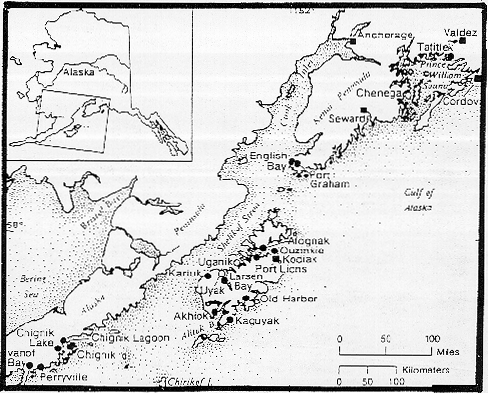
|
 The
University of Alaska Fairbanks is an Affirmative
Action/Equal Opportunity employer, educational
institution, and provider is a part of the University of Alaska
system. Learn more about UA's notice of nondiscrimination. The
University of Alaska Fairbanks is an Affirmative
Action/Equal Opportunity employer, educational
institution, and provider is a part of the University of Alaska
system. Learn more about UA's notice of nondiscrimination.
Alaska Native Knowledge
Network
University of Alaska Fairbanks
PO Box 756730
Fairbanks AK 99775-6730
Phone (907) 474.1902
Fax (907) 474.1957 |
Questions or comments?
Contact ANKN |
|
Last
modified
August 15, 2006
|
|
|